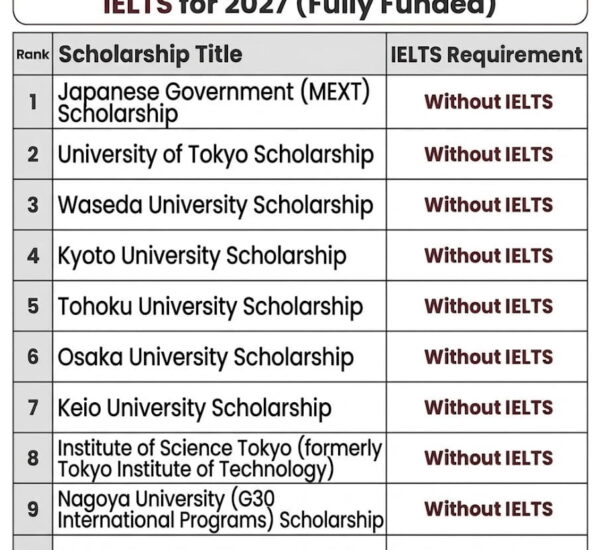
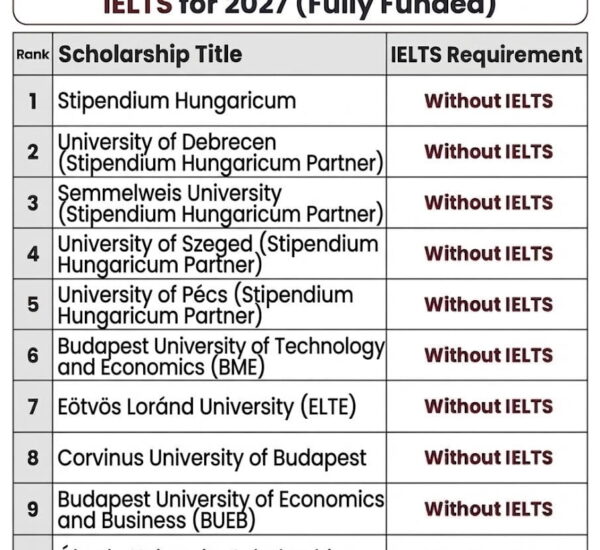
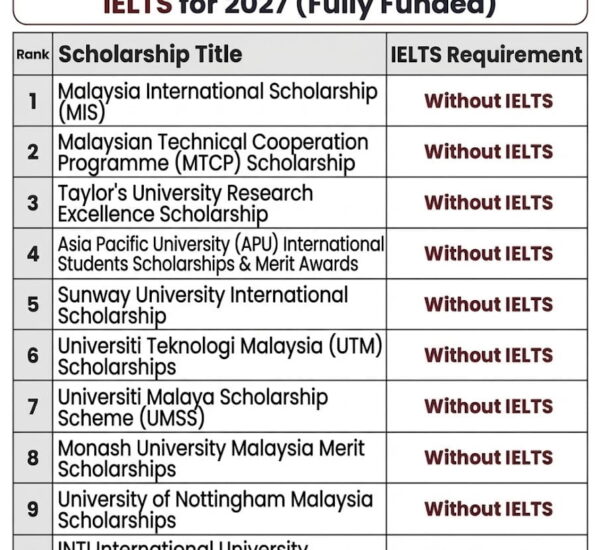
South Korea’s flagship government scholarship starts from a genuinely rare position: no mandatory language test at the time of application at all. IELTS and TOPIK scores are optional and only add bonus preference points — a structural advantage that carries through to several of Korea’s top science and technology universities, which build explicit Medium of Instruction (MOI) waivers directly into their own admission policies.
The Shift in Korean Admissions: Bypassing IELTS in 2027
The Global Korea Scholarship (GKS), funded by the Korean government through the National Institute for International Education (NIIED), states plainly that there is no mandatory language requirement at the time of application — if no language score is submitted, your personal statement and study plan are reviewed in its place. On the university side, institutions like UNIST and KAIST go further still, explicitly exempting applicants who hold a certificate proving their prior degree was delivered entirely in English.
Table of Contents
How to Use an MOI Letter or Rely on GKS’s Language-Optional Policy
If your prior degree was delivered wholly in English, request an official certificate from your previous institution’s registrar confirming this — universities like UNIST and KAIST accept this as a direct substitute for IELTS or TOEFL. If you’re applying through GKS specifically, remember that submitting a language score is optional; a strong personal statement and study plan can carry your application even without one, though a TOPIK or English test score does earn additional preference points.
Before shortlisting scholarships, it’s worth understanding your study in Korea financial aid picture in full — a full scholarship covers tuition and a stipend, but you’ll still need proof of funds and health coverage for your D-2 student visa, both covered in Section 4.
2. Requirements to Waive IELTS for Korean Universities and Student Visas
University/Scholarship Admission vs. Korea D-2 Student Visa Requirements
The Korean D-2 student visa process assesses your Certificate of Admission, proof of financial means, and a completed health check — it does not independently mandate an English test. The language-proficiency requirement is set entirely by your university and chosen program, so once that’s satisfied through IELTS, an MOI letter, or GKS’s own language-optional policy, there’s no separate test required specifically for the visa itself.
How to Get an Official MOI Certificate
Request this directly from your previous institution’s registrar, on official letterhead, confirming your degree was delivered wholly in English. UNIST’s own scholarship guidance and KAIST’s admissions documentation both list this as valid supporting evidence for a language-test waiver.
Alternative Accepted Tests and Routes (TOEFL, TOPIK, No Test at All)
- For English-taught programs: TOEFL, Cambridge English, or an MOI letter are commonly accepted alongside IELTS; universities like KAIST and UNIST explicitly waive the requirement for graduates of English-medium institutions
- For Korean-taught programs: TOPIK (Test of Proficiency in Korean), typically Level 3 or higher — most GKS recipients also complete a mandatory one-year Korean language training course regardless of their program’s teaching language, unless they already hold TOPIK Level 5 or 6
- GKS specifically: No language score is mandatory at application — TOPIK or English test results only add bonus preference points during selection
Always confirm the exact accepted list on your specific program’s official page, since English-taught tracks vary department by department even within the same university.
3. List of South Korea Scholarships Without IELTS
3.1 Global Korea Scholarship (GKS)
Coverage: Full Tuition, Round-Trip Airfare, Monthly Stipend (KRW 900,000 for degree students; KRW 1,500,000 for research students), One-Year Korean Language Training, Health Insurance | Degree Level: Bachelor’s, Master’s & PhD | English Requirement: No mandatory language test at application; TOPIK or English scores are optional and only add preference points.
🔗 Official site: studyinkorea.go.kr
South Korea’s flagship government scholarship, GKS (formerly KGSP) selects around 1,500 students annually from over 150 countries across nearly every academic discipline, funded through the National Institute for International Education. What makes this scholarship stand out on this list is its own official notice confirming there is no language score requirement to apply at all — if you don’t submit one, your personal statement and study plan are reviewed instead, though a TOPIK Level 3+ or strong English test score can still boost your total selection points.
3.2 KAIST (Korea Advanced Institute of Science and Technology)
Coverage: Full Tuition Coverage + Monthly Stipend (KRW 300,000–1,000,000 depending on track), Health Insurance | Degree Level: Bachelor’s, Master’s & PhD | English Requirement: IELTS 6.5/TOEFL 83 standard, but explicitly waived for citizens of English-speaking countries or applicants holding a certificate proving their prior degree was delivered in English.
🔗 Official site: admission.kaist.ac.kr
Korea’s first and top-ranked public science and technology university, KAIST automatically considers 94% of its international student body for institutional funding, with no separate scholarship application beyond selecting “KAIST Scholarship” as your financial resource during the regular admission process. KAIST’s own English Proficiency Test policy is unusually explicit: applicants can request a waiver by submitting a certificate proving their prior Bachelor’s degree was delivered in English as the medium of instruction, a genuine documented MOI route rather than an inferred one.
3.3 Yonsei University
Coverage: Full or Half Tuition Exemption (Yonsei Global Scholarship); merit and need-based tracks also available | Degree Level: Undergraduate & Graduate | English Requirement: Standard Yonsei admission policy for the relevant program’s teaching language.
🔗 Official site: gosc.yonsei.ac.kr/gosc/academics/scholarships.do
One of Korea’s oldest and most prestigious private universities, Yonsei layers its own institutional scholarships — including awards specific to Underwood International College, its flagship English-medium undergraduate track — on top of external funding routes like GKS and the POSCO Asia Fellowship. Because Yonsei’s Global Service Center centralizes information across degree programs, Korean language courses, and summer/winter schools in one place, applicants weighing an English-medium versus Korean-medium route can compare funding options for both without navigating separate offices.
3.4 Seoul National University (SNU)
Coverage: Full Tuition for up to 4–6 Semesters + Monthly Stipend (KRW 500,000–2,000,000 depending on program); round-trip airfare and health insurance for select tracks | Degree Level: Undergraduate & Graduate | English Requirement: Standard SNU International Admission policy; some majors (such as Global Public Administration) are taught primarily in English.
🔗 Official site: en.snu.ac.kr/academics/resources/scholarships
Korea’s flagship national university, SNU runs its International Admission tracks entirely separately from the domestic Korean process, with dedicated scholarship categories like the SNU Global Scholarship and SNU President Fellowship layered on top of GKS eligibility. Because SNU explicitly notes that Korean language training is mandatory unless a student already meets the TOPIK Grade 3 standard within their first year, applicants who prefer an English-focused route should target specifically English-taught majors like Global Public Administration rather than assuming university-wide flexibility.
3.5 Korea University
Coverage: Tuition reductions ranging from partial to full waiver (KU Scholarships); department-specific awards also available | Degree Level: Undergraduate & Graduate | English Requirement: Standard admission policy; students with high English language proficiency receive an exemption from intensive Korean language training in several departments.
🔗 Official site: oia.korea.ac.kr/oia/under/Scholarships.do
One of Korea’s top three private universities (alongside Yonsei and Sungkyunkwan, collectively nicknamed “SKY” institutions when grouped with SNU), Korea University’s own undergraduate application guide confirms that strong English proficiency can exempt students from otherwise-mandatory intensive Korean language training, letting them proceed directly into major coursework. This makes Korea University a practical option for MOI-route applicants who want to avoid an extended Korean-language onboarding period.
3.6 Sungkyunkwan University (SKKU)
Coverage: 50% Tuition Waiver (Freshman Scholarship) or Full Tuition + Admission Fee Waiver (Conditional Scholarship) for STEM graduate students | Degree Level: Graduate (STEM fields, including Medicine) | English Requirement: Standard SKKU admission policy; the STEM scholarship itself carries no separate English test beyond your program’s own requirement.
🔗 Official site: skku.edu/eng/CampusLife/support/scholarship.do
One of Korea’s oldest universities with a strong reputation in business (its Graduate School of Business partners with MIT Sloan and Columbia), SKKU runs a dedicated STEM scholarship program that automatically grants incoming international graduate students in science, technology, engineering, and mathematics fields a 50% tuition waiver in their first semester, with a path to full funding based on further evaluation. Because this scholarship is layered directly into the graduate admission process rather than requiring a separate English test, applicants who cleared SKKU’s standard admission requirement through an MOI letter or alternative test remain fully eligible.
3.7 POSTECH (Pohang University of Science and Technology)
Coverage: Full Tuition + Monthly Stipend (KRW 1,850,000 for Master’s; KRW 2,200,000 for PhD via TA/RA assistantship) | Degree Level: Graduate (Master’s & PhD) | English Requirement: All graduate programs are taught entirely in English; applicants may submit a document specifying the language of instruction for each course completed as an alternative to a standard test score.
🔗 Official site: gift.postech.ac.kr
One of Korea’s top three science and technology institutes, POSTECH’s Graduate Institute of Ferrous Technology (GIFT) and broader graduate school fund nearly every admitted international student through a TA/RA assistantship covering both tuition and a living stipend. POSTECH’s own official admissions guide explicitly instructs applicants who studied in more than one language to submit a document specifying which language each subject was completed in, functioning as a genuine institutional MOI-verification pathway rather than a blanket English test requirement.
3.8 Hanyang University
Coverage: 30–100% Tuition Reduction depending on scholarship tier (Hanyang Scholarship for Excellence in Language Proficiency, TOPIK-based awards, DKKIM Korea Scholarship) | Degree Level: Undergraduate & Graduate | English Requirement: TOEFL iBT 90+/IELTS 6.5+ for the English Language Proficiency scholarship track; TOPIK Level 2+ is the baseline for most departments, with the English-taught HY-in program accepting some applicants without TOPIK.
🔗 Official site: oia.hanyang.ac.kr
Particularly strong in engineering and science across its Seoul and ERICA campuses, Hanyang layers multiple language-specific scholarship tracks — including a dedicated award for students with strong TOPIK scores and a separate one for strong English scores — giving applicants a funding path regardless of which language track they pursue. Because Hanyang’s own admission guide confirms that its English-taught HY-in program may accept applicants without TOPIK in some cases, students focused on an English-medium route have a genuine alternative to the university’s otherwise Korean-language-centered baseline requirement.
3.9 Ewha Womans University
Coverage: Full Tuition + Admission Fee Waiver, First Semester (International Students Scholarship, TOPIK Level 6 track); Full Tuition + Dormitory + Stipend (Ewha Global Partnership Program) | Degree Level: Undergraduate & Graduate | English Requirement: Standard Ewha admission policy for the relevant program’s teaching language.
🔗 Official site: isa.ewha.ac.kr
Korea’s leading women’s university, Ewha runs a genuinely tiered international scholarship portfolio, from the flagship Ewha Global Partnership Program covering full tuition, housing, and a stipend, down to targeted awards like the International Students Scholarship reserved for applicants with an outstanding admissions profile and a strong TOPIK Level 6 score. Because Ewha’s scholarship system explicitly rewards either strong Korean proficiency or strong academic admission credentials depending on the specific award, applicants without an IELTS score can target the tracks that align with their actual language strength rather than being funneled into a single English-test requirement.
3.10 UNIST (Ulsan National Institute of Science and Technology)
Coverage: Full Tuition Waiver + Monthly Stipend (up to KRW 13,200,000/year for PhD), Meal Plan (Undergraduate) | Degree Level: Undergraduate, Master’s & PhD | English Requirement: IELTS and TOEFL are explicitly not required for applicants who provide a certificate confirming their prior degree was completed entirely in English, or for native English speakers from specified countries.
🔗 Official site: cia.unist.ac.kr/quick-links/scholarship
All courses at UNIST are conducted in 100% English, and the university automatically awards a full scholarship to every admitted international undergraduate — no separate financial aid application required. UNIST’s own admissions guidance is among the most direct on this entire list: “IELTS and TOEFL are not required if applicants provide a certificate confirming that they have completed all of their Bachelor’s or Master’s courses entirely in English” — a clean, explicitly published MOI waiver rather than a discretionary exception.
4. Step-by-Step Application Strategy for 2027
How to Request an MOI Letter From Your University Registrar
- Email your previous institution’s registrar at least 8 weeks before your earliest deadline
- Request an official certificate on headed paper confirming your degree was delivered wholly in English
- For POSTECH specifically, prepare a document that clearly specifies the language of instruction for each individual subject if your education mixed languages
- Keep both digital and certified physical copies, since some universities request originals during the visa application stage
Application Timelines: GKS vs. University-Specific Deadlines
GKS applications typically open around February to March each year through either the Embassy Track (via your home country’s Korean embassy) or the University Track (direct to a designated university) — you must choose only one track, since applying to both results in disqualification from either. University-level scholarships at KAIST, UNIST, and POSTECH generally run on their own Fall and Spring intake cycles, with scholarship consideration automatically triggered by your standard graduate or undergraduate application.
Beyond the scholarship itself, budget for costs that none of these programs always cover in full: supplementary health insurance beyond the national coverage, the proof-of-funds documentation required for your D-2 student visa, and a low-fee international transfer service such as Wise for moving remaining funds without heavy bank markups. Understanding your full study in Korea financial aid picture — not just the scholarship’s headline value — is what actually determines whether the offer is liveable.
5. Frequently Asked Questions (FAQs)
Will Korean authorities grant a D-2 student visa without IELTS?
Yes, in the vast majority of cases. The Korean D-2 student visa process assesses your Certificate of Admission, proof of financial means, and a completed health check — not an independent English test score. The language-proficiency requirement is set entirely by your university and chosen program, so once that’s satisfied through IELTS, an MOI letter, or GKS’s own language-optional policy, there is no separate test required specifically for the visa itself.
Is an MOI letter cheaper and faster than IELTS for 2027?
Yes, in almost every case where it’s accepted. An MOI letter is typically issued free of charge by your previous institution’s registrar within a couple of weeks, compared to the cost and scheduling required for IELTS. The trade-off is that MOI acceptance is decided university by university — UNIST and KAIST publish explicit waivers, while others like SNU still expect Korean proficiency benchmarks (TOPIK Grade 3) regardless of your English documentation, so confirm your specific target program’s policy before assuming either route clears you.
6. Conclusion & Checklist
- [ ] Confirm whether your target scholarship or university follows GKS’s no-mandatory-test approach or requires a specific IELTS/TOEFL/TOPIK threshold
- [ ] Request your MOI letter early, on official letterhead, confirming your prior degree was delivered wholly in English
- [ ] Check whether your program requires the standard one-year Korean language training course, and whether a TOPIK Level 5–6 score can shorten or waive it
- [ ] Decide between the GKS Embassy Track and University Track before applying — you cannot apply to both
- [ ] Budget for supplementary health insurance and D-2 visa proof-of-funds requirements separately from your scholarship stipend
- [ ] Re-verify every university’s current deadline and language policy directly on the official link before applying
7. Disclaimer
“Without IELTS” does not mean without any proof of language proficiency or academic readiness. Every scholarship on this list still requires some form of documented qualification — whether that’s an MOI certificate, IELTS, TOEFL, a TOPIK certificate for Korean-medium tracks, or, in the case of GKS, a strong personal statement submitted in place of any language score. Which requirement applies depends entirely on the specific scholarship’s own published policy and the admitting university’s admission procedure — Korea’s D-2 student visa process does not add a separate national English test requirement on top of this, but it does require its own financial and health documentation. Always confirm the exact accepted route directly on the university’s or NIIED’s official page before applying, as policies change between admissions cycles.
- 10 Best Japan Scholarships Without IELTS for 2027 (Fully Funded)
- 10 Best South Korea Scholarships Without IELTS for 2027 (Fully Funded)
- 10 Best Hungary Scholarships Without IELTS for 2027 (Fully Funded)
- 10 Best Malaysia Scholarships Without IELTS for 2027 (Fully Funded)
- 10 Best Turkey Scholarships Without IELTS for 2027 (Fully Funded)