Hungary runs one of Europe’s most genuinely flexible scholarship systems when it comes to English testing. Its flagship government scholarship builds a Medium of Instruction (MOI) waiver directly into its own eligibility rules, and Hungarian-taught programs bypass English testing altogether — backed by a free preparatory year to reach the required language level.
The Shift in Hungarian Admissions: Bypassing IELTS in 2027
Stipendium Hungaricum, funded by the Hungarian government through the Tempus Public Foundation, states plainly in its own guidelines that applicants who received their previous degree from an institution where English was the medium of instruction are exempt from submitting a fresh English test score. On top of that, several partner universities — including the University of Debrecen — confirm that IELTS specifically is not required at all; any properly proctored English exam at the required level is accepted.
Table of Contents
How to Use an MOI Letter or Choose a Hungarian-Taught Program
If your prior degree was delivered wholly in English, request an official certificate from your previous institution’s registrar confirming this, and submit it in place of IELTS or TOEFL. If you’d rather sidestep English testing entirely, Hungarian-medium programs require no IELTS at all and come with a fully funded one-year preparatory course to bring your Hungarian to the required B2 level before your degree begins.
Before shortlisting scholarships, it’s worth understanding your study in Hungary financial aid picture in full — a full scholarship covers tuition and a stipend, but you’ll still need proof of funds and health coverage for your student visa, both covered in Section 4.
2. Requirements to Waive IELTS for Hungarian Universities and Student Visas
University/Scholarship Admission vs. Hungarian D-Type Student Visa Requirements
The Hungarian D-type national student visa process assesses your university acceptance letter, proof of financial means (typically at least €600/month), and health insurance — it does not independently mandate an English test. The language-proficiency requirement is set entirely by your university and chosen program, so once that’s satisfied through IELTS, an MOI letter, or a Hungarian-language route, there’s no separate test required specifically for the visa itself.
How to Get an Official MOI Certificate
Request this directly from your previous institution’s registrar, on official letterhead, confirming your degree was delivered wholly in English. Stipendium Hungaricum’s own scholarship guidelines list this as valid supporting evidence — check your specific university’s exact wording, since acceptance is ultimately confirmed during that university’s own admission procedure.
Alternative Accepted Tests and Routes (TOEFL, Any Proctored English Exam, Hungarian Language Track)
- For English-taught programs: TOEFL, Cambridge English, or an MOI letter are commonly accepted alongside IELTS; some universities (like Debrecen) accept any properly proctored English exam at the required level, not just IELTS specifically
- For Hungarian-taught programs: No English test is required at all — a free one-year Hungarian preparatory course brings you to B2 level before your degree starts
- University entrance exams: Many Hungarian universities also run their own subject-specific entrance evaluations (particularly for Medicine) that sit alongside, not instead of, your English documentation
Always confirm the exact accepted list on your specific program’s official page, since Stipendium Hungaricum funds programs across 30+ partner universities, each with its own admission procedure.
3. List of Hungary Scholarships Without IELTS
3.1 Stipendium Hungaricum
Coverage: Full Tuition Fee Waiver, Monthly Stipend (HUF 43,700 for BA/MA; up to HUF 180,000 for PhD), Dormitory or Housing Allowance, Health Insurance | Degree Level: Non-Degree, Bachelor’s, Master’s, One-Tier Master’s & PhD | English Requirement: Some universities require IELTS/TOEFL, but the program’s own guidelines confirm that a certificate proving your previous degree was English-medium exempts you from submitting a language test.
🔗 Official site: stipendiumhungaricum.hu
Hungary’s flagship government scholarship funds over 900 English-medium study programs across more than 30 partner universities, reaching applicants from over 100 eligible countries through bilateral agreements. What makes this scholarship stand out for IELTS-free applicants is that its own official documentation explicitly lists prior English-medium education as a direct alternative to a language test — a genuine, published exemption rather than a university-level courtesy, alongside the option to study entirely in Hungarian with a free preparatory year included.
3.2 University of Debrecen (Stipendium Hungaricum Partner)
Coverage: Full Tuition Fee Waiver, Monthly Stipend, Housing Allowance, Health Insurance (via Stipendium Hungaricum) | Degree Level: Bachelor’s, Master’s, One-Tier Master’s & PhD | English Requirement: IELTS is explicitly not required; any properly proctored English exam at the required level is accepted.
🔗 Official site: edu.unideb.hu/p/faq-stipendium-hungaricum-scholarship
One of Hungary’s four major medical universities, Debrecen has trained international students in English for over five decades and remains a leading host for Stipendium Hungaricum recipients across medicine, dentistry, and pharmacy programs. Debrecen’s own FAQ page is unusually direct on this point: “No, IELTS is not required, any exam type is accepted as long as it is a proctored exam and on the required level,” making it one of the clearest, most explicitly stated non-IELTS policies among all Hungarian universities on this list.
3.3 Semmelweis University (Stipendium Hungaricum Partner)
Coverage: Full Tuition Fee Waiver, Monthly Stipend, Dormitory or Housing Allowance, Health Insurance | Degree Level: One-Tier Master’s (Medicine, Dentistry, Pharmacy) & PhD | English Requirement: Standard Stipendium Hungaricum policy applies; separate entrance evaluation (biology/chemistry) required for Medicine applicants.
🔗 Official site: semmelweis.hu/mobilitas/en/stipendium-hungaricum
Hungary’s oldest medical institution, Semmelweis has delivered English-language medical, dental, and pharmaceutical education for decades and remains one of the most sought-after Stipendium Hungaricum destinations for health sciences. Because nominated applicants proceed through Semmelweis’s own admission procedure — including an entrance exam for Medicine — rather than a separate scholarship-specific English test, students who satisfied their prior degree’s MOI requirement move directly into that same academic evaluation as any other applicant.
3.4 University of Szeged (Stipendium Hungaricum Partner)
Coverage: Full Tuition Fee Waiver, Monthly Stipend, Housing Allowance, Health Insurance | Degree Level: Bachelor’s, Master’s, One-Tier Master’s & PhD | English Requirement: Standard Stipendium Hungaricum policy; Hungarian-medium track available via a two-semester intensive preparatory program.
🔗 Official site: u-szeged.hu/stipendium-hungaricum
The University of Szeged offers programs in English as well as French, German, Spanish, Italian, Russian, and Turkish, alongside its own Hungarian Studies Center running an intensive two-semester Hungarian-as-a-foreign-language preparatory program for international students who prefer that route entirely. This dual pathway makes Szeged a practical choice for students weighing whether to pursue an English-medium MOI-based application or sidestep English testing altogether by starting with the Hungarian-language track.
3.5 University of Pécs (Stipendium Hungaricum Partner)
Coverage: Full Tuition Fee Waiver, Monthly Stipend (HUF 43,700 for BA/MA), Dormitory or Housing Allowance, Health Insurance | Degree Level: Bachelor’s, Master’s, One-Tier Master’s & PhD | English Requirement: Standard Stipendium Hungaricum policy; “many programs accept alternative English proof” according to the university’s own guidance, varying by country and program.
🔗 Official site: international.pte.hu
Hungary’s oldest university, founded in 1367, Pécs has conducted degree programs in English for over 40 years and now hosts more than 5,600 international students from 140+ countries. As one of Hungary’s four major medical universities alongside Semmelweis, Debrecen, and Szeged, Pécs conducts its own entrance evaluations for Medicine applicants, and its own published guidance confirms that alternative English proof is accepted on many programs, provided applicants confirm the exact policy for their specific country and course.
3.6 Budapest University of Technology and Economics (BME)
Coverage: Full Tuition Fee Waiver, Monthly Stipend, Housing Allowance, Health Insurance (via Stipendium Hungaricum) | Degree Level: Bachelor’s, Master’s & PhD | English Requirement: Standard Stipendium Hungaricum policy applies; a one-year Preparatory Course is available for BSc applicants whose English (or Mathematics/Physics) falls short of the entry standard.
🔗 Official site: bme.hu/en/scolarships
Hungary’s leading engineering university, BME hosts roughly 3,000 international students out of 24,000 total, drawn from over 100 countries across its civil engineering, architecture, electrical engineering, and natural sciences faculties. Rather than rejecting Bachelor’s applicants who fall short of the required English level, BME’s own admission policy directs them into a structured one-year Preparatory Course covering English alongside foundational Mathematics and Physics — a genuinely accessible bridge rather than an outright barrier for students still building their language skills.
3.7 Eötvös Loránd University (ELTE)
Coverage: Full Tuition Fee Waiver, Monthly Stipend, Housing Allowance, Health Insurance (via Stipendium Hungaricum) | Degree Level: Bachelor’s, Master’s & PhD | English Requirement: Standard Stipendium Hungaricum policy; each applicant’s language proof is verified during ELTE’s own admission procedure.
🔗 Official site: elte.hu/en/current-students/stipendium-hungaricum
Hungary’s top-ranked research university and the alma mater of multiple Nobel laureates, ELTE hosts over 5,300 international students across more than 100 English-taught degree programs spanning nine faculties. Because ELTE’s own Department of Erasmus+ and International Programmes manages every step of the Stipendium Hungaricum application — from document checks through to admission — applicants using an MOI letter or alternative English proof go through the identical faculty-level review as any other candidate, with dedicated Stipendium Hungaricum coordinators available at the faculty level for language-specific queries.
3.8 Corvinus University of Budapest
Coverage: Full Tuition Fee Waiver, Monthly Stipend, Housing Allowance, Health Insurance (via Stipendium Hungaricum); additional Corvinus Doctoral Scholarship top-up available | Degree Level: Bachelor’s, Master’s & PhD | English Requirement: Standard Stipendium Hungaricum policy applies for the relevant program.
🔗 Official site: uni-corvinus.hu/post/landing-page/application/scholarships-and-discounts
Hungary’s leading business and economics university, Corvinus is AACSB and AMBA dual-accredited — placing it in the world’s top 2% for business education — with roughly 15% of its 11,000 students coming from abroad. Notably, Corvinus offers a safety net for applicants who apply through Stipendium Hungaricum but aren’t ultimately nominated: they remain welcome to enroll as self-funded students with a first-year tuition discount, meaning a missed government nomination doesn’t necessarily end the application entirely.
3.9 Budapest University of Economics and Business (BUEB)
Coverage: Full Tuition Fee Waiver, Monthly Stipend, Housing Allowance, Health Insurance (via Stipendium Hungaricum) | Degree Level: Bachelor’s, Master’s & PhD | English Requirement: Standard Stipendium Hungaricum policy applies for the relevant program.
🔗 Official site: uni-bge.hu/en/stipendium-hungaricum
The largest business-focused university in Hungary with roots dating back to 1857, BUEB (formerly Budapest Business School) hosts over 20,000 students across two campuses and four faculties, with a strong international cohort in marketing, international business, and finance programs. If a Stipendium Hungaricum applicant isn’t awarded the scholarship, BUEB’s own guidance confirms they can still apply as a fee-paying student by contacting the relevant faculty directly, keeping the door open even without a successful nomination.
3.10 Óbuda University
Coverage: Full Tuition Fee Waiver, Monthly Stipend (HUF 43,700 for BSc/MSc; up to HUF 180,000 for PhD), Accommodation Contribution, Health Insurance | Degree Level: Bachelor’s, Master’s & PhD | English Requirement: Standard Stipendium Hungaricum policy applies for the relevant program.
🔗 Official site: uni-obuda.hu/stipendium-hungaricum
Specializing in engineering, information technology, and applied sciences, Óbuda University has built its Stipendium Hungaricum partnership into a core part of its internationalization strategy, drawing applicants from among 101 eligible partner countries. Beyond Stipendium Hungaricum, Óbuda also layers additional funding routes for enrolled students — including the National Higher Education Scholarship (NFÖH) and merit-based University Awards offering 20–50% tuition reductions based on GPA — giving students multiple ongoing funding options once admitted.
4. Step-by-Step Application Strategy for 2027
How to Request an MOI Letter From Your University Registrar
- Email your previous institution’s registrar at least 8 weeks before the January application deadline
- Request an official certificate on headed paper confirming your degree was delivered wholly in English
- Submit this alongside your other Stipendium Hungaricum documents through the Tempus Public Foundation’s online application system
- If considering a Hungarian-taught program instead, contact your target university’s Hungarian Studies or preparatory program office early, since these routes often have separate intake timelines
Application Timelines: Stipendium Hungaricum vs. University-Specific Deadlines
The Stipendium Hungaricum application period typically runs from mid-November to 15 January, submitted through the Tempus Public Foundation’s online portal alongside your home country’s sending partner nomination process (such as a national Ministry of Education or Higher Education Commission). Following this, universities like Semmelweis conduct their own admission procedures between March and May, with final results and notifications arriving by June or July — so document preparation should begin well before the January cutoff.
Beyond the scholarship itself, budget for costs that Stipendium Hungaricum doesn’t fully absorb: any supplementary medical insurance above the standard coverage, the proof-of-funds requirement for your D-type visa (typically at least €600/month), and a low-fee international transfer service such as Wise for moving remaining funds without heavy bank markups. Understanding your full study in Hungary financial aid picture — not just the scholarship’s headline value — is what actually determines whether the offer is liveable.
5. Frequently Asked Questions (FAQs)
Will Hungarian authorities grant a D-type student visa without IELTS?
Yes, in the vast majority of cases. The Hungarian D-type student visa process assesses your university acceptance letter, proof of financial means, and health insurance — not an independent English test score. The language-proficiency requirement is set entirely by your university and chosen program, so once that’s satisfied through IELTS, an MOI letter, or the Hungarian-language route, there is no separate test required specifically for the visa itself.
Is an MOI letter cheaper and faster than IELTS for 2027?
Yes, in almost every case where it’s accepted. An MOI letter is typically issued free of charge by your previous institution’s registrar within a couple of weeks, compared to the cost and scheduling required for IELTS. The trade-off is that MOI acceptance is confirmed during your target university’s own admission procedure, so submit it alongside your other Stipendium Hungaricum documents and confirm directly with your chosen university if you’re uncertain.
6. Conclusion & Checklist
- [ ] Decide whether you’re pursuing an English-medium program (MOI or test-based) or a Hungarian-medium program (no English test, free prep year)
- [ ] Request your MOI letter early, on official letterhead, confirming your prior degree was delivered wholly in English
- [ ] Check whether your target university runs an additional entrance evaluation (common for Medicine, Dentistry, and Pharmacy)
- [ ] Submit your Stipendium Hungaricum application well before the 15 January deadline, alongside your home country’s sending partner nomination
- [ ] Budget for supplementary health insurance and D-type visa proof-of-funds requirements separately from your scholarship stipend
- [ ] Re-verify every university’s current deadline and language policy directly on the official link before applying
7. Disclaimer
“Without IELTS” does not mean without any proof of language proficiency. Every scholarship and university on this list still requires some form of documented qualification — whether that’s an MOI certificate, IELTS, TOEFL, another proctored English exam, or enrollment in a Hungarian-language preparatory program. Which requirement applies depends entirely on your chosen program’s teaching language and the specific university’s own admission procedure — Hungary’s D-type student visa process does not add a separate national English test requirement on top of this, but it does require its own financial and health insurance documentation. Always confirm the exact accepted route directly on the university’s or Tempus Public Foundation’s official page before applying, as policies change between admissions cycles.
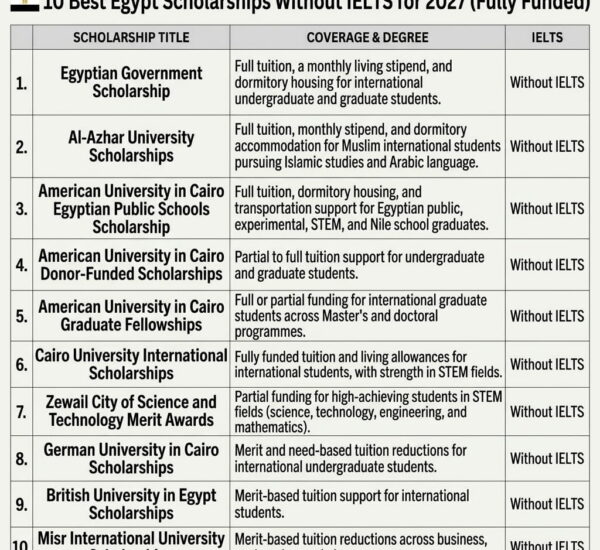
- 10 Best Egypt Scholarships Without IELTS for 2027 (Fully Funded)
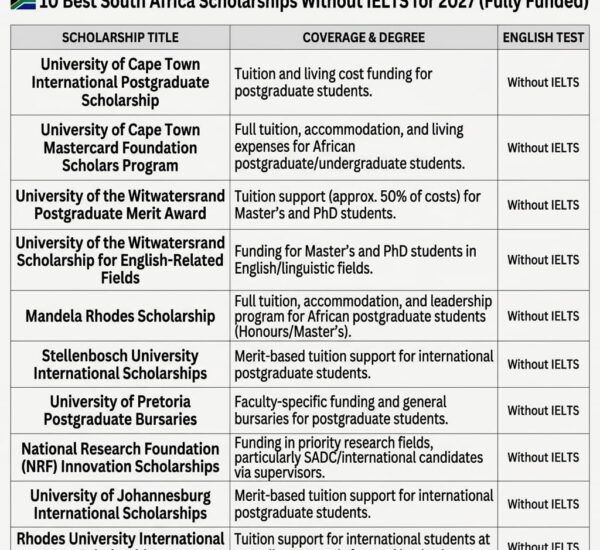
- 10 Best South Africa Scholarships Without IELTS for 2027 (Fully Funded)
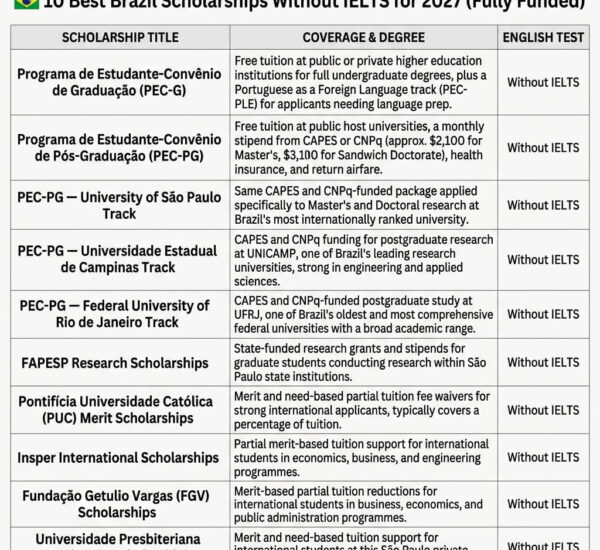
- 10 Best Brazil Scholarships Without IELTS for 2027 (Fully Funded)
- 10 Best Mexico Scholarships Without IELTS for 2027 (Fully Funded)
- 10 Best Azerbaijan Scholarships Without IELTS for 2027 (Fully Funded)