The phrase worth reading carefully in Wits University’s own admissions guidance: international applicants “from non-English-medium secondary or tertiary education systems” typically need to demonstrate proficiency through IELTS or TOEFL. Read that sentence again, and the implication becomes clear — it’s specifically framed around students coming from non-English-medium backgrounds, which means the flip side is equally true: applicants whose prior education was already conducted in English are, in practice, often outside the group this requirement is actually written for.
That distinction matters more in South Africa than in most countries covered in this series, because English genuinely is the working language of instruction at nearly every major South African university. Stellenbosch University shifted to English as its primary teaching language back in 2015, formally abolishing Afrikaans as a language of instruction at several faculties by 2017 — a deliberate policy decision aimed partly at attracting more international students and academic staff. Combined with a student visa financial evidence requirement that sits noticeably below what UK, US, or Australian institutions expect, and a cost of living that remains one of the more affordable options among research-intensive universities globally, South Africa offers genuinely competitive international student financial aid value once you understand which of its funding routes are open to non-South African applicants at all.
This guide walks through exactly which South Africa scholarships for international students without IELTS genuinely exist for 2027, where prior English-medium education carries real weight in admissions, and — critically — which of the country’s biggest funding sources are actually restricted to South African or regional SADC citizens rather than open worldwide.
The Eligibility Filter South Africa Applies Differently
Before comparing individual scholarships, understand one structural reality specific to this country: the National Research Foundation, South Africa’s largest research-funding body, restricts its most generous Full Cost of Study tier to South African citizens and permanent residents only. International applicants can still access NRF funding, but typically at a Partial Cost of Study tier, or through supervisor grant-linked awards that are, per recent guidance, increasingly opening up to broader international applicants rather than being closed entirely.
The Scholarships
1. University of Cape Town International Postgraduate Scholarship
Competitive tuition and living cost funding for international postgraduate students across UCT’s full range of academic departments, Africa’s highest-ranked university.
🔗 uct.ac.za/students/fees-funding-postgraduate-degree-funding-bursaries-scholarships/international-and-refugee-scholarships
UCT explicitly runs a dedicated international and refugee scholarship stream separate from its domestic funding, meaning international applicants aren’t competing against South African students for the same limited pool — check current renewal criteria directly, since this funding operates on annually reviewed terms.
2. University of Cape Town Mastercard Foundation Scholars Program
Full scholarships covering tuition, accommodation, and living expenses for academically talented students from disadvantaged backgrounds across Africa.
🔗 uct.ac.za
Part of a broader network exceeding 5,000 scholars across the continent, this programme specifically targets African nationals rather than being open globally — confirm your specific country’s eligibility before applying, since coverage varies by partner arrangement.
3. University of the Witwatersrand Postgraduate Merit Award
Tuition support covering approximately 50% of costs for admitted Master’s and PhD students demonstrating strong academic performance.
🔗 wits.ac.za/study-at-wits/financial-aid-and-scholarships-administration/scholarships-and-bursaries
Wits’s own admissions guidance frames the standard IELTS 6.5 or TOEFL 90 requirement specifically around applicants from non-English-medium backgrounds — students arriving with a genuinely English-medium prior degree are generally not the population this test threshold was written to screen.
4. University of the Witwatersrand Scholarship for English-Related Fields
Funding for full-time Master’s and PhD students specifically studying English or English-related academic fields, with the award amount determined by committee review.
🔗 wits.ac.za
A genuinely distinctive, narrower award among this list — worth knowing about specifically if your academic focus is linguistics, literature, or English-language education rather than the more commonly marketed STEM and business fields.
5. Mandela Rhodes Scholarship
Comprehensive funding covering tuition, accommodation, and a leadership development programme for postgraduate students who are citizens of African countries.
🔗 mandelarhodes.org
Applicants must be under 30 years old and registered or registering for an Honours or Master’s degree — a genuinely prestigious, leadership-focused award restricted specifically to African nationals rather than open worldwide.
6. Stellenbosch University International Scholarships
Merit-based tuition support for international postgraduate students, at a university that formally transitioned to English-medium instruction across most faculties.
🔗 sun.ac.za
Because Stellenbosch’s institutional shift toward English instruction was explicitly designed to attract international students and academic staff, its own admissions process tends to weigh prior English-medium academic performance favorably rather than treating a missing IELTS score as an automatic barrier.
7. University of Pretoria Postgraduate Bursaries
Dedicated international funding pools alongside the university’s general postgraduate bursary structure.
🔗 up.ac.za
Worth checking directly for which specific faculty’s international pool matches your intended field of study, since University of Pretoria administers these bursaries departmentally rather than through one single central application.
8. National Research Foundation Innovation Scholarships
Funding in priority national research fields, generally favoring South African and Southern African Development Community (SADC) candidates, though supervisor grant-linked awards are gradually opening to a broader international applicant pool.
🔗 nrf.ac.za
Securing a South African-based supervisor whose own NRF grant can extend funding to you is genuinely the most realistic route into this programme as a non-South African, non-SADC applicant — contact potential supervisors directly rather than applying to the NRF cold.
9. University of Johannesburg International Scholarships
Merit-based tuition support for international postgraduate students across UJ’s broad academic portfolio.
🔗 uj.ac.za
A genuinely underrated option among South Africa’s “big five” research universities, worth considering specifically for applicants seeking a large, urban Johannesburg-based campus alternative to Wits.
10. Rhodes University International Scholarships
Tuition support for international students at this smaller, research-focused university based in Makhanda, Eastern Cape.
🔗 ru.ac.za
A genuinely distinctive smaller-campus option among this list, known for strong journalism, pharmacy, and environmental science programmes, worth weighing against the larger metropolitan universities if campus size and community feel matter to your decision.
Making Sense of the English Requirement Across South African Universities
The pattern that holds across nearly every institution above: standardized English test thresholds (IELTS 6.5, TOEFL 90) are generally written specifically for applicants coming from non-English-medium educational backgrounds, with prior English-medium academic transcripts carrying genuine weight in admissions review even where a formal exemption isn’t spelled out in writing. This is functionally similar to the MOI-letter pattern seen throughout this series, just framed through the lens of “who this requirement is actually targeting” rather than an explicit waiver clause.
Frequently Asked Questions
Do I need IELTS for University of Cape Town or Wits if I already studied in English?
Both universities frame their standard English test thresholds around applicants from non-English-medium backgrounds specifically, meaning a prior English-medium degree can carry genuine weight in your application even without a formal written exemption — confirm directly with your specific faculty’s admissions office, since this isn’t guaranteed uniformly.
Is the National Research Foundation open to all international students?
Not at its most generous funding tier — Full Cost of Study is restricted to South African citizens and permanent residents. International applicants generally access Partial Cost of Study funding instead, or supervisor grant-linked awards, which are gradually becoming more accessible to a broader international pool.
Is the Mandela Rhodes Scholarship open to students from outside Africa?
No — this scholarship is specifically restricted to citizens of African countries, alongside an age limit of under 30, so applicants from outside the continent should look toward UCT’s, Wits’s, or Stellenbosch’s own institutional scholarships instead.
Does South Africa’s student visa process check my English proficiency separately?
No. South Africa’s study visa process focuses on your university acceptance letter, proof of financial means, and medical and health insurance documentation — your English proficiency was already assessed and settled during university or scholarship admission.
What These Scholarships Typically Don’t Cover
Even South Africa’s more generous funding programmes leave some gaps worth planning for. Budget separately for South Africa’s study visa financial evidence requirement, mandatory health insurance for the duration of your stay, and settling-in costs before your first stipend payment, if any, arrives. A service like Wise is worth using specifically for moving remaining funds or family support into a South African rand account without the markup a traditional international bank transfer typically carries.
Timing Worth Knowing
The Mandela Rhodes Scholarship typically opens in April and closes around June for the following year’s intake. University merit scholarships at UCT, Wits, and Stellenbosch generally share each institution’s own broader admissions deadline, commonly falling between 30 June and 30 September for the following February intake, which is when South Africa’s academic year typically begins. National Research Foundation deadlines run through each individual university’s own postgraduate funding office rather than a single centralized date, so confirm the specific timeline through your target institution rather than the NRF directly.
Before You Apply
- Check whether your target scholarship’s IELTS threshold is genuinely framed around non-English-medium applicants specifically, and whether your prior education qualifies you outside that group
- Confirm whether your target funding source (particularly NRF) is restricted to South African or SADC citizens before investing significant application time
- If pursuing NRF funding as a non-South African applicant, contact a potential South African-based supervisor directly rather than applying cold
- Note that South Africa’s academic year begins in February, meaning most scholarship deadlines fall the preceding June through September
- Budget separately for South Africa’s study visa financial evidence requirement and health insurance
- Re-verify every scholarship’s current deadline and eligibility criteria directly on the official university or NRF page before applying
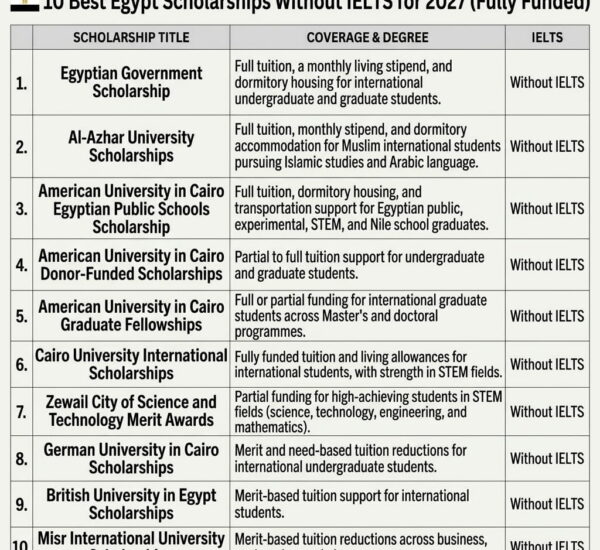
- 10 Best Egypt Scholarships Without IELTS for 2027 (Fully Funded)
- 10 Best South Africa Scholarships Without IELTS for 2027 (Fully Funded)
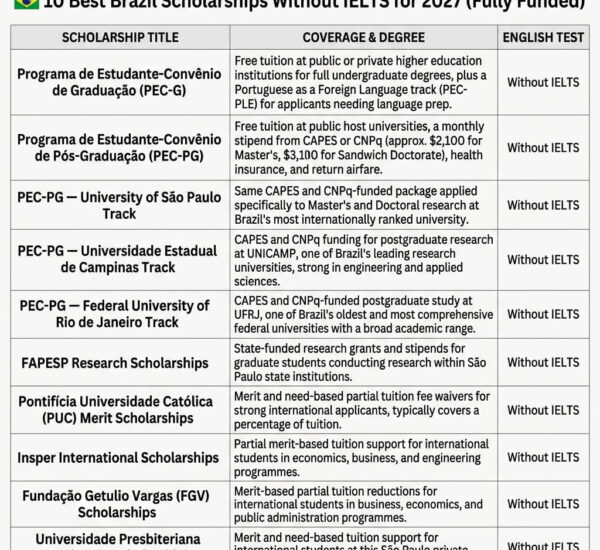
- 10 Best Brazil Scholarships Without IELTS for 2027 (Fully Funded)
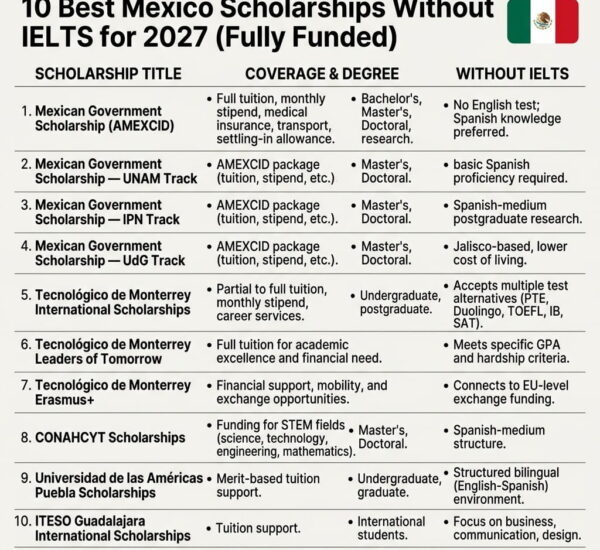
- 10 Best Mexico Scholarships Without IELTS for 2027 (Fully Funded)
- 10 Best Azerbaijan Scholarships Without IELTS for 2027 (Fully Funded)