Japan’s flagship government scholarship starts from a genuinely accessible position: knowledge of Japanese and IELTS/TOEFL scores are not mandatory for most application categories. This structural flexibility carries through to a growing number of Japan’s top national universities, which now run entire English-taught degree programs (often branded under the “G30” initiative) built specifically for students with little or no Japanese ability.
The Shift in Japanese Admissions: Bypassing IELTS in 2027
The Japanese Government (MEXT) Scholarship, funded by the Ministry of Education, Culture, Sports, Science and Technology, confirms there is no mandatory Japanese language requirement, and for English-taught programs specifically, a letter from your college stating your education was conducted in English is commonly accepted in place of a fresh IELTS or TOEFL score. On the university side, institutions like Nagoya University’s G30 program and the Institute of Science Tokyo’s International Graduate Program are built entirely around English instruction, admitting students with little or no Japanese ability from day one.
Table of Contents
How to Use an MOI Letter or Choose an English-Taught (G30) Program
If your prior degree was delivered wholly in English, request an official letter from your previous institution’s registrar confirming this — several MEXT-affiliated universities accept this route directly, per the Ministry’s own scholarship guidelines. If you’d rather sidestep an English test entirely, target one of Japan’s G30 or International Graduate Program tracks — these programs are taught 100% in English and were purpose-built to admit students without requiring Japanese proficiency at enrollment.
Before shortlisting scholarships, it’s worth understanding your study in Japan financial aid picture in full — a full scholarship covers tuition and a stipend, but you’ll still need proof of funds and health coverage for your student visa, both covered in Section 4.
2. Requirements to Waive IELTS for Japanese Universities and Student Visas
University/Scholarship Admission vs. Japanese Student Visa (Ryugaku) Requirements
The Japanese “Ryugaku” (Student) visa process assesses your Certificate of Eligibility, university acceptance, and proof of financial support — it does not independently mandate an English test. The language-proficiency requirement is set entirely by your university and chosen program, so once that’s satisfied through IELTS, TOEFL, an MOI letter, or enrollment in an English-taught track, there’s no separate test required specifically for the visa itself.
How to Get an Official MOI Certificate
Request this directly from your previous institution’s registrar, on official letterhead, confirming your degree was delivered wholly in English. MEXT’s own application guidelines list this as a valid document type — alongside a TOEFL, IELTS, or JLPT score report — for demonstrating language proficiency.
Alternative Accepted Tests and Routes (TOEFL, JLPT, Fully English-Taught Programs)
- For English-taught programs: TOEFL, an MOI/language-of-education certificate, or the university’s own assessment are commonly accepted alongside IELTS
- For Japanese-taught programs: JLPT (Japanese-Language Proficiency Test), typically N2 or N1 for humanities and social science fields — MEXT provides preparatory Japanese language courses for most scholarship categories regardless
- G30 and equivalent English-medium programs: No Japanese proficiency is required at enrollment at all; some programs (like Nagoya’s G30) provide intensive Japanese classes during the first year purely as a bonus, not a requirement
Always confirm the exact accepted list on your specific program’s official page, since English-medium tracks vary faculty by faculty even within the same university.
3. List of Japan Scholarships Without IELTS
3.1 Japanese Government (MEXT) Scholarship
Coverage: Full Tuition, Monthly Stipend, Round-Trip Airfare, Entrance/Examination Fee Waiver | Degree Level: Undergraduate, Master’s, PhD & Research Students | English Requirement: No mandatory Japanese language requirement; a language-of-education certificate (MOI) is accepted alongside TOEFL/IELTS for English-taught programs.
🔗 Official site: studyinjapan.go.jp/en/planning/scholarships/mext-scholarships
Japan’s flagship government scholarship, running since 1954, funds international students through either Embassy Recommendation (via your local Japanese embassy) or University Recommendation (direct to a designated Japanese university), covering tuition, housing, airfare, and a monthly stipend. MEXT’s own official application guidelines are unusually direct on language: for applicants meeting the English-proficiency condition, the accepting university itself confirms and documents the grounds for judging that proficiency, meaning a certificate proving your prior degree was English-medium is a genuinely built-in alternative rather than an inferred workaround.
3.2 University of Tokyo
Coverage: MEXT Honors Scholarship (Full Tuition + Stipend); University of Tokyo Fellowship (institutional scholarship) | Degree Level: Undergraduate & Graduate | English Requirement: Standard admission policy per program; several graduate schools and the PEAK undergraduate program are taught entirely in English.
🔗 Official site: u-tokyo.ac.jp/en/prospective-students/scholarships.html
Japan’s top-ranked university, UTokyo runs its PEAK program (Programs in English at Komaba) as a fully English-taught undergraduate liberal arts track, alongside numerous English-medium graduate programs across its schools of science, engineering, and public policy. Because UTokyo explicitly states it does not administer the MEXT Embassy Recommendation application process itself — that runs through your home country’s Japanese embassy — applicants should treat the university’s own scholarship page as a guide to institutional funding, while tracking the MEXT deadline separately through diplomatic channels.
3.3 Waseda University
Coverage: Pre-Enrollment Merit Scholarships (partial tuition); around 40% of international students receive some form of scholarship after enrollment | Degree Level: Undergraduate & Graduate | English Requirement: IELTS/TOEFL required for English-based programs, but applicants holding a degree from an English-medium institution may qualify for a waiver.
🔗 Official site: waseda.jp/inst/scholarship/en/for-international-students
One of Japan’s most prominent private universities, Waseda operates the School of International Liberal Studies (SILS), its flagship bachelor’s program taught entirely in English since 2004, alongside numerous other English-based faculties. Recipient accounts collected by independent scholarship trackers confirm that students holding prior English-medium degrees have successfully waived the IELTS/TOEFL requirement for Waseda’s English-based programs, making an MOI letter a genuinely viable route for applicants without a fresh test score.
3.4 Kyoto University
Coverage: MEXT Scholarship (via Embassy or University Recommendation); numerous privately funded institutional and external scholarships | Degree Level: Undergraduate & Graduate | English Requirement: Standard admission policy; the Kyoto University International Undergraduate Program (Kyoto iUP) and several graduate schools are taught partly or entirely in English.
🔗 Official site: kyoto-u.ac.jp/en/current/how-to/financial-aid/scholarships-for-international-students
One of Japan’s most prestigious national universities, Kyoto University’s iUP program is a 4.5-year undergraduate track combining a preparatory course with liberal arts and sciences instruction in English and Japanese, offering a structured entry point for students without native-level Japanese. Kyoto University’s own admissions guidance notes that only students enrolling in specific English-taught tracks like Kyoto iUP or the Undergraduate International Course in Civil Engineering are eligible to apply for the MEXT scholarship through university recommendation, so confirm your target program’s exact recommendation pathway before applying.
3.5 Tohoku University
Coverage: MEXT Scholarship; new Tohoku University International Excellence Scholarship launching for students enrolling from AY2027 | Degree Level: Undergraduate, Master’s & Professional Degree Programs | English Requirement: Standard admission policy; the Future Global Leadership (FGL) Program is a fully English-taught undergraduate track.
🔗 Official site: insc.tohoku.ac.jp/english/scholarship-for-international-students
Tohoku University is launching a brand-new International Excellence Scholarship beginning with the 2027 academic year, providing focused financial support to the top third of eligible international students across undergraduate, master’s, and professional degree programs — including students admitted through the newly launching Gateway College. Its existing FGL Program already automatically nominates top-performing English-track applicants for either the MEXT Scholarship or the university’s own President Scholarship based on entrance exam results, giving English-medium applicants two parallel funding routes without a separate application.
3.6 Osaka University
Coverage: Full Tuition + Monthly Stipend (MEXT Scholarship route); Osaka University Scholarship (JPY 80,000/month) for accepted English-taught program students | Degree Level: Undergraduate & Graduate | English Requirement: Standard admission policy; the International College offers all-English undergraduate degree programs including Human Sciences and Science.
🔗 Official site: osaka-u.ac.jp/en/campus/tuition/scholar/support
Osaka University’s International College runs multiple undergraduate degree programs conducted completely in English, including the Human Sciences All-English Program and the International Undergraduate Program in Science, each with dedicated institutional scholarships built specifically for that cohort. Because the university explicitly confirms these funding tracks are made available to international students accepted into fully English-conducted programs, applicants who qualify through an MOI-style admission route face no separate English test at the scholarship stage.
3.7 Keio University
Coverage: “Design the Future” Award (Full Tuition + Living Stipend + Admission Grant); Keio University Scholarship (undergraduate & graduate) | Degree Level: Undergraduate & Graduate | English Requirement: Standard admission policy per program; Keio currently runs two undergraduate programs taught entirely in English.
🔗 Official site: keio.ac.jp/en/admissions/scholarship
With Japan’s largest university scholarship fund at 24 billion yen, Keio funds international students through its flagship “Design the Future” Award — covering full academic fees, monthly living expenses, and a one-off admission grant — alongside standard institutional and government-funded routes. Keio’s own official FAQ confirms directly: “If you are enrolled in degree programs delivered in English, it is not necessary for you to acquire Japanese for your study,” making its two dedicated English-medium undergraduate programs a genuine IELTS-alternative entry point rather than a Japanese-fluency requirement in disguise.
3.8 Institute of Science Tokyo (formerly Tokyo Institute of Technology)
Coverage: MEXT Scholarship (Full Tuition + Monthly Stipend); Scholarship for Outstanding International Undergraduates (Full or Half Tuition) | Degree Level: Undergraduate (GSEP) & Graduate (International Graduate Program) | English Requirement: MEXT applicants may qualify by having completed their prior curriculum at an institution where all instruction was in English, as verified by the university.
🔗 Official site: students.isct.ac.jp/en/012/tuition-and-scholarship/scholarships
Formed in 2024 through the merger of Tokyo Institute of Technology and Tokyo Medical and Dental University, Science Tokyo’s Global Scientists and Engineers Program (GSEP) and International Graduate Program (IGP) — originally launched in 2007 — admit students with little or no Japanese ability into full English-medium engineering and science degrees. Science Tokyo’s own MEXT scholarship eligibility criteria explicitly list completion of prior education at an English-medium institution as one of three qualifying language-proficiency routes, alongside standard test scores, making it a genuinely documented MOI pathway.
3.9 Nagoya University (G30 International Programs)
Coverage: Nagoya University Global 30 Undergraduate Scholarship; University Recommendation MEXT Scholarship — both automatically applied for at admission | Degree Level: Undergraduate (10 programs) & Graduate (19 programs) | English Requirement: No Japanese language requirement at the time of enrollment; programs are fully taught in English.
🔗 Official site: admissions.g30.nagoya-u.ac.jp
Since 2011, Nagoya University’s G30 International Program has offered full degrees taught entirely in English across engineering, sciences, medicine, economics, and humanities, explicitly designed so that “students of any nationality can earn a Nagoya University degree studying only in English.” Every eligible G30 applicant is automatically considered for both the Nagoya University Global 30 Undergraduate Scholarship and the University Recommendation MEXT Scholarship simply by selecting “Yes” on the scholarship section of the standard admission application — no separate form, and no Japanese test anywhere in the process.
3.10 Kyushu University
Coverage: MEXT Scholarship (via Embassy or University Recommendation); Kyushu University Friendship Scholarship for exchange and double-degree students | Degree Level: Undergraduate & Graduate | English Requirement: Standard admission policy; the university runs an International Undergraduate Program with English as the language of instruction.
🔗 Official site: kyushu-u.ac.jp/en/admission/fees/support
One of Japan’s leading national universities, Kyushu explicitly advertises that prospective students can “enroll at any of our undergraduate schools for programs taught in Japanese, or consider applying to one of several programs taught entirely in English,” with every graduate school additionally offering English-medium international program tracks. Because Kyushu channels most of its international scholarship funding through the standard MEXT Embassy and University Recommendation categories, English-track applicants follow the identical government scholarship pathway as their Japanese-medium peers, without a separate institutional English test layered on top.
4. Step-by-Step Application Strategy for 2027
How to Request an MOI Letter From Your University Registrar
- Email your previous institution’s registrar at least 8 weeks before your earliest deadline
- Request an official certificate on headed paper confirming your degree was delivered wholly in English
- For MEXT applications specifically, submit this alongside your TOEFL, IELTS, or JLPT score report (if any) — MEXT’s guidelines list it as one of several acceptable proof-of-language documents
- If targeting a G30 or fully English-medium program instead, confirm with the specific university that no separate language certificate is needed at all
Application Timelines: MEXT vs. University-Specific G30 Deadlines
MEXT Embassy Recommendation deadlines vary by country but typically fall around April to May each year, so document preparation should begin well ahead of that window through your local Japanese embassy or consulate. University-level G30 and English-medium programs (Nagoya, Science Tokyo, Osaka) generally run their own separate intake cycles — Nagoya’s G30 undergraduate applications, for example, opened November 2, 2026 for its first round — with scholarship consideration automatically triggered by your standard application.
Beyond the scholarship itself, budget for costs that MEXT and university scholarships don’t always cover in full: supplementary health insurance beyond Japan’s National Health Insurance system, the proof-of-funds documentation required for your Certificate of Eligibility, and a low-fee international transfer service such as Wise for moving remaining funds without heavy bank markups. Understanding your full study in Japan financial aid picture — not just the scholarship’s headline value — is what actually determines whether the offer is liveable.
5. Frequently Asked Questions (FAQs)
Will Japanese authorities grant a student (Ryugaku) visa without IELTS?
Yes, in the vast majority of cases. The Japanese student visa process assesses your Certificate of Eligibility, university acceptance, and proof of financial support — not an independent English test score. The language-proficiency requirement is set entirely by your university and chosen program, so once that’s satisfied through IELTS, an MOI letter, or enrollment in a fully English-medium program, there is no separate test required specifically for the visa itself.
Is an MOI letter cheaper and faster than IELTS for 2027?
Yes, in almost every case where it’s accepted. An MOI letter is typically issued free of charge by your previous institution’s registrar within a couple of weeks, compared to the cost and scheduling required for IELTS. The trade-off is that MOI acceptance is decided university by university and even faculty by faculty — MEXT’s own guidelines list it as one accepted route among several, so confirm your specific target program’s exact policy before assuming it clears you.
6. Conclusion & Checklist
- [ ] Decide whether you’re pursuing a fully English-medium program (G30, IGP, GSEP — no Japanese needed) or a standard Japanese-medium program with an English-taught track
- [ ] Request your MOI letter early, on official letterhead, confirming your prior degree was delivered wholly in English
- [ ] For MEXT, confirm whether you’re applying via Embassy Recommendation or University Recommendation, since deadlines and required documents differ
- [ ] Check your target university’s specific G30 or English-program admission timeline separately from the general MEXT calendar
- [ ] Budget for supplementary health insurance and Certificate of Eligibility documentation separately from your scholarship stipend
- [ ] Re-verify every university’s current deadline and language policy directly on the official link before applying
7. Disclaimer
“Without IELTS” does not mean without any proof of language proficiency or academic readiness. Every scholarship on this list still requires some form of documented qualification — whether that’s an MOI/language-of-education certificate, IELTS, TOEFL, a JLPT certificate for Japanese-medium tracks, or enrollment in a fully English-taught program that requires no language test at all. Which requirement applies depends entirely on your chosen program’s teaching language and the specific university’s own admission procedure — Japan’s student visa process does not add a separate national English test requirement on top of this, but it does require its own financial and health documentation. Always confirm the exact accepted route directly on the university’s or MEXT’s official page before applying, as policies change between admissions cycles.
- 10 Best Japan Scholarships Without IELTS for 2027 (Fully Funded)
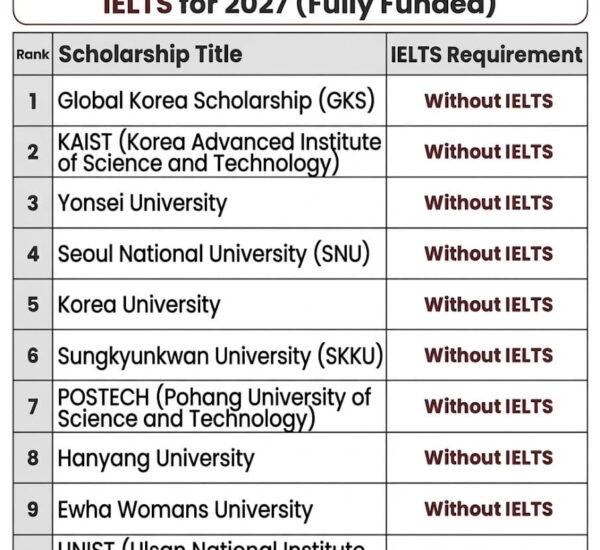
- 10 Best South Korea Scholarships Without IELTS for 2027 (Fully Funded)
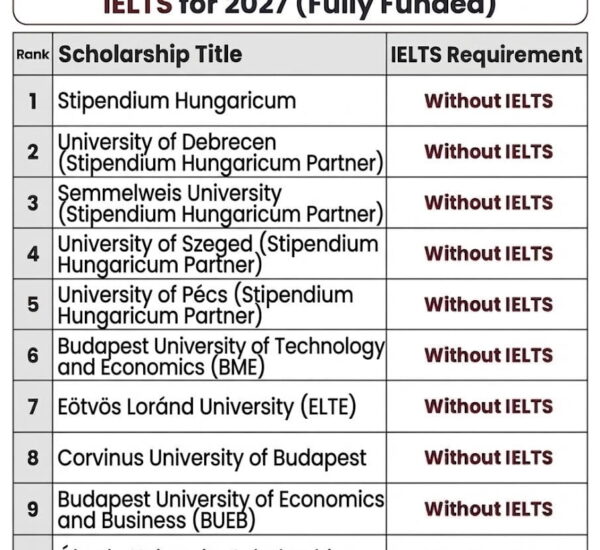
- 10 Best Hungary Scholarships Without IELTS for 2027 (Fully Funded)
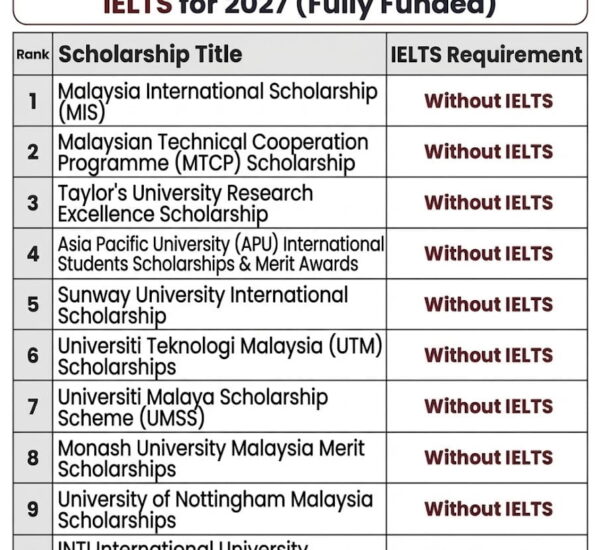
- 10 Best Malaysia Scholarships Without IELTS for 2027 (Fully Funded)
- 10 Best Turkey Scholarships Without IELTS for 2027 (Fully Funded)