Italy runs one of the most layered scholarship systems in Europe — government grants, regional need-based awards, and individual university merit scholarships all operate side by side. For 2027 applicants, this layering is good news: several of these routes accept a Medium of Instruction (MOI) letter, a standardized test like the GRE or SAT, or simply set no independent English test at all, since Italy’s regional grants are assessed on financial and academic criteria rather than language.
The Shift in Italian Admissions: Bypassing IELTS in 2027
Italy’s government scholarship, MAECI, explicitly allows applicants whose previous degree was delivered in English to submit an English proficiency certificate from their prior university in place of a fresh IELTS or TOEFL score. On the regional side, DSU (Diritto allo Studio Universitario) grants — distributed by agencies like EDISU Piemonte, ER.GO, and LazioDiSCo — are assessed purely on financial need (via the ISEE Parificato) and academic credits, with no English test tied to the grant itself.
Table of Contents
How to Use MOI Letters & Alternative Tests for Italian Applications
If your target program is English-taught and your prior degree was delivered wholly in English, request an official MOI letter from your previous institution’s registrar — MAECI’s own guidance confirms this is accepted as an alternative to IELTS/TOEFL. Some university-level merit scholarships go further still: the University of Bologna’s International Talents award and Sapienza’s meritorious-student competitions are based on GRE or SAT scores rather than an English test, giving strong test-takers a second route in entirely.
Before shortlisting scholarships, it’s worth understanding your study in Italy financial aid picture in full — a tuition waiver alone won’t cover mandatory health insurance or the ISEE Parificato documentation needed for regional grants, both covered in Section 4.
2. Requirements to Waive IELTS for Italian Universities and Student Visas
University/Scholarship Admission vs. Italian Student Visa Requirements
The Italian national student visa (Type D) process does not independently mandate an English test. What the visa office assesses is your university admission letter or pre-enrolment confirmation, proof of financial means, and accommodation arrangements — the English or Italian language requirement is set entirely by your university and specific program, not layered on separately by the visa office.
This means once your university has accepted your language proof — whether IELTS, an MOI letter, or an Italian-language certificate — there’s no additional national-level English test required for the visa itself.
How to Get an Official MOI Certificate or English Proficiency Certificate
Request this directly from your previous institution’s registrar, confirming your degree was delivered wholly in English. MAECI’s own official call for applications explicitly lists this as an accepted route for English-taught Italian programs, so keep a certified copy ready alongside your other application documents.
Alternative Accepted Tests and Certificates (TOEFL, GRE, SAT, CILS/CELI)
- For English-taught programs: TOEFL iBT, Cambridge English, or an MOI letter are commonly accepted alongside IELTS
- For Italian-taught programs: CILS, CELI, or PLIDA at B2 level — IELTS is simply not the relevant test
- For select university merit scholarships: GRE or SAT scores can substitute for a language test entirely, since these scholarships evaluate general academic aptitude rather than English proficiency specifically
Always confirm the exact accepted list on your specific program’s official page, since requirements are frequently set at the program or scholarship level rather than university-wide.
3. Top 10 Double-Checked Italy Scholarships Without IELTS
3.1 MAECI Italian Government Scholarship
Coverage: €900/month stipend, tuition and enrolment fee exemption (university-dependent), health insurance | Degree Level: Master’s, PhD & Language Courses | English Requirement: IELTS/TOEFL/Cambridge accepted, but applicants may substitute an English proficiency certificate from their prior university confirming their degree was taught in English. 🔗 Official site: studyinitaly.esteri.it
Italy’s flagship government scholarship, MAECI is administered by the Ministry of Foreign Affairs and International Cooperation and is open to virtually all eligible nationalities across nearly every academic field. Because MAECI’s own official call for applications explicitly permits applicants to prove English proficiency through documentation from their previous institution rather than a fresh test score, this is one of the cleanest genuine MOI-route scholarships on this list — though applicants should still secure a university admission letter first, since MAECI requires this as a prerequisite to the scholarship application itself.
3.2 Invest Your Talent in Italy (IYT)
Coverage: Full tuition fee exemption, €10,000/year stipend, mandatory paid internship at a partner Italian company | Degree Level: Master’s (Engineering, Architecture, Economics & Management) | English Requirement: Standard admission policy for each partner university’s English-taught program; MOI accepted at several participating institutions. 🔗 Official site: uni-italia.it/en/institutional/invest-your-talent-in-italy-en
Jointly promoted by MAECI, the Italian Trade Agency, and Uni-Italia, this program is distinctive for pairing a full scholarship with a mandatory internship at a partner Italian company, directly across engineering, architecture, and business-focused Master’s programs. All participating programs are taught entirely in English specifically to widen access for international applicants, and because the English-proficiency bar is set by each partner university rather than a single centralized IYT policy, MOI-route applicants who cleared their target university’s own requirement remain fully eligible for the scholarship itself.
3.3 EDISU Piemonte Regional Scholarship (DSU)
Coverage: Financial contribution toward tuition, living costs, and accommodation (amount varies by ISEE bracket) | Degree Level: Bachelor’s, Master’s & PhD | English Requirement: None — the scholarship is assessed purely on financial need (ISEE Parificato) and academic credits (CFU), with no English test tied to the grant itself. 🔗 Official site: edisu.piemonte.it/en/scholarships-and-grants
As the regional agency for the right to education in Piedmont, EDISU distributes DSU grants to students at universities including the University of Turin and Politecnico di Torino based entirely on financial eligibility and academic merit, not language testing. This is one of the clearest IELTS-free routes on this list: the scholarship’s own published rules confirm it is not an English-language scholarship test system at all — your university admission, not the DSU grant, is where any English requirement sits.
3.4 University of Bologna International Talents @Unibo Scholarship
Coverage: €6,500/year gross stipend plus full tuition exemption, for two academic years | Degree Level: Master’s (Second Cycle Degree Programmes) | English Requirement: Selection is based on GRE test scores and financial status verification, not an English proficiency test. 🔗 Official site: unibo.it/en/study/study-grants-and-subsidies
Awarding 30 scholarships annually to outstanding international students entering Master’s programs, this initiative from one of the world’s oldest universities evaluates candidates on GRE scores and verified financial need rather than a language-proficiency test. Because the scholarship application is submitted separately through the Studenti Online portal after your program admission, any English requirement for your specific Master’s program is handled independently at the admissions stage — the scholarship committee itself doesn’t add a second English hurdle on top.
3.5 Politecnico di Milano Merit-Based International Scholarship
Coverage: €10,000/year (Platinum), €8,000/year (Gold), or full tuition waiver only (Silver) | Degree Level: Master’s (English-taught Engineering, Architecture & Design) | English Requirement: Standard admission policy for English-taught programs; language certificate confirmed after selection, not required at initial application. 🔗 Official site: polimi.it/en/prospective-students/how-much-does-it-cost/scholarships
One of Italy’s top-ranked technical universities for engineering and design, Politecnico di Milano’s tiered merit scholarship is awarded automatically to top-ranked applicants who apply during the Early Bird admissions window, with selection based primarily on GPA and prior academic achievement. Notably, the university’s own scholarship documentation confirms that your language certificate is only formally required if you’re selected for the award, giving MOI-route and alternative-test applicants breathing room to finalize their English documentation after the initial ranking stage.
3.6 Bocconi Graduate Merit Award
Coverage: 100% tuition and fee waiver, worth approximately €18,500/year | Degree Level: Master’s (MSc & MA programmes) | English Requirement: Standard Bocconi admission policy; evaluation is based primarily on GPA and admission test score (GMAT/GRE), with no separate scholarship-specific English test. 🔗 Official site: unibocconi.it/en/applying-bocconi/master-science-and-ma-programs/funding/bocconi-graduate-merit-awards-ay-2026-27
One of Europe’s top-ranked business schools, Bocconi automatically considers every applicant to its Master’s programs for this full tuition waiver — no separate scholarship application is required. Because the award’s evaluation criteria center on GPA plus your GMAT or GRE score rather than an independent English test, students who satisfied their program’s English requirement through an MOI letter or alternative test remain on completely equal footing in the ranking process.
3.7 University of Padua International Excellence Scholarship
Coverage: €8,000/year gross plus full tuition fee waiver | Degree Level: Bachelor’s & Master’s (English-taught programmes) | English Requirement: Standard University of Padua admission policy for the relevant English-taught program. 🔗 Official site: unipd.it/en/padua-excellence
Offering up to 69 scholarships annually across a wide range of English-taught disciplines, this program requires no separate scholarship application beyond applying to one of Padua’s eligible degree programs — eligible applicants are automatically considered based on academic excellence in their prior studies. Padua is also a partner institution for both MAECI and Invest Your Talent in Italy, giving students multiple funding routes into the same English-taught programs depending on which English-proficiency pathway suits them best.
3.8 Politecnico di Torino International Scholarships (TOPoliTO)
Coverage: €8,000/year gross, covering the full duration of the Bachelor’s or Master’s program | Degree Level: Bachelor’s & Master’s (Engineering & Architecture) | English Requirement: Standard PoliTo admission policy; Bachelor’s applicants can qualify via the university’s own admission test rather than a standalone English certificate in some tracks. 🔗 Official site: international.polito.it/financial_aid/politecnico_international_scholarships
Italy’s oldest technical university, Politecnico di Torino’s TOPoliTO program targets non-European students holding an international secondary or Master’s qualification, with selection based on a combination of the university’s own admission test score and prior academic record. Because a strong result on PoliTo’s admission test can carry significant weight in the eligibility process, applicants who are still finalizing their English documentation have a genuine secondary route into consideration, alongside standard IELTS/TOEFL/MOI-based admission.
3.9 Sapienza University of Rome Scholarships for Meritorious Students
Coverage: €3,000–€4,300/year plus tuition fee exemption (two-year duration) | Degree Level: Master’s | English Requirement: Eligibility for the “Don’t Miss Your Chance” track is based on a valid SAT (Scholastic Assessment Test) certificate, not an English proficiency test. 🔗 Official site: uniroma1.it/en/pagina/scholarships-meritorious-students-italian-and-international-universities
As Europe’s largest university by enrollment, Sapienza runs several parallel meritorious-student competitions, including one track that qualifies candidates purely through their SAT score from the College Board, entirely separate from any English-language test requirement. This makes Sapienza a genuinely distinct option on this list: strong SAT-takers can qualify for scholarship funding through an academic aptitude test rather than an English-proficiency exam, provided their target degree program’s own admission requirements are separately satisfied.
3.10 Erasmus Mundus Joint Master Degrees (EMJMD)
Coverage: €1,400/month stipend, tuition, travel allowance (up to €33,600 total per student) | Degree Level: Master’s (studied across 2+ European countries, frequently including Italian partner universities) | English Requirement: Standard consortium policy applies; applicants from English-medium academic backgrounds are frequently exempt from a formal test. 🔗 Official site: eacea.ec.europa.eu/scholarships/erasmus-mundus-catalogue_en
Erasmus Mundus funds joint Master’s degrees delivered by consortia spanning multiple European countries, with Italian institutions — including Bologna, Padua, and Politecnico di Milano — participating in a substantial share of the catalogue’s 200+ programmes. Several EMJMD consortia explicitly list exemptions for “nationals of English-speaking countries or graduates from universities where the medium of instruction is exclusively English,” giving genuine MOI-route applicants a documented path in — though because each consortium sets its own exact policy, always confirm the specific program page in the official catalogue before assuming your exemption applies.
4. Step-by-Step Application Strategy for 2027
How to Request an MOI Letter or English Proficiency Certificate
- Email your previous institution’s registrar at least 8 weeks before your earliest deadline
- Request an official certificate confirming your degree was delivered wholly in English, on institutional letterhead
- For MAECI specifically, keep this alongside your university admission letter, since MAECI requires proof of university admission before the scholarship application itself
- For GRE/SAT-based merit scholarships (Bologna, Sapienza), register for the relevant test well in advance, since testing centers and result-processing times vary by country
Application Timelines: Government Scholarships vs. Regional Grants vs. University Awards
MAECI applications for the 2026/2027 cycle closed March 26, 2026 — expect a similar late-March 2027 deadline for the following cycle, with the portal opening two to three weeks prior. Regional DSU grants (EDISU Piemonte and equivalents) typically open their portals from June through August/September, requiring you to already hold university admission before applying. University-level merit scholarships (Bologna, PoliMi, Bocconi, Padua, PoliTorino) are generally tied to each program’s own admissions cycle and are frequently automatically assessed upon application.
Beyond the scholarship itself, budget for costs that none of these programs typically cover in full: mandatory health insurance, the ISEE Parificato documentation required for regional DSU grants, and a low-fee international transfer service such as Wise for moving remaining funds without heavy bank markups. Understanding your full study in Italy financial aid picture — not just the scholarship’s headline value — is what actually determines whether the offer is liveable.
5. Frequently Asked Questions (FAQs)
Will the Italian Consulate grant a student visa without IELTS? Yes, in the vast majority of cases. The Italian national student visa process assesses your university admission letter or pre-enrolment confirmation, financial means, and accommodation arrangements — not an independent English test score. The language-proficiency requirement is set entirely by your university and specific program, so once that’s satisfied through IELTS, an MOI letter, or an Italian-language certificate, there is no separate test required specifically for the visa itself.
Is an MOI letter cheaper and faster than IELTS for 2027? Yes, in almost every case where it’s accepted. An MOI letter is typically issued free of charge by your previous institution’s registrar within a couple of weeks, compared to the cost and scheduling required for IELTS. The trade-off is that MOI acceptance in Italy is set program by program, and several merit scholarships on this list (Bologna, Bocconi, Sapienza) instead evaluate GRE, GMAT, or SAT scores — so confirm which specific requirement applies to your target scholarship before assuming any single route clears you.
6. Conclusion & Checklist
- [ ] Confirm whether your specific program is English-taught or Italian-taught — this determines whether IELTS or an Italian-language certificate is the relevant test
- [ ] For MAECI, confirm whether your prior degree qualifies for the English proficiency certificate route instead of a fresh IELTS/TOEFL score
- [ ] For GRE/SAT-based merit scholarships, register for the relevant test well ahead of your target application window
- [ ] Prepare your ISEE Parificato documentation early if applying for a regional DSU grant
- [ ] Budget for health insurance and visa-related costs separately from your tuition/stipend scholarship
- [ ] Re-verify every scholarship’s current deadline and language policy directly on the official link before applying
7. Disclaimer
“Without IELTS” does not mean without any proof of proficiency or academic aptitude. Every scholarship on this list still requires some form of documented qualification — whether that’s an MOI certificate, IELTS, TOEFL, an Italian-language certificate such as CILS or CELI, or a standardized test like the GRE or SAT used in place of an English exam. Which requirement applies depends entirely on your chosen program’s teaching language and the specific scholarship’s own evaluation criteria — Italy’s student visa process does not add a separate national English test requirement on top of this, but it does require its own financial and admission documentation. Always confirm the exact accepted route directly on the university’s or ministry’s official page before applying, as policies change between admissions cycles and application rounds.
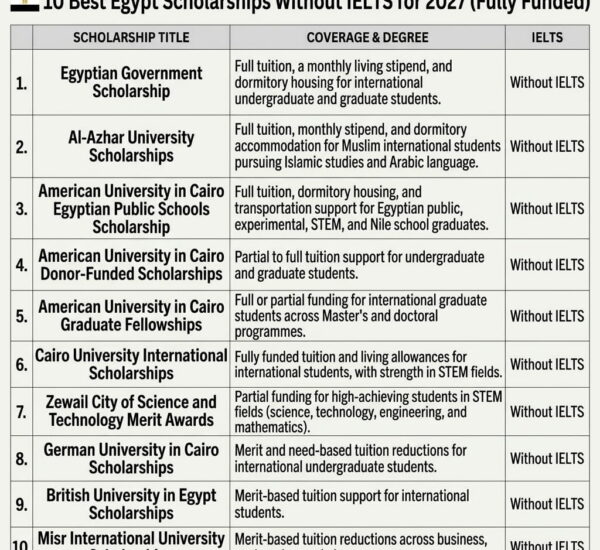
- 10 Best Egypt Scholarships Without IELTS for 2027 (Fully Funded)
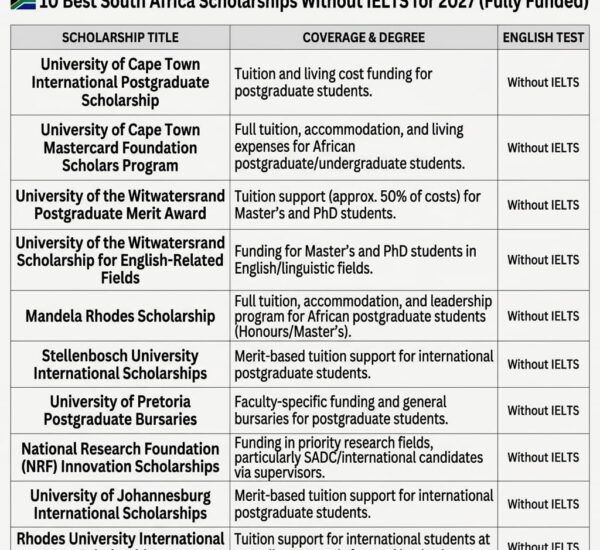
- 10 Best South Africa Scholarships Without IELTS for 2027 (Fully Funded)
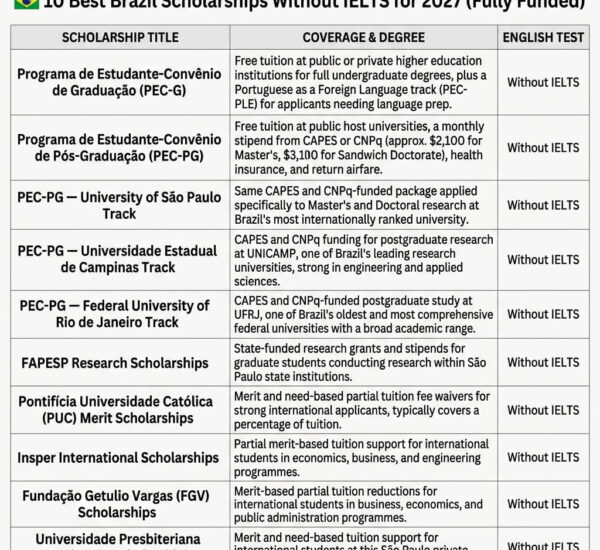
- 10 Best Brazil Scholarships Without IELTS for 2027 (Fully Funded)
- 10 Best Mexico Scholarships Without IELTS for 2027 (Fully Funded)
- 10 Best Azerbaijan Scholarships Without IELTS for 2027 (Fully Funded)