Germany turns the usual “without IELTS” question on its head. Because so many German degree programs are taught in German rather than English, IELTS was often never the relevant test to begin with — and for the English-taught programs that do exist, universities and scholarship bodies frequently accept a Medium of Instruction (MOI) letter or an alternative test in its place.
The Shift in German Admissions: Bypassing IELTS in 2027
Germany’s public universities charge no tuition fees for almost all degree programs, a fact that already makes the country one of the most cost-effective Tier-1 destinations regardless of scholarship status. On the language side, the split is structural rather than a recent policy trend: German-taught programs have always required TestDaF, DSH, or the Goethe-Zertifikat — not IELTS — while English-taught Master’s programs typically accept IELTS, TOEFL, or an approved MOI certificate confirming your prior degree was delivered entirely in English.
Table of Contents
How to Use MOI Letters & German Proficiency Certificates for German Applications
If your target program is English-taught, ask your previous institution’s registrar for an official MOI letter confirming your degree was delivered wholly in English — universities including TU Munich and RWTH Aachen have been known to accept this in place of a fresh IELTS or TOEFL score for specific programs. If your target program is German-taught, the relevant document isn’t an English certificate at all — you’ll need TestDaF or DSH, since IELTS was never the applicable test.
Before shortlisting scholarships, it’s worth understanding your study in Germany financial aid picture in full — free tuition still leaves a mandatory blocked account for your visa, health insurance, and living costs to plan for, all covered in Section 4.
2. Requirements to Waive IELTS for German Universities and Student Visas
University/Language of Instruction vs. German Student Visa Requirements
This is the detail that trips up most applicants: the German student visa (National Visa, Type D) process does not independently mandate IELTS. What the visa office actually assesses is your university admission letter, proof of financial resources (via a blocked account or equivalent), and health insurance — the English or German language requirement is set entirely by your university and program, not layered on separately by the visa office.
This means once your university has accepted your language proof — whether that’s IELTS, an MOI letter, or a German test — there’s no additional national-level English test required for the visa itself.
How to Get an Official MOI Certificate
Request this directly from your previous institution’s registrar, on official letterhead, confirming your degree was delivered wholly in English. Always verify with your specific German program whether it accepts MOI before assuming — as one detailed 2027 guide on this topic puts it, checking the language requirements section of your program’s own page takes about two minutes and saves guessing based on generic lists.
Alternative Accepted Tests and Certificates (TOEFL, Cambridge, TestDaF, DSH)
- For English-taught programs: TOEFL iBT, Cambridge English, PTE Academic, or an MOI letter are commonly accepted alongside IELTS
- For German-taught programs: TestDaF, DSH, or the Goethe-Zertifikat (typically B2 or higher) — IELTS is simply not the relevant test
- Political foundation scholarships (covered in Section 3) frequently require German proficiency regardless of your program’s teaching language, since interviews and paperwork are conducted in German
Always confirm the exact accepted list on your specific program’s official page, since requirements are set at the program level, not university-wide.
3. Top 10 Double-Checked Germany Scholarships Without IELTS
3.1 DAAD Scholarships (General Programme Database)
Coverage: Full or partial funding depending on programme; typically includes monthly stipend, travel allowance, and health insurance | Degree Level: Master’s, PhD & Research Stays | English Requirement: Set by the language of instruction — English-taught programs require IELTS/TOEFL/equivalent; German-taught programs require TestDaF/DSH instead. 🔗 Official site: daad.de/en/studying-in-germany/scholarships/daad-scholarships
As the world’s largest funding organisation of its kind, DAAD supports well over 100,000 German and international students and researchers annually across a database of more than 100 individual scholarship programmes. Because DAAD itself doesn’t administer a single centralised scholarship but rather a searchable database organised by country, subject, and degree level, the language requirement genuinely tracks the language of instruction of your chosen programme rather than defaulting to IELTS — meaning a German-taught program funded through DAAD may never ask for an English test at all.
3.2 DAAD EPOS (Development-Related Postgraduate Courses)
Coverage: Full Tuition (where applicable), €934/month stipend (Master’s), Travel Allowance, Health Insurance | Degree Level: Postgraduate (Master’s & PhD) | English Requirement: Accepts IELTS, TOEFL, or documented proof matching the specific programme’s language of instruction; MOI accepted for several country profiles. 🔗 Official site: www2.daad.de — Study Scholarships for Postgraduate Courses
Aimed at specialists from developing and emerging countries, DAAD EPOS funds postgraduate study in fields tied to sustainable development — engineering, public health, economics, agriculture, and more. Applicants should note that DAAD’s official guidance is explicit that language proof must match the programme’s actual language of instruction, so while an MOI letter is accepted for many English-taught EPOS courses, it isn’t a blanket substitute across every listing — always check the specific programme call before assuming.
3.3 Heinrich Böll Foundation Scholarship
Coverage: €934/month (Master’s) or higher (PhD), plus health insurance and family allowances | Degree Level: Master’s & PhD | English Requirement: None — applicants must instead prove German proficiency at B2 level or DSH-1, regardless of whether their chosen programme is taught in English. 🔗 Official site: boell.de/en/scholarships
Affiliated with Germany’s Green political movement, the Heinrich Böll Foundation supports around 1,450 students and 200 doctoral candidates annually who share its commitment to ecology, democracy, and human rights. This scholarship is a genuinely clean example for this list: IELTS is not part of the requirement at all, since the Foundation’s own eligibility criteria call for German-language proficiency instead, making it a strong option for applicants who are confident in German but want to skip English testing entirely.
3.4 Konrad-Adenauer-Stiftung (KAS) Scholarship Programme
Coverage: €992/month (Master’s), €1,400/month (PhD), plus health insurance and seminar programme | Degree Level: Master’s & PhD | English Requirement: None — German proficiency at B2 level is required for all scholars before study begins. 🔗 Official site: kas.de/en/web/begabtenfoerderung-und-kultur
One of Germany’s most established political foundations, KAS funds international students and doctoral candidates who can relate to its values around democracy and the rule of law, backed by a global alumni network of over 3,000 international scholars. As with Heinrich Böll, KAS’s language requirement is German, not English — applicants who’ve already committed to German-language preparation can pursue this scholarship without ever needing to sit IELTS.
3.5 Friedrich Ebert Foundation Scholarship
Coverage: €992/month base amount, plus health insurance and a child allowance where applicable | Degree Level: Bachelor’s, Master’s & Diploma | English Requirement: Set by the specific degree programme’s language of instruction; scholarship itself does not add an additional IELTS requirement. 🔗 Official site: www2.daad.de — Friedrich Ebert Foundation Scholarship
Affiliated with Germany’s Social Democratic tradition, this foundation funds students from the Global South, post-Soviet states, and eastern/south-eastern European countries who demonstrate academic merit and a commitment to social democratic values. Because eligible applicants must already be enrolled in or admitted to a German degree programme before applying, whatever language proof (English or German) satisfied that original admission carries through — there is no separate, scholarship-specific English test layered on top.
3.6 Friedrich Naumann Foundation Scholarship
Coverage: Up to €850/month, plus health insurance contribution | Degree Level: Master’s & PhD | English Requirement: None — application documents and the selection interview must be conducted in German, even for English-taught programmes. 🔗 Official site: freiheit.org/student-scholarships
Affiliated with Germany’s liberal political tradition, the Friedrich Naumann Foundation funds Master’s and PhD students committed to liberal, cosmopolitan values across Germany, Switzerland, and the wider EU. This is one of the clearest IELTS-free routes on this list: the Foundation’s own published guidance states plainly that German is required for the application and interview regardless of your programme’s teaching language — meaning even students in a fully English-taught degree pursue this scholarship entirely through German rather than any English test.
3.7 Deutschlandstipendium
Coverage: €300/month (€150 federal government + €150 private sponsor), for at least two semesters | Degree Level: Undergraduate & Master’s | English Requirement: Set by the individual university’s admission policy; the scholarship itself imposes no separate English test. 🔗 Official site: deutschlandstipendium.de — English overview
One of Germany’s most accessible merit scholarships, the Deutschlandstipendium supported around 33,500 students in 2025 across all participating public and state-recognised universities, awarded regardless of the applicant’s nationality or family income. Because the programme is administered independently by each participating university rather than through one national application, the English-proficiency route you used to gain admission — IELTS, MOI, or otherwise — is simply inherited from your university’s own policy, with no additional language test required at the scholarship stage.
3.8 Erasmus Mundus Joint Master Degrees (EMJMD)
Coverage: €1,400/month stipend, tuition, travel allowance (up to €33,600 total per student) | Degree Level: Master’s (studied across 2+ European countries, often including Germany) | English Requirement: Standard consortium policy applies; applicants from English-medium academic backgrounds are frequently exempt from a formal test. 🔗 Official site: eacea.ec.europa.eu/scholarships/erasmus-mundus-catalogue_en
Erasmus Mundus funds joint Master’s degrees delivered by consortia of universities across multiple European countries, with German institutions participating in a large share of the catalogue’s 200+ programmes. Program documentation for several EMJMD consortia explicitly lists exemptions for “nationals of English-speaking countries or graduates from universities where the medium of instruction is exclusively English,” giving genuine MOI-route applicants a documented path in — though because each consortium sets its own exact policy, always confirm the specific programme page in the official catalogue before assuming your exemption applies.
3.9 RWTH Aachen International Academy Scholarships
Coverage: Up to 25% tuition reduction (Study Scholarship) or up to 35% (GTS Scholarship for select countries) | Degree Level: Master’s (English-taught Engineering programmes) | English Requirement: Standard RWTH International Academy admission policy applies (IELTS 6.5/TOEFL 90/PTE 58+ or equivalent). 🔗 Official site: academy.rwth-aachen.de/en/services/scholarships
RWTH Aachen, one of Germany’s leading technical universities, offers these tuition-reduction scholarships specifically through its English-taught Master’s programmes in engineering, with the GTS scholarship in particular supporting bachelor graduates from Africa, Indonesia, Thailand, Iran, and Turkey. Applications run through the same RWTHonline portal as your regular Master’s application — no separate scholarship form — meaning students who met RWTH’s English requirement through any accepted test remain automatically in consideration.
3.10 TUM Deutschlandstipendium (Technical University of Munich)
Coverage: €300/month, for at least two semesters | Degree Level: Undergraduate & Master’s | English Requirement: Standard TUM admission policy for the relevant programme; no additional English test for the scholarship itself. 🔗 Official site: tum.de/en/studies/fees-and-financial-aid/scholarships/tum-scholarships/deutschlandstipendium
As one of Germany’s top-ranked technical universities, TUM’s implementation of the national Deutschlandstipendium is notably accessible for international students: applicants can apply as soon as they’ve submitted their degree application and received an applicant number, without waiting for a final admission decision. Because English proficiency is verified once at the point of program admission — through whichever test or MOI route TUM accepted — recipients face no separate English requirement to actually receive or renew the scholarship itself.
4. Step-by-Step Application Strategy for 2027
How to Request an MOI Letter From Your University Registrar
- Email your registrar’s office at least 8 weeks before your earliest deadline
- Request an official Medium of Instruction certificate, on headed paper, confirming your degree was delivered wholly in English
- Check your specific program’s language requirements page for the exact accepted wording — generic “universities without IELTS” lists go stale quickly, since individual admissions offices update their policies often
- If your target program is German-taught, request TestDaF or DSH preparation resources instead — an MOI letter won’t help there regardless of how strong your English is
Application Timelines: DAAD & Political Foundations vs. University-Level Scholarships
DAAD EPOS applications for 2027 intake typically open between September and December 2026, while political foundation scholarships (Böll, KAS, Naumann) run on fixed biannual cycles — commonly around March and September deadlines. University-level scholarships like the Deutschlandstipendium and RWTH’s tuition reductions are generally tied to each program’s own admissions cycle, giving more flexibility if you miss a foundation deadline.
Beyond the scholarship itself, budget for costs that none of these programs typically cover in full: the mandatory blocked account (Sperrkonto) required for your visa application, statutory or private health insurance (GKV vs. private), and a low-fee international transfer service such as Wise for moving remaining funds without heavy bank markups. Getting a full picture of your study in Germany financial aid options — not just the scholarship’s headline value — is what actually determines whether the offer is liveable.
5. Frequently Asked Questions (FAQs)
Will the German Embassy grant a student visa without IELTS? Yes, in the vast majority of cases. The German national student visa process assesses your university admission letter, financial proof (typically a blocked account), and health insurance — not an independent English test score. The language-proficiency requirement is set entirely by your university and specific program, so once that’s satisfied through IELTS, an MOI letter, or a German-language certificate, there is no separate test required specifically for the visa itself.
Is an MOI letter cheaper and faster than IELTS for 2027? Yes, in almost every case where it’s accepted. An MOI letter is typically issued free of charge by your previous institution’s registrar within days to a couple of weeks, compared to the cost and scheduling required for IELTS. The trade-off is that MOI acceptance in Germany is set program by program, and several political foundation scholarships on this list require German proficiency regardless of your MOI status — so confirm which requirement actually applies to your specific scholarship and program before assuming either route clears you.
6. Conclusion & Checklist
- [ ] Confirm whether your specific program is English-taught or German-taught — this determines whether IELTS is even the relevant test
- [ ] For English-taught programs, check whether an MOI letter is accepted in place of IELTS/TOEFL
- [ ] For political foundation scholarships (Böll, KAS, Naumann), prepare for a German-language application and interview regardless of your program’s teaching language
- [ ] Request your MOI letter or begin German test preparation early, based on which route applies
- [ ] Budget for the blocked account, health insurance, and visa costs separately from your tuition/stipend scholarship
- [ ] Re-verify every scholarship’s current deadline and language policy directly on the official link before applying
7. Disclaimer
“Without IELTS” does not mean without any language proficiency proof. Every scholarship on this list still requires some form of documented language proficiency — whether that’s an MOI certificate, IELTS, TOEFL, or a German-language certificate such as TestDaF, DSH, or B2-level proficiency for political foundation scholarships. Which requirement applies depends entirely on whether your chosen program is taught in English or German, and university/program policies determine the accepted route — Germany’s student visa process does not add a separate national English test requirement on top of this, but it does require its own financial and health insurance documentation. Always confirm the exact accepted route directly on the university’s or foundation’s official page before applying, as policies change between admissions cycles and application rounds.
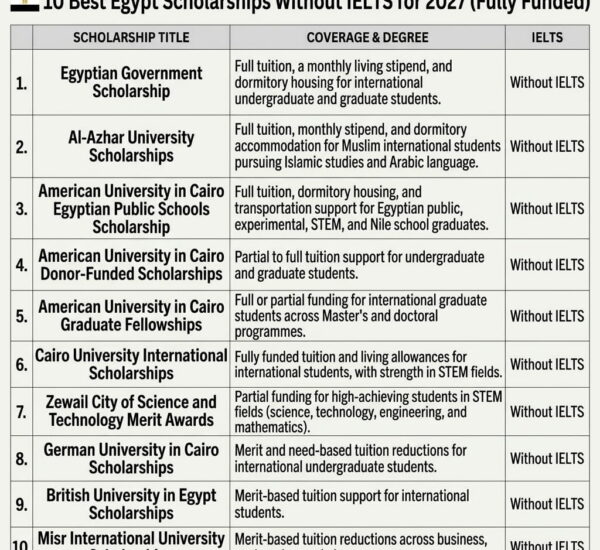
- 10 Best Egypt Scholarships Without IELTS for 2027 (Fully Funded)
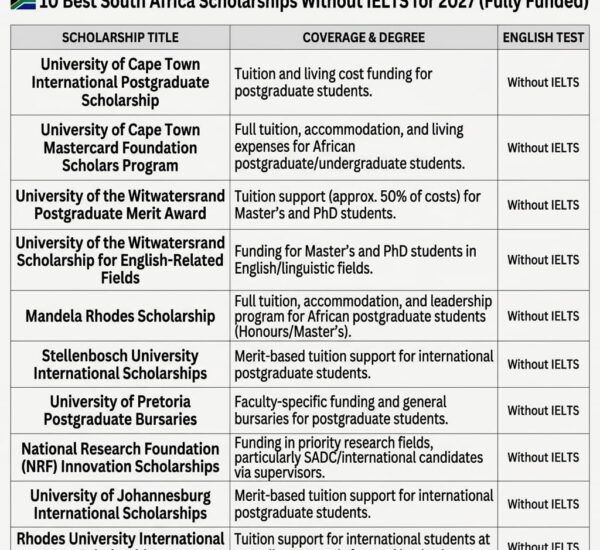
- 10 Best South Africa Scholarships Without IELTS for 2027 (Fully Funded)
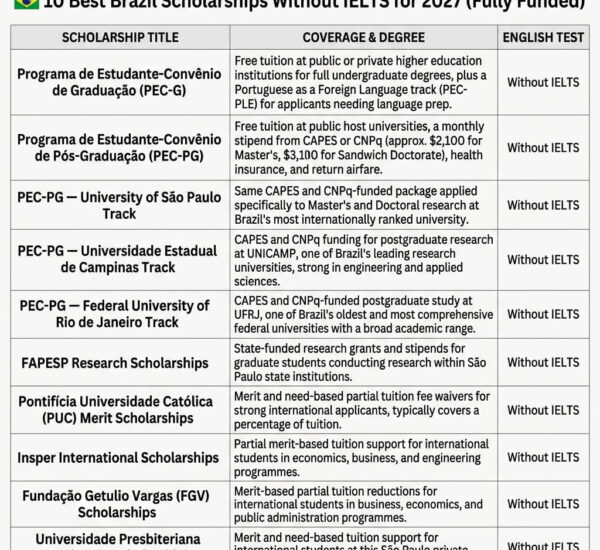
- 10 Best Brazil Scholarships Without IELTS for 2027 (Fully Funded)
- 10 Best Mexico Scholarships Without IELTS for 2027 (Fully Funded)
- 10 Best Azerbaijan Scholarships Without IELTS for 2027 (Fully Funded)