China’s scholarship system runs on a similar principle to Germany and Italy: your language requirement tracks the language your program is taught in, not a fixed global standard. For 2027 applicants, this means IELTS is often simply not the relevant test — English-taught programs frequently accept a Medium of Instruction (MOI) letter, while Chinese-taught programs require the HSK proficiency test instead.
The Shift in Chinese Admissions: Bypassing IELTS in 2027
China’s flagship Chinese Government Scholarship (CSC), along with programs like the ANSO Scholarship and most university-level awards, explicitly allow applicants whose previous degree was delivered in English to submit an English Proficiency Certificate from their prior university in place of a fresh IELTS or TOEFL score. On the Chinese-taught side, the HSK (Hanyu Shuiping Kaoshi) test is the actual relevant requirement — IELTS was never applicable there in the first place.
Table of Contents
How to Use MOI Letters & HSK for Chinese Applications
If your target program is English-taught and your prior degree was delivered wholly in English, request an official MOI letter from your previous institution’s registrar — CSC’s own guidance confirms this is accepted as an alternative to IELTS/TOEFL for eligible applicants. If your target program is Chinese-taught, the relevant document is an HSK certificate, typically Level 4 for Master’s and Level 5 for PhD study — no English test applies there at all.
Before shortlisting scholarships, it’s worth understanding your study in China financial aid picture in full — a tuition waiver alone won’t cover mandatory health insurance or the visa financial-proof documentation, both covered in Section 4.
2. Requirements to Waive IELTS for Chinese Universities and Student Visas
University/Scholarship Admission vs. Chinese Student Visa (X1/X2) Requirements
The Chinese student visa (X1/X2) process does not independently mandate an English test. What the visa office assesses is your JW201/JW202 admission form or Letter of Admission, proof of financial means, and a physical examination form — the English or Chinese language requirement is set entirely by your university and specific program, not layered on separately by the visa office.
This means once your university has accepted your language proof — whether IELTS, an MOI letter, or an HSK certificate — there’s no additional national-level English test required for the visa itself.
How to Get an Official English Proficiency Certificate (MOI)
Request this directly from your previous institution’s registrar, confirming your degree was delivered wholly in English. CSC’s own official guidance and several university admissions pages confirm this route is accepted for English-taught Chinese programs, so keep a certified copy ready alongside your other application documents.
Alternative Accepted Tests and Certificates (TOEFL, Duolingo, HSK, HSKK)
- For English-taught programs: TOEFL iBT, Duolingo English Test, PTE Academic, or an MOI letter are commonly accepted alongside IELTS
- For Chinese-taught programs: HSK (generally Level 4 for Master’s, Level 5 for PhD) — IELTS is simply not the relevant test
- New for 2027: Some bachelor’s-level CSC applicants must additionally submit a CSCA (China Scholastic Competency Assessment) score, a general academic aptitude test separate from any language exam
Always confirm the exact accepted list on your specific program’s official page, since requirements are frequently set at the program level rather than university-wide.
3. Top 10 Double-Checked China Scholarships Without IELTS
3.1 Chinese Government Scholarship (CSC)
Coverage: Tuition exemption, free on-campus accommodation, comprehensive medical insurance, monthly stipend | Degree Level: Bachelor’s, Master’s & PhD | English Requirement: IELTS 6.0+/TOEFL 80+ standard, but applicants may substitute an English Proficiency Certificate from their prior university confirming their degree was taught in English. 🔗 Official site: campuschina.org
Administered by the China Scholarship Council under the Ministry of Education, CSC is China’s flagship scholarship, funding students across more than 280 designated universities in nearly every academic field. Because CSC’s own official guidance explicitly permits applicants to prove English proficiency through documentation from their previous institution rather than a fresh test score, this is one of the cleanest genuine MOI-route scholarships on this list — Chinese-taught program applicants instead submit HSK results, since IELTS was never the relevant test for that track.
3.2 Schwarzman Scholars
Coverage: Full Tuition, Travel, Room & Board, Health Insurance, In-Country Travel | Degree Level: Master’s (Global Affairs, Tsinghua University) | English Requirement: Standard IELTS 7/TOEFL 100 applies, but the requirement is explicitly waived for applicants who studied at an English-medium institution for at least two years at undergraduate or graduate level. 🔗 Official site: schwarzmanscholars.org
One of the most prestigious one-year Master’s programs in the world, Schwarzman Scholars brings together 100–200 scholars annually at Tsinghua University’s Schwarzman College for a fully funded degree in public policy, economics and business, or international studies. The program’s own admissions documentation is unusually explicit about its MOI-style waiver: applicants who studied in English for two or more years at the undergraduate or Master’s level do not need to submit any English test score at all, making this a genuinely clean IELTS-free route for qualifying candidates.
3.3 Yenching Academy Scholarship (Peking University)
Coverage: Full Tuition, Travel Stipend, Accommodation, Monthly Stipend, Field Study Costs | Degree Level: Master’s (China Studies) | English Requirement: Standard test score accepted, but students and alumni of English-taught degree programs are exempted from submitting any English proficiency test result. 🔗 Official site: yenchingacademy.pku.edu.cn/ADMISSIONS.htm
Yenching Academy’s interdisciplinary Master’s in China Studies admits roughly 120 scholars a year, with international students making up around 75% of the cohort, and courses available in both English and Chinese. The program’s admissions criteria state plainly that native English speakers and graduates of English-taught degree programs are exempted from providing an English test score entirely, giving MOI-route applicants one of the most straightforward exemptions on this list — provided their prior degree was genuinely delivered wholly in English.
3.4 Confucius Institute Scholarship (CIS)
Coverage: Tuition Exemption, Accommodation, Living Allowance, Comprehensive Medical Insurance | Degree Level: Master’s in Teaching Chinese to Speakers of Other Languages (MTCSOL) & Chinese Language Study | English Requirement: None — eligibility is assessed through HSK, HSKK, or BCT scores, not an English test. 🔗 Official site: cis.chinese.cn
Established to cultivate qualified international Chinese-language teachers, the Confucius Institute Scholarship is one of the clearest genuinely IELTS-free routes on this list: applicants are assessed on their Chinese proficiency test scores — a minimum HSK Level 3 score of 210 for most tracks — with no English test requirement anywhere in the eligibility criteria. This makes it a strong option specifically for students confident in Chinese who want to skip English testing entirely, rather than an MOI-route alternative.
3.5 CAS-ANSO Scholarship
Coverage: Full Tuition Waiver, Monthly Stipend (RMB 3,000–8,000), Travel Allowance, Health Insurance, Visa Fee Allowance | Degree Level: Master’s & PhD (Science & Technology fields) | English Requirement: Applicants must demonstrate proficiency in either English or Chinese; IELTS/TOEFL accepted, but other official proof of English proficiency is also valid. 🔗 Official site: english.ucas.ac.cn
Funded by the Chinese Academy of Sciences and 36 partner scientific institutions across the Belt and Road regions, ANSO supports 100–200 Master’s students and 300 PhD students annually at institutions including USTC, UCAS, and CAS-affiliated institutes nationwide. Because the scholarship’s own eligibility criteria explicitly list Chinese proficiency as an equally valid alternative to English testing, applicants confident in Chinese have a straightforward second route in, separate from the standard IELTS/TOEFL/MOI track used by English-focused applicants.
3.6 Zhejiang University Scholarship
Coverage: Full or partial tuition waiver, varies by scholarship tier (CSC, Zhejiang Provincial, or ZJU-institutional) | Degree Level: Bachelor’s, Master’s & PhD | English Requirement: Standard admission policy applies per program’s language of instruction; several English-taught programs (ZJU-UoE Institute, MBBS) accept MOI or alternative tests. 🔗 Official site: iczu.zju.edu.cn/iczuen
Zhejiang University’s international scholarship structure layers CSC funding, the Zhejiang Provincial Government Scholarship, and ZJU’s own institutional awards, giving applicants multiple parallel funding routes into the same programs. Because undergraduate and graduate degrees are offered in both Chinese and English depending on the department, the university’s own admission guides make clear that the language requirement tracks your specific program rather than a single university-wide test policy — English-taught tracks like the ZJU-UoE Institute programs follow standard MOI-friendly international admissions criteria.
3.7 Fudan University Scholarships (incl. Shanghai Government Scholarship)
Coverage: Tuition exemption, monthly stipend (RMB 2,500–3,500 depending on degree level), accommodation, medical insurance | Degree Level: Bachelor’s, Master’s & PhD | English Requirement: HSK or IELTS/TOEFL required depending on program language; Confucius Institute Scholarship route also available through Fudan. 🔗 Official site: fudan.edu.cn/en/Scholarships
Fudan University in Shanghai channels three parallel scholarship routes to international students: the Chinese Government Scholarship, the Shanghai Municipal Government Scholarship, and the Confucius Institute Scholarship, each with its own eligibility criteria and language requirement. Because Fudan’s own FAQ confirms that the language proof required depends entirely on whether your specific program is Chinese-taught or English-taught, students who qualify for an MOI-style exemption or hold sufficient HSK scores can access any of these three funding routes without a standalone IELTS score.
3.8 Tsinghua University Tuition Scholarship & Beijing Government Scholarship
Coverage: Full or partial tuition waiver (Tsinghua Tuition Scholarship); tuition, accommodation, insurance and stipend tiers A–C (Beijing Government Scholarship) | Degree Level: Bachelor’s, Master’s & PhD | English Requirement: Standard Tsinghua admission policy for English-taught programs; new bachelor’s applicants must also submit a CSCA score starting 2027. 🔗 Official site: yz.tsinghua.edu.cn/en/Financial_Aid/Financial_Aid_System.htm
Beyond the CSC and Schwarzman Scholars routes already covered, Tsinghua maintains its own institutional financial aid system, layering Tsinghua Tuition Scholarships and the Beijing Government Scholarship for International Students on top of government funding for outstanding applicants. With over 30 Master’s and PhD programs taught entirely in English, applicants who satisfy Tsinghua’s standard English-taught admission requirement — through IELTS, TOEFL, or an accepted alternative — remain eligible for these institutional scholarships without a separate language hurdle at the funding stage.
3.9 Peking University Scholarship for International Students
Coverage: Full/partial tuition waiver, monthly living expenses, medical insurance (PKU Scholarship); tuition waiver, accommodation, insurance and stipend tiers A–C (Beijing Government Scholarship) | Degree Level: Bachelor’s, Master’s & PhD | English Requirement: Standard admission policy for the relevant program; new applicants need only submit one scholarship application to be considered for all applicable categories. 🔗 Official site: isd.pku.edu.cn/en
Distinct from the specialized Yenching Academy program, Peking University’s general scholarship system automatically considers eligible applicants for both the university’s own scholarship and the Beijing Government Scholarship through a single application — no need to apply separately to each. Because PKU explicitly states that new undergraduate applicants do not need to submit a separate scholarship application at all, with merit-based awards granted automatically upon admission, students who cleared PKU’s standard English-taught admission requirement face no additional scholarship-specific English test.
3.10 USTC Fellowship (University of Science and Technology of China)
Coverage: Level A: tuition waiver, medical insurance, RMB 3,000/month stipend, accommodation subsidy; Level B: tuition waiver only | Degree Level: Bachelor’s & Master’s | English Requirement: Standard USTC admission policy for English-taught programs; fellowship funded jointly by CSC, CAS-ANSO, or USTC itself. 🔗 Official site: ic.ustc.edu.cn/en/v7info.php?Nav_x=16
USTC, one of China’s elite C9 League universities specializing in science and technology, layers its own institutional fellowship on top of CSC and CAS-ANSO funding, giving applicants three potential funding sources through a single application in the USTC system. Because the fellowship’s Level A and Level B tiers are awarded based on the university’s holistic evaluation of each applicant rather than a standalone language test, students who met USTC’s admission requirement through IELTS, TOEFL, or an accepted alternative remain fully eligible for either funding tier.
4. Step-by-Step Application Strategy for 2027
How to Request an MOI Letter or English Proficiency Certificate
- Email your previous institution’s registrar at least 8 weeks before your earliest deadline
- Request an official certificate confirming your degree was delivered wholly in English, on institutional letterhead
- For CSC specifically, keep this alongside your university admission or pre-admission letter, since most scholarship routes require this as a prerequisite
- For Chinese-taught programs, register for the HSK test well in advance, since results are typically valid for only two years
Application Timelines: Government Scholarships vs. University Institutional Awards
CSC applications for the 2027/2028 cycle are expected to close between mid-February and late April 2027, depending on the chosen university or embassy channel — apply through your national nominating agency (Type A) or directly to a designated university (Type B) well ahead of this window. Schwarzman Scholars and Yenching Academy run on their own separate, earlier deadlines (typically September–December), entirely apart from standard CSC timelines. University-level institutional scholarships (Tsinghua, PKU, USTC, Zhejiang) are generally tied to each program’s own admissions cycle and frequently automatically assessed upon application.
Beyond the scholarship itself, budget for costs that none of these programs typically cover in full: the mandatory comprehensive medical insurance required for your student visa, the Foreigner Physical Examination Form, and a low-fee international transfer service such as Wise for moving remaining funds without heavy bank markups. Understanding your full study in China financial aid picture — not just the scholarship’s headline value — is what actually determines whether the offer is liveable.
5. Frequently Asked Questions (FAQs)
Will the Chinese Embassy grant a student visa (X1/X2) without IELTS? Yes, in the vast majority of cases. The Chinese student visa process assesses your JW201/JW202 admission form or Letter of Admission, proof of financial means, and a completed physical examination form — not an independent English test score. The language-proficiency requirement is set entirely by your university and specific program, so once that’s satisfied through IELTS, an MOI letter, or an HSK certificate, there is no separate test required specifically for the visa itself.
Is an MOI letter cheaper and faster than IELTS for 2027? Yes, in almost every case where it’s accepted. An MOI letter is typically issued free of charge by your previous institution’s registrar within a couple of weeks, compared to the cost and scheduling required for IELTS. The trade-off is that MOI acceptance in China is set program by program, and Chinese-taught programs require an HSK certificate instead regardless of your MOI status — so confirm which specific requirement applies to your target program before assuming either route clears you.
6. Conclusion & Checklist
- [ ] Confirm whether your specific program is English-taught or Chinese-taught — this determines whether IELTS or HSK is the relevant test
- [ ] For CSC and most scholarships, confirm whether your prior degree qualifies for the English Proficiency Certificate route instead of a fresh IELTS/TOEFL score
- [ ] For Chinese-taught programs, register for the HSK test well ahead of your target application window, noting the two-year validity period
- [ ] Check whether new bachelor’s-level CSC applicants in your intake need to submit a CSCA score for 2027
- [ ] Budget for comprehensive medical insurance and the physical examination form separately from your tuition/stipend scholarship
- [ ] Re-verify every scholarship’s current deadline and language policy directly on the official link before applying
7. Disclaimer
“Without IELTS” does not mean without any proof of language proficiency. Every scholarship on this list still requires some form of documented qualification — whether that’s an MOI certificate, IELTS, TOEFL, or an HSK/HSKK certificate for Chinese-taught programs and Chinese-language-focused scholarships. Which requirement applies depends entirely on your chosen program’s teaching language and the specific scholarship’s own evaluation criteria — China’s student visa process does not add a separate national English test requirement on top of this, but it does require its own admission and health documentation. Always confirm the exact accepted route directly on the university’s or China Scholarship Council’s official page before applying, as policies change between admissions cycles and application rounds.
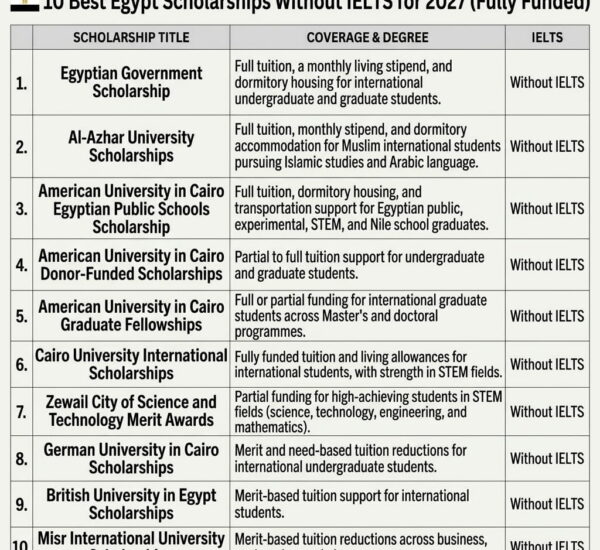
- 10 Best Egypt Scholarships Without IELTS for 2027 (Fully Funded)
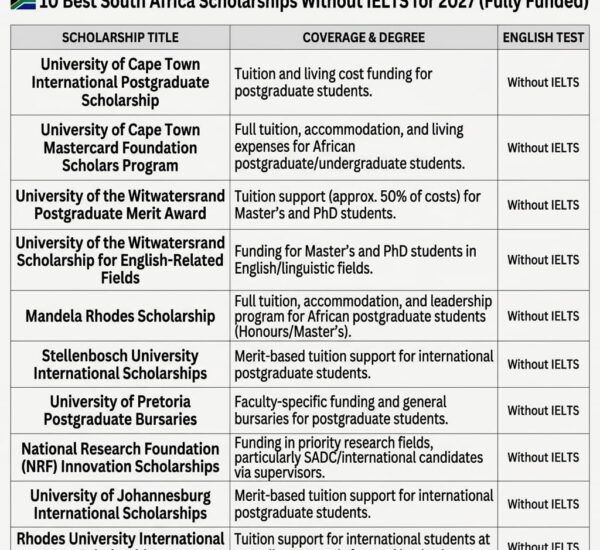
- 10 Best South Africa Scholarships Without IELTS for 2027 (Fully Funded)
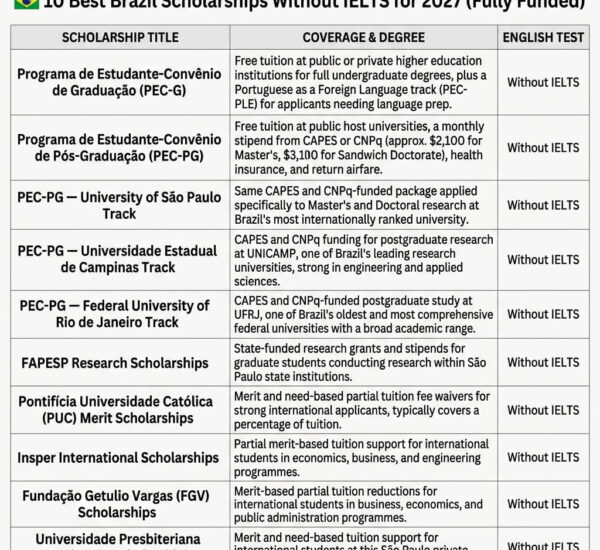
- 10 Best Brazil Scholarships Without IELTS for 2027 (Fully Funded)
- 10 Best Mexico Scholarships Without IELTS for 2027 (Fully Funded)
- 10 Best Azerbaijan Scholarships Without IELTS for 2027 (Fully Funded)