For 2027 applicants, IELTS is no longer the only gateway into a UK university. From government-funded flagship scholarships to individual university awards, a growing list of UK institutions now accept a Medium of Instruction (MOI) letter, the Duolingo English Test (DET), or simply set no independent English requirement at all — leaving the decision to the university you apply to.
The Shift in UK Admissions: Bypassing IELTS in 2027
The UK government’s own flagship scholarship, Chevening, formally removed its English-language requirement back in 2020, and the UK’s Commonwealth Scholarships now leave English proficiency entirely to the discretion of the host university. This cascades down: individual universities are increasingly building their own MOI waiver policies, especially for applicants whose prior degree was taught wholly in English.
Table of Contents
How to Use MOI Letters & Duolingo (DET) for UK Applications
If your secondary or undergraduate education was conducted entirely in English, ask your institution’s registrar for an MOI certificate on official headed paper. Universities like Aston explicitly built this into their admissions policy. If MOI isn’t available, the Duolingo English Test is now accepted for university admission at institutions including Coventry, York, and Strathclyde — though note the important caveat covered in Section 2.
Before you shortlist scholarships, it’s worth understanding your study in UK financial aid options in full, because a tuition-only scholarship still leaves living costs, the mandatory Immigration Health Surcharge, and visa fees to plan for — we cover this funding gap in Section 4.
2. Requirements to Waive IELTS for UK Universities and Visas
University Admission vs. UKVI Visa Requirements — The Critical Distinction
This is the single most important fact for 2027 applicants: your university’s admission policy and the UK Home Office’s visa requirement are two separate things. A university may accept Duolingo or an MOI letter to admit you onto a course, but UK Visas and Immigration (UKVI) only recognises approved Secure English Language Tests (SELTs) — IELTS for UKVI, PTE Academic UKVI, Trinity ISE, and LanguageCert Academic — for the visa itself.
The good news: many UK universities that are Higher Education Providers with degree-awarding powers can self-assess your English level and endorse it directly on your CAS (Confirmation of Acceptance for Studies). When this happens, the visa officer accepts the university’s own CAS endorsement, and no separate SELT certificate is required at the visa stage either.
How to Get an Official MOI Certificate
Request this directly from your previous institution’s registrar. It should be on official letterhead, confirm your course and assessments were wholly delivered in English, and — for some universities like Aston — must be an original, wet-stamped document.
Alternative Accepted Tests (Duolingo, TOEFL iBT, PTE Academic)
- Duolingo English Test: Accepted for admission at a growing list of universities; typically 105–120+ recommended for competitive scholarship applicants
- TOEFL iBT: Widely accepted for admission, though not always a UKVI-approved SELT
- PTE Academic UKVI: One of the few tests approved for both admission and the visa itself
Always confirm the exact policy on your specific course page — MOI and Duolingo acceptance can vary by department even within the same university.
3. Top 10 Double-Checked UK Scholarships Without IELTS
3.1 Chevening Scholarship
Coverage: Full Tuition, Living Stipend, Airfare, Visa Costs | Degree Level: Postgraduate (one-year Master’s) | English Requirement: Chevening itself sets no English language requirement — your chosen UK university sets its own.
🔗 Official site: chevening.org
The UK’s flagship international scholarship programme is the cleanest example of the 2027 shift: Chevening formally dropped its own English-test requirement in 2020, meaning your application to the scholarship itself is never blocked by a missing IELTS score. Instead, you apply to three eligible UK university courses, and each course’s own English proficiency policy — whether that’s IELTS, PTE, Duolingo, or an accepted MOI letter — determines whether you clear that specific hurdle. With around 1,800 scholarships awarded annually across 160+ eligible countries, it remains one of the most competitive but also most flexible funding routes for the 2027 cycle.
3.2 Commonwealth Scholarship (CSC)
Coverage: Full Tuition, Travel, Living Allowance | Degree Level: Postgraduate (Master’s & PhD) | English Requirement: Set entirely by the host UK university — MOI and alternative tests often accepted.
🔗 Official site: cscuk.fcdo.gov.uk
Funded by the UK’s Foreign, Commonwealth and Development Office, the Commonwealth Scholarship Commission (CSC) has funded over 31,000 students since 1960 and offers around 800 awards annually to citizens of Commonwealth countries. Like Chevening, the CSC itself does not administer a standardised English test — your English proficiency is assessed by the specific UK university you’re nominated to, which means candidates from English-medium university backgrounds can frequently clear this stage with an MOI letter rather than a fresh IELTS booking. Because nomination is typically routed through a national nominating agency in your home country, applicants should start this process well ahead of the CSC’s published deadlines.
3.3 GREAT Scholarships
Coverage: Minimum £10,000 towards tuition | Degree Level: Postgraduate (one-year taught Master’s) | English Requirement: Set by the participating university; standard admission policy applies (MOI/Duolingo accepted at many partner institutions).
🔗 Official site: study-uk.britishcouncil.org/scholarships-funding/great-scholarships
Jointly funded by the UK government’s GREAT Britain Campaign and the British Council, GREAT Scholarships offer over 140 awards across more than 60 UK universities for the 2026–27 academic year, with eligibility organised by home country. Because each award is administered by an individual partner university rather than a central body, the English-language route — SELT, Duolingo, or MOI — depends entirely on which institution and course you’re shortlisting, so check your specific country page on the Study UK website before assuming any waiver applies.
3.4 Rhodes Scholarship
Coverage: Full Tuition, Stipend, Health Insurance, Flights | Degree Level: Postgraduate (University of Oxford) | English Requirement: Must meet Oxford’s English proficiency policy — many applicants from English-medium academic backgrounds are exempt from a formal test.
🔗 Official site: rhodeshouse.ox.ac.uk
One of the oldest and most prestigious postgraduate awards in the world, the Rhodes Scholarship funds full-time study at Oxford across almost any subject, alongside a living stipend of over £20,000 a year. Because eligibility runs through the University of Oxford’s own graduate admissions system rather than a separate Rhodes Trust policy, candidates who completed their prior degree wholly in English are frequently exempted from a fresh English test altogether, with Oxford instead reviewing academic transcripts and reference letters as proof of proficiency. Competition is intense — acceptance rates hover around 4% in several constituencies — so a strong academic and leadership profile matters far more than which English-proficiency route you take.
3.5 Clarendon Fund Scholarship
Coverage: Full Tuition + Living Grant (min. £18,000+/year) | Degree Level: Postgraduate (Master’s & DPhil, University of Oxford) | English Requirement: Standard Oxford graduate admissions policy applies; no separate scholarship application or English test needed beyond your course requirements.
🔗 Official site: ox.ac.uk/admissions/graduate/fees-and-funding/funding/clarendon
The Clarendon Fund is Oxford’s largest graduate scholarship scheme, offering over 140 new awards every year to students from any country and any subject area. What makes Clarendon uniquely low-friction is that you are automatically considered the moment you apply for a Master’s or DPhil course by the relevant December or January deadline — there’s no separate scholarship form, no extra essay, and no additional English test beyond whatever your specific graduate course already requires for admission. For applicants juggling multiple scholarship applications at once, this “apply once, get considered automatically” structure is a genuine time-saver.
3.6 Gates Cambridge Scholarship
Coverage: Full Tuition + Stipend up to £20,000/year | Degree Level: Postgraduate (University of Cambridge) | English Requirement: Set by Cambridge’s own graduate admissions policy; MOI and alternative tests accepted per department.
🔗 Official site: gatescambridge.org
Funded by a $210 million donation from the Bill and Melinda Gates Foundation, the Gates Cambridge Scholarship offers around 80 fully funded postgraduate awards a year to applicants from any country outside the UK, with roughly two-thirds reserved for PhD candidates. As with Oxford’s Clarendon award, the English-language requirement here is determined entirely by Cambridge’s own graduate admissions process for your specific course, and strong candidates from English-medium academic backgrounds can often satisfy this through transcript review rather than a fresh IELTS sitting. With an acceptance rate near 0.5%, this is among the most selective scholarships on this list, so the application essays and departmental fit matter enormously.
3.7 Aston University International Scholarships
Coverage: £3,500–£25,000 tuition reduction (varies by award) | Degree Level: Undergraduate & Postgraduate | English Requirement: Aston has a published, explicit MOI waiver policy — students from Tier 1 universities and English-medium backgrounds can waive IELTS directly with a wet-stamped MOI letter.
🔗 Official site: aston.ac.uk/international/scholarships
Aston University stands out on this list for having one of the most clearly documented IELTS-waiver policies of any UK institution: applicants from qualifying Tier 1 universities can obtain an English-language waiver directly on the basis of an original, wet-stamped Medium of Instruction letter, without needing to sit Duolingo, TOEFL, or IELTS at all. Combined with Aston’s country-specific scholarship tracks (including GREAT Scholarships for select nations) and awards reaching up to £25,000 through schemes like the Ernest Edward Sanctuary Scholarship, this makes Aston a strong first stop for students who already hold English-medium qualifications and want the clearest, most predictable waiver route.
3.8 Coventry University International Scholarships
Coverage: £2,000–£6,000 tuition reduction (varies by scheme) | Degree Level: Undergraduate & Postgraduate | English Requirement: Coventry accepts TOEFL and Duolingo for admission on many programmes, alongside its standard IELTS 6.0+ requirement.
🔗 Official site: coventry.ac.uk/international-students-hub/apply-for-a-scholarship
Coventry University runs one of the more accessible international scholarship structures in the UK, with the Coventry University Group Scholarship automatically applying a tuition discount to eligible self-funded international students with no separate application needed. On the English-proficiency side, Coventry is explicitly named among the UK universities that accept the Duolingo English Test for university admission, giving applicants a genuinely lower-cost, faster alternative to IELTS — though as with all UK institutions, always confirm whether your specific course and nationality still require a UKVI-approved SELT for the visa stage itself.
3.9 University of Bedfordshire International Scholarships
Coverage: Fee discounts, Commonwealth & Chevening partner scholarships | Degree Level: Undergraduate & Postgraduate | English Requirement: Accepts alternative English diagnostic tests alongside IELTS; MOI accepted per programme.
🔗 Official site: beds.ac.uk/international/fees-and-scholarships
The University of Bedfordshire is a designated partner institution for both the Chevening Scholarship and the Commonwealth Scholarship, giving international students a direct route into two of the UK’s most prestigious government-funded awards through a single application ecosystem. Bedfordshire is also frequently cited among UK universities offering generous scholarships alongside alternative English diagnostic tests, making it a practical option for students who want both funding and a more flexible English-proficiency pathway in one place, particularly for postgraduate applicants entering through the Commonwealth Scholarship route.
3.10 University of Westminster Scholarships
Coverage: Full Tuition, Accommodation, Living Expenses & Flights (Full Scholarships) or £3,000 (Excellence Award) | Degree Level: Undergraduate & Postgraduate | English Requirement: Standard Westminster admissions English policy applies per course; GREAT Scholarships partner institution.
🔗 Official site: westminster.ac.uk/study/fees-and-funding/scholarships
Based in the heart of London, the University of Westminster offers some of the most generous fully funded scholarships on this list — its Full International Scholarships cover tuition, accommodation, living expenses, and even flights for students from developing countries, judged on academic excellence, development potential, and financial need. Westminster is also a GREAT Scholarships partner university, meaning applicants from GREAT-eligible countries have a second, parallel funding route into the same postgraduate programmes. Because Westminster’s scholarships are highly competitive with far more applicants than places, pairing a strong personal statement with early application is essential — don’t wait for a scholarship offer before applying to your course itself.
4. Step-by-Step Application Strategy for 2027
How to Request an MOI Letter From Your University Registrar
- Email your registrar’s office at least 8 weeks before your earliest scholarship or course deadline
- Request an official Medium of Instruction certificate, on headed paper, confirming your course and assessments were wholly delivered in English
- Check whether your target university (like Aston) requires the letter to be wet-stamped rather than a scanned PDF
- Keep a digital and physical copy — some universities request the original by post for visa purposes
Application Timelines: Government Scholarships vs. University-Level Awards
Government-funded programmes like Chevening typically open in August and close in early November, with interviews following months later — meaning 2027 entry applicants should already be preparing by mid-2026. University-level scholarships (Aston, Coventry, Bedfordshire, Westminster) generally run on rolling or later deadlines tied to each course’s own admissions cycle, giving you more flexibility if you miss a government scholarship window.
Beyond the scholarship award itself, budget for costs that none of these scholarships typically cover in full: the mandatory Immigration Health Surcharge (IHS), proof of funds for your visa application, and a low-fee international transfer service such as Wise for moving remaining funds without heavy bank markups. Understanding your full study in UK financial aid picture — not just the headline scholarship value — is what actually determines whether the offer is liveable.
5. Frequently Asked Questions (FAQs)
Will UKVI grant a Student visa without IELTS?
Yes, in specific circumstances. If your university is authorised to self-assess your English level and endorse this on your CAS, UKVI accepts that endorsement in place of a separate SELT certificate. If your university is not authorised to self-assess, or your course requires it, you will still need an approved SELT (IELTS for UKVI, PTE Academic UKVI, Trinity ISE, or LanguageCert Academic) specifically for the visa stage — Duolingo and standard TOEFL iBT are not UKVI-approved SELTs, even if your university accepted them for admission.
Is an MOI letter cheaper and faster than IELTS for 2027?
Yes, in almost every case. An MOI letter is typically issued free of charge by your previous institution’s registrar within 5–10 working days, compared to the cost and test-centre scheduling required for IELTS. The trade-off is that MOI is accepted for university admission only at most institutions — always check separately whether your visa route also requires a SELT.
6. Conclusion & Checklist
- Confirm whether your specific course (not just the general university policy) accepts MOI, Duolingo, or requires IELTS
- Separately confirm whether your visa route requires a UKVI-approved SELT, even if the university itself doesn’t
- Request your MOI letter early, and check if it needs to be wet-stamped
- Apply to government scholarships (Chevening, Commonwealth, GREAT) months ahead of university-level awards
- Budget for the Immigration Health Surcharge and proof-of-funds requirement separately from your tuition scholarship
- Re-verify every scholarship’s current deadline and English policy directly on the official link before applying
7. Disclaimer
“Without IELTS” does not mean without any English proficiency proof, and it does not mean without a UK visa language requirement. Every scholarship and university on this list still requires some form of documented English proficiency for either admission, your visa, or both — whether that’s an MOI certificate, Duolingo, PTE Academic UKVI, or IELTS itself. University admission policies and UKVI visa requirements are assessed separately, and acceptance of an alternative test for one does not guarantee acceptance for the other. Always confirm the exact accepted route directly on the university’s and UKVI’s official pages before applying, as policies change between admissions cycles.
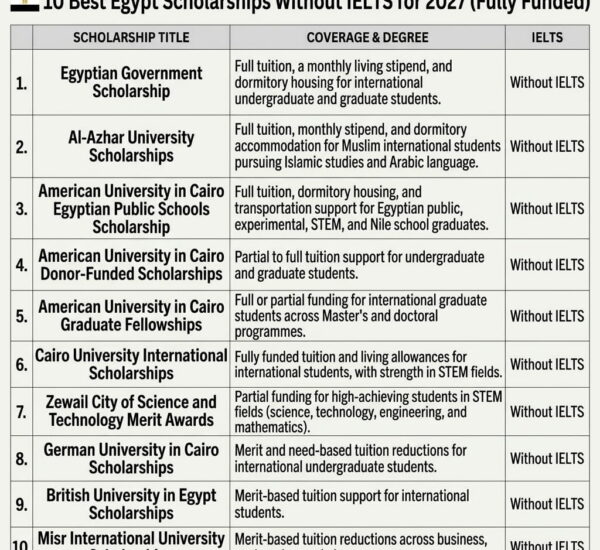
- 10 Best Egypt Scholarships Without IELTS for 2027 (Fully Funded)
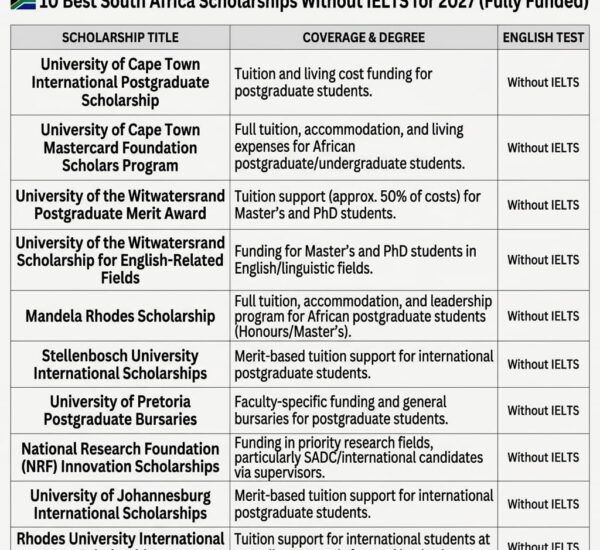
- 10 Best South Africa Scholarships Without IELTS for 2027 (Fully Funded)
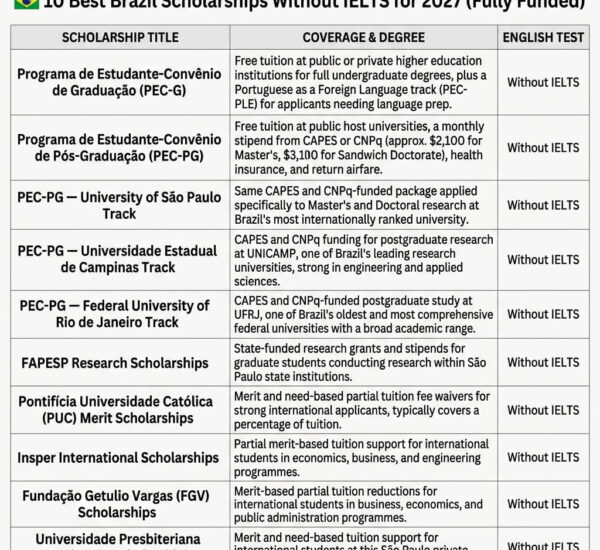
- 10 Best Brazil Scholarships Without IELTS for 2027 (Fully Funded)
- 10 Best Mexico Scholarships Without IELTS for 2027 (Fully Funded)
- 10 Best Azerbaijan Scholarships Without IELTS for 2027 (Fully Funded)