Canada has quietly become one of the most accessible countries for IELTS-free international applications. For 2027 entry, a wide range of Canadian universities accept prior English-medium education, the Duolingo English Test (DET), or alternative proficiency exams like CanTEST and CAEL — meaning your scholarship shortlist doesn’t have to be built around a single test score.
The Shift in Canadian Admissions: Bypassing IELTS in 2027
Unlike the UK’s visa system, Canada’s study permit process itself does not mandate a specific English test — the requirement is set entirely by the university you’re admitted to. This has given Canadian institutions unusual flexibility: schools like the University of Alberta and the University of Saskatchewan explicitly accept three or more years of full-time education conducted in English as a direct substitute for IELTS, while others like Concordia and Coventry-style Duolingo policies (common across Canadian campuses) let you sit an online test from home instead.
Table of Contents
How to Use Prior English Education & Duoligo (DET) for Canadian Applications
If your secondary or undergraduate education was delivered entirely in English, most Canadian universities will accept an official transcript or letter confirming this in place of a fresh test. Where that’s not available, the Duolingo English Test is now widely accepted for university admission across Canada — though as always, check your specific program page, since exemptions are typically set at the faculty level, not the whole institution.
Before shortlisting scholarships, it’s worth understanding your study in Canada financial aid picture in full — a tuition scholarship alone won’t cover the Guaranteed Investment Certificate (GIC) proof-of-funds requirement or mandatory provincial health coverage, both of which we cover in Section 4.
2. Requirements to Waive IELTS for Canadian Universities and Study Permits
University Admission vs. IRCC Study Permit Requirements — The Key Distinction
This is the detail most guides skip: Immigration, Refugees and Citizenship Canada (IRCC) does not set an English-language test requirement for the study permit itself. The study permit process assesses your acceptance letter, proof of funds (often via a GIC), and ties to your home country — not a language test score. The English-proficiency hurdle exists entirely at the university admission stage, which means once you clear your university’s own policy, there’s no separate language gate to clear for the study permit.
This is a meaningfully different structure from the UK’s SELT-for-visa system, and it’s part of why Canada has become such a flexible destination for MOI-route applicants.
How to Get Proof of English-Medium Education
Request an official transcript or letter from your previous school or university confirming your studies were delivered in English. Universities like Alberta and Saskatchewan specify a minimum of three years of full-time English-medium education in a country where English is the principal language — check your target university’s exact wording before assuming you qualify.
Alternative Accepted Tests (Duolingo, CanTEST, CAEL, PTE Academic)
- Duolingo English Test: Increasingly accepted for admission across Canadian universities; fast, online, and lower cost than IELTS
- CanTEST / CAEL: Canadian-specific English tests accepted at several universities, including Saskatchewan
- PTE Academic: Accepted at many Canadian institutions as a direct IELTS alternative
Always confirm your program’s specific accepted list — English-proficiency policy in Canada is set faculty-by-faculty, not university-wide.
3. Top 10 Double-Checked Canada Scholarships Without IELTS
3.1 Lester B. Pearson International Scholarship (University of Toronto)
Coverage: Full Tuition, Books, Fees & Residence (4 years) | Degree Level: Undergraduate | English Requirement: Standard U of T admission policy applies; MOI and alternative tests accepted per program.
🔗 Official site: future.utoronto.ca/pearson-scholarships
Canada’s largest scholarship program for international students, the Pearson Scholarship names roughly 37 students a year and covers every cost of a four-year undergraduate degree at one of the world’s top-ranked universities. What makes this scholarship distinctive is the nomination structure: you can’t self-apply — your high school must nominate you first, after which you complete the university application and a private scholarship link. Because the scholarship application deadline (November 6) follows shortly after admission, students planning for 2027 entry should confirm their school’s nomination process well before their senior year begins.
3.2 McCall MacBain Scholarship (McGill University)
Coverage: Full Tuition, Fees, $2,300/month Stipend, Relocation Grant | Degree Level: Postgraduate (Master’s & Professional) | English Requirement: McGill has an explicit, published waiver: applicants who completed an undergraduate degree at an institution where English is the language of instruction, or who lived and studied/worked for four consecutive years in a majority-English country, do not need to submit IELTS or TOEFL.
🔗 Official site: mccallmacbainscholars.org
The McCall MacBain Scholarship is Canada’s largest leadership-based graduate award, funding up to 30 full scholarships plus 100 additional entrance awards annually. Unlike many scholarships that leave English policy vague, McCall MacBain spells out its MOI-style exemption directly in its eligibility criteria — a genuine, documented waiver rather than an inferred one. Because the scholarship application is entirely separate from McGill’s own admissions process, with its own June–September window, applicants need to track two parallel deadlines rather than assuming one application covers both.
3.3 University of Calgary International Entrance Scholarship
Coverage: $10,000–$20,000/year, renewable for 4 years | Degree Level: Undergraduate | English Requirement: Must satisfy UCalgary’s English Language Proficiency policy; multiple accepted test types beyond IELTS.
🔗 Official site: ucalgary.ca/registrar/awards/university-calgary-international-entrance-scholarship
This scholarship rewards outstanding first-year international undergraduates with up to $20,000 annually, renewable through to graduation provided a 2.60 GPA is maintained. There’s no separate scholarship application — every eligible international applicant is automatically considered as part of their admission review, which removes one layer of paperwork for students juggling multiple applications. Because the scholarship ties directly to meeting Calgary’s English Language Proficiency requirement rather than IELTS specifically, applicants using alternative tests or MOI documentation remain fully eligible.
3.4 University of Alberta International Entrance Scholarships
Coverage: $5,000–$120,000 (varies by award, e.g. President’s International Distinction Scholarship) | Degree Level: Undergraduate | English Requirement: Alberta has a published, explicit exemption: three or more years of full-time education in English (excluding ESL) in a country where English is the principal language.
🔗 Official site: ualberta.ca/en/admissions/tuition-and-scholarships/international-entrance-scholarships
The University of Alberta stands out on this list for having one of the clearest, most explicitly documented IELTS-waiver policies of any Canadian institution — a defined threshold of prior English-medium education, rather than a vague “case-by-case” review. Its flagship President’s International Distinction Scholarship offers up to $120,000 over four years to top-achieving incoming undergraduates, and because scholarship consideration is automatic upon admission, students who qualify for the English waiver face no additional barrier at the scholarship stage either.
3.5 Concordia University International Scholarships
Coverage: Full Tuition + Fees, Books, Residence (Presidential Scholarship) or up to 50% tuition (International Scholars Award) | Degree Level: Undergraduate | English Requirement: Accepts IELTS, TOEFL, or the Duolingo English Test (DET) as equally valid proof of proficiency.
🔗 Official site: concordia.ca/international/students-from-abroad/scholarships
Concordia’s Presidential Scholarship is one of Montreal’s most prestigious international undergraduate awards, covering full tuition, fees, books, and residence for the duration of the degree, alongside a second fully funded track — the Concordia International Scholars award — for students who’ve overcome personal hardship. Concordia is notable for explicitly listing Duolingo alongside IELTS and TOEFL as an accepted proficiency route in its own admissions documentation, giving applicants a genuinely lower-cost, faster path to meeting the English requirement without it being buried in fine print.
3.6 University of Saskatchewan International Student Awards
Coverage: $10,000–$20,000 (IB Excellence & International Excellence Awards) | Degree Level: Undergraduate | English Requirement: Accepts TOEFL iBT, CanTEST, CAEL, MELAB, PTE Academic, Cambridge qualifications, and Duolingo — one of the widest accepted-test lists in Canada.
🔗 Official site: admissions.usask.ca/money/scholarships.php
USask’s International Excellence and IB Excellence Awards are automatically considered for every eligible international applicant, with no separate scholarship form required. What makes this university particularly useful for IELTS-free applicants is the sheer breadth of its accepted English-test list — beyond the standard IELTS/TOEFL/Duolingo trio, USask also recognises CanTEST and CAEL, two Canadian-developed tests that are less commonly accepted internationally, giving students from certain academic backgrounds an easier proficiency route than at most peer universities.
3.7 University of British Columbia International Scholars Program
Coverage: Up to $25,000/year (International Major Entrance Scholarships & Outstanding International Student Awards) | Degree Level: Undergraduate | English Requirement: Standard UBC policy applies; UBC’s Vantage One program offers an alternative pathway for strong students who narrowly miss the direct-entry English requirement.
🔗 Official site: you.ubc.ca/financial-planning/scholarships-awards-international-students
UBC devotes more than $35 million annually to international undergraduate awards, with every complete admission application automatically reviewed for its merit-based scholarships — no extra form needed. For students who are academically strong but fall just short of UBC’s direct-entry English requirement, the Vantage One program offers a structured academic pathway into full UBC standing rather than an outright rejection, making UBC a practical option even for applicants who haven’t yet cleared a formal English test at the required band.
3.8 York University International Scholarships
Coverage: $2,500–$120,000 over 4 years (Tentanda Via Award & President’s International Scholarship of Excellence) | Degree Level: Undergraduate | English Requirement: Standard York admissions policy; multiple accepted alternative tests per program.
🔗 Official site: futurestudents.yorku.ca/financing-your-degree/international-scholarships
York’s international scholarship range is unusually wide, from smaller $2,500 entrance awards up to the Tentanda Via Award, worth up to $120,000 over four years for students who’ve shown resilience overcoming significant personal challenges. Every international applicant is automatically assessed for an entrance scholarship based on final admission average the moment they apply — meaning students focused on clearing their English requirement through an accepted alternative test don’t lose out on scholarship consideration by skipping IELTS specifically.
3.9 University of Waterloo International Student Entrance Scholarship
Coverage: $10,000 (guaranteed for eligible international students) + up to $80,000 in faculty-specific awards | Degree Level: Undergraduate | English Requirement: Standard Waterloo admission policy; accepted tests vary by faculty.
🔗 Official site: uwaterloo.ca/future-students/financing/international-scholarships
As of the 2026 intake, Waterloo automatically awards a $10,000 International Student Entrance Scholarship to every eligible international fee-paying student admitted to first-year full-time studies — no separate application, and no minimum admission average beyond the standard offer. Students entering competitive faculties like Mathematics or Science can layer this with faculty-specific awards worth up to $80,000, making Waterloo one of the more reliably generous options on this list for high-achieving applicants regardless of which accepted English test they used.
3.10 Dalhousie University International Scholarships
Coverage: Over 2,000 entrance awards annually, values vary by award | Degree Level: Undergraduate & Graduate | English Requirement: Standard Dalhousie policy; university also runs its own English Language Pathway programs for students who haven’t yet met the direct-entry requirement.
🔗 Official site: dal.ca/international-students.html
Dalhousie invests more than CAD $67 million annually across its entrance award pool, with a single General Entrance Award application covering consideration for the majority of its scholarships. What sets Dalhousie apart for IELTS-free applicants is its in-house English Language Pathway: rather than simply rejecting students who haven’t cleared a formal test, Dalhousie offers a structured bridge program that leads directly into full degree studies, giving students who are still building their English proficiency a genuine route to the same scholarships as directly admitted students.
4. Step-by-Step Application Strategy for 2027
How to Request Proof of English-Medium Education
- Email your previous school or university’s registrar at least 8 weeks before your earliest deadline
- Request an official transcript or letter confirming your studies were conducted entirely in English
- Check whether your target university (like Alberta or Saskatchewan) has a minimum years-of-study threshold for the waiver to apply
- Keep both a digital and certified physical copy, since some scholarship committees request originals
Application Timelines: Flagship Scholarships vs. Automatic University Awards
Programs like McCall MacBain run on their own separate, competitive timeline (June–September for 2027 entry) entirely apart from McGill’s own admissions cycle — meaning missing this window means waiting a full year. By contrast, most of the university-level scholarships on this list (Calgary, Alberta, Waterloo, York) are automatically triggered by your admission application, so the priority there is simply applying to your program as early as possible.
Beyond the scholarship award itself, budget for the costs Canadian scholarships typically don’t cover in full: the mandatory Guaranteed Investment Certificate (GIC) for your study permit application, provincial or university-mandated health insurance, and a low-fee international transfer service such as Wise for moving remaining funds without heavy bank markups. Getting a full picture of your study in Canada financial aid options — not just the headline scholarship value — is what actually determines whether the offer is liveable.
5. Frequently Asked Questions (FAQs)
Will IRCC grant a Canadian study permit without IELTS?
Yes, in the vast majority of cases. IRCC’s study permit process does not set an independent English-language test requirement — your acceptance letter, proof of financial support (often via a GIC), and ties to your home country are what’s assessed. The English-proficiency requirement exists entirely at the university admission stage, so once your chosen university accepts your English proof (IELTS, Duolingo, MOI, or otherwise), there is no separate test required specifically for the study permit itself.
Is Duolingo cheaper and faster than IELTS for 2027?
Yes, in almost every case. Duolingo is typically a fraction of IELTS’s cost, delivers results within about 48 hours, and can be taken from home on a laptop with a webcam — no test-centre booking required. The trade-off is that Duolingo acceptance in Canada varies by faculty rather than whole university, so always confirm your specific program’s accepted test list before relying on it.
6. Conclusion & Checklist
Confirm whether your specific faculty (not just the general university policy) accepts Duolingo, prior English-medium education, or requires IELTS
Request your proof-of-English-education transcript or letter early, checking any minimum years-of-study threshold
Apply to flagship, separately timed scholarships (McCall MacBain) as early as their own portal opens
Budget for the GIC, provincial health insurance, and other study permit costs separately from your tuition scholarship
Re-verify every scholarship’s current deadline and English policy directly on the official link before applying
7. Disclaimer
“Without IELTS” does not mean without any English proficiency proof. Every scholarship and university on this list still requires some form of documented English proficiency — whether that’s a transcript proving prior English-medium education, the Duolingo English Test, CanTEST, CAEL, PTE Academic, or IELTS itself. University admission policies determine your accepted English-proficiency route; Canada’s study permit process does not add a separate test requirement on top of this, but it does require its own proof of funds and admission documentation. Always confirm the exact accepted route directly on the university’s official page before applying, as policies change between admissions cycles.
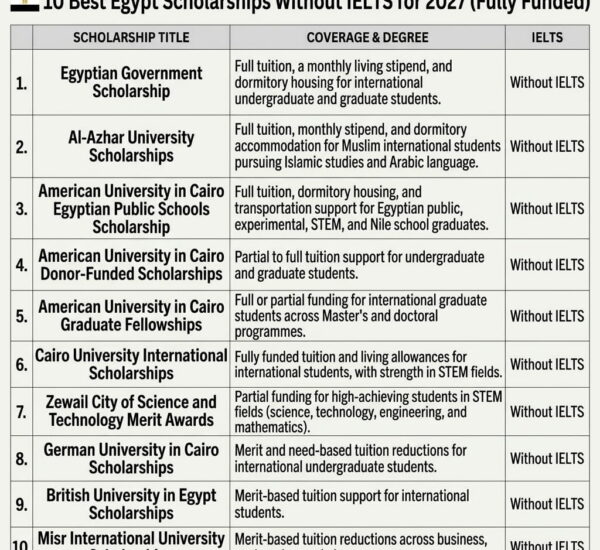
- 10 Best Egypt Scholarships Without IELTS for 2027 (Fully Funded)
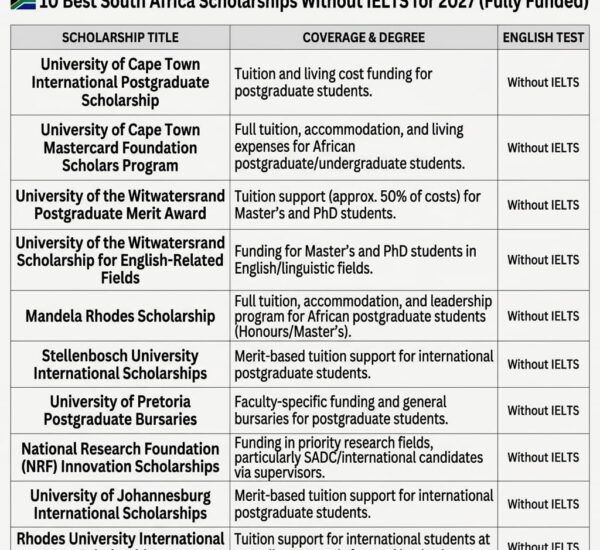
- 10 Best South Africa Scholarships Without IELTS for 2027 (Fully Funded)
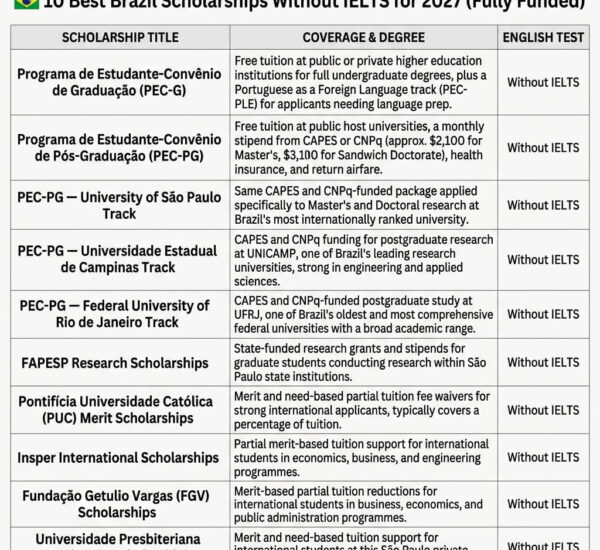
- 10 Best Brazil Scholarships Without IELTS for 2027 (Fully Funded)
- 10 Best Mexico Scholarships Without IELTS for 2027 (Fully Funded)
- 10 Best Azerbaijan Scholarships Without IELTS for 2027 (Fully Funded)