If you have ever typed “how to study abroad for free” or “what documents do I need for a student visa” into Google at 2 AM, overwhelmed and unsure where to even begin — this guide was built for you.
Studying abroad is one of the most life-changing decisions a person can make. It is also one of the most confusing processes to navigate — a maze of scholarship applications, bank statements, visa documents, insurance requirements, and country comparisons that can leave even the most motivated student paralyzed before they even submit a single application.
This is the complete, step-by-step blueprint that brings every piece of that puzzle together in one place. By the end of this guide, you will understand exactly how to find and win scholarships, what financial documents you need and how much money you actually need to show, which visa documents are required for every major study destination, how student health insurance works, which countries offer the best value for international students in 2026, and the exact sequence of steps to follow from “I want to study abroad” to “I am on the plane.”
Bookmark this guide. Read it from top to bottom. This is everything you need.
Table of Contents
Why You Need a Blueprint, Not Just Information
The internet is full of scattered articles about studying abroad — one article about scholarships, another about visas, another about bank statements, none of them connected. Students end up with fragments of information and no clear sequence of what to do first, second, and third.
A blueprint is different. A blueprint gives you the order of operations.
Here is the truth that most guides do not tell you: the order in which you complete these steps determines your success rate. Students who research countries first, then scholarships, then financial documents, then visa applications — in that specific sequence — have dramatically higher success rates than students who jump straight to visa applications without first securing funding, or who apply for scholarships without understanding which countries and universities actually match their academic profile.
This guide follows the correct sequence. Let us begin.
Step 1: Choosing the Best Country to Study Abroad in 2026
Before you research a single scholarship or visa requirement, you need to answer one question: which country is the right fit for your academic goals, budget, and career plans?
This decision affects everything that follows — which scholarships you are eligible for, how much money you need to show, what visa documents are required, and what kind of health insurance you will need.
The Best Countries to Study Abroad for International Students in 2026
Germany — Best for Zero Tuition Fees Germany’s public universities charge little to no tuition fees for international students at most degree levels, making it one of the most financially accessible high-quality study destinations in the world. Combined with DAAD scholarships covering living costs, Germany offers exceptional value, particularly for STEM fields, engineering, and research-focused programs.
Norway — Best for Tuition-Free Education Like Germany, Norway charges zero tuition fees at all public universities for every student regardless of nationality. Combined with a high cost of living, Norway works best for students who secure a scholarship or part-time work to cover living expenses.
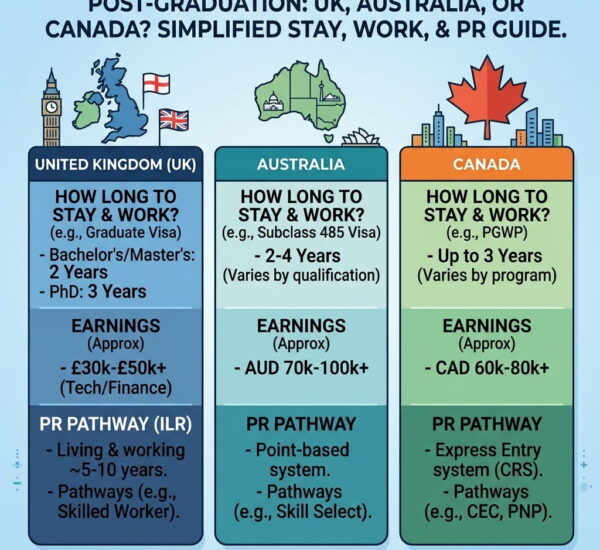
Canada — Best for Post-Study Work and Immigration Pathways Canada offers some of the strongest post-graduation work permit programs in the world, allowing international students to work in Canada for up to three years after graduation — and often providing a pathway to permanent residency. This makes Canada the top choice for students whose long-term goal includes immigration.
Japan — Best for Generous Government Scholarships Japan’s MEXT Scholarship is one of the most generous government-funded scholarship programs in the world, with monthly stipends that comfortably cover living costs even in Tokyo. Japan is ideal for students interested in technology, engineering, and a culturally rich academic environment.
Ireland — Best for English-Speaking Europe with Strong Tech Industry Ireland combines English-language instruction, EU access, and a thriving technology sector hosting European headquarters for Google, Meta, and Apple — making it excellent for students pursuing tech careers with strong local internship and employment opportunities.
UK — Best for Globally Recognized One-Year Master’s Degrees The UK’s one-year Master’s programs allow students to earn an internationally respected degree in half the time of most countries, reducing both tuition costs and time away from career progression — combined with the Graduate Route visa allowing 2 years of post-study work.
Australia — Best for High Living Stipends and Quality of Life Australia’s scholarship stipends, particularly through Australia Awards, are among the most generous in the world, and Australia consistently ranks among the top countries globally for quality of life, safety, and multicultural acceptance.
Hungary and Poland — Best Cheapest Countries to Study Abroad in Europe For students seeking the cheapest countries to study abroad while still receiving an EU-recognized degree, Hungary (through Stipendium Hungaricum) and Poland offer dramatically lower living costs than Western Europe while maintaining strong academic standards and full scholarship coverage options.
Step 2: The Complete Guide to Finding and Winning Scholarships
Once you have identified your target country, the next step is securing funding. This is where most students get stuck — not because scholarships do not exist, but because they do not know how to apply for a scholarship abroad step by step in a way that actually produces results.
How to Apply for a Scholarship Abroad — Step by Step
Step 1: Build your complete academic profile document. Before applying anywhere, compile a master document containing your GPA, standardized test scores, extracurricular activities, work experience, volunteer history, and career goals. This becomes the source document for every application you submit.
Step 2: Identify scholarships matched to your specific profile. Generic searches for “scholarships abroad” return generic, oversaturated results. Search using specific combinations: your field of study, your nationality, your target country, and your degree level together — for example, “fully funded Master’s scholarships in public health for African students in Germany 2026.”
Step 3: Create a scholarship tracking spreadsheet. Record every scholarship’s deadline, required documents, award amount, and application status. Missing a deadline because of disorganization is one of the most common and most avoidable mistakes students make.
Step 4: Write a compelling, specific Statement of Purpose for each scholarship. A statement of purpose for scholarship applications should never be generic. Research each scholarship’s specific values and mission, then explicitly connect your personal story, academic background, and future goals to what that committee is looking for.
Step 5: Secure strong letters of recommendation early. Request recommendation letters at least 6-8 weeks before your deadline, and provide your recommenders with your resume and a summary of your goals to help them write a stronger, more specific letter.
Step 6: Apply to multiple scholarships simultaneously. Apply to at least 8-12 scholarships across government programs, university-specific awards, and private foundation grants to maximize your probability of securing funding.
The 5 Best Scholarships for International Students in 2026
After researching hundreds of scholarship programs worldwide, these five stand out as the most generous, accessible, and well-administered fully funded scholarships for international students available in 2026.
1. Fulbright Foreign Student Program (USA) The world’s most prestigious international exchange scholarship, funding over 4,000 international students annually for Master’s and PhD study in the United States. Covers full tuition, living stipend, airfare, and health insurance. Open to students from over 160 countries.
2. DAAD Scholarship (Germany) Germany’s flagship scholarship program providing monthly stipends of €934 to €1,200, full health insurance, and travel allowances for Master’s and PhD students at Germany’s tuition-free public universities. One of the highest-value scholarships in the world given Germany’s minimal tuition costs.
3. Chevening Scholarship (UK) The UK government’s flagship scholarship for one-year Master’s degrees, covering full tuition with no cap, monthly living allowance, and airfare. Specifically designed to develop future global leaders, making leadership experience a critical selection criterion.
4. MEXT Scholarship (Japan) Japan’s government scholarship offering some of the highest monthly stipends of any government program globally — up to ¥148,000 per month for PhD students — plus full tuition waiver and round-trip airfare.
5. Australia Awards Scholarship (Australia) Funds students from developing partner countries with full tuition, living stipend of approximately AUD $27,000 per year, airfare, and Overseas Student Health Cover — one of the most comprehensive funding packages available anywhere in the world.
Official Scholarship Portals You Should Bookmark
To consistently find new scholarship opportunities throughout your search, bookmark these types of resources:
- Government education ministry websites of your target countries (DAAD.de for Germany, Chevening.org for UK, studyinjapan.go.jp for Japan)
- University-specific scholarship pages for every institution on your shortlist
- Embassy and cultural exchange websites in your home country, which often list bilateral scholarship agreements
- Dedicated scholarship aggregator portals that compile opportunities across countries, degree levels, and fields of study, updated regularly with new postings and deadline reminders
Using a combination of official government portals and aggregator websites ensures you do not miss opportunities that are not widely advertised through mainstream search results.
Step 3: Understanding the Financial Requirements — Bank Statements and Proof of Funds
This is the step that derails more study abroad applications than any other. Understanding student visa financial proof requirements is absolutely critical, because even students with admission offers and partial scholarships are frequently rejected at the visa stage due to insufficient or improperly formatted financial documentation.
What Is a Bank Statement for Student Visa Requirements?
A bank statement for student visa purposes is official documentation from a financial institution showing that you (or your sponsor) have sufficient funds to cover your tuition and living expenses for a defined period — typically the first year of your study program, sometimes the full program duration.
How Much Bank Balance Is Required for Student Visa Applications?
The required amount varies significantly by country:
USA: Typically requires proof of funds covering the full first year of tuition plus living expenses, often $25,000–$60,000 depending on the institution and program, as specified on your I-20 form.
UK: Requires proof of funds covering tuition for one year plus living costs — for students studying in London, this is approximately £1,334 per month for up to 9 months (£12,006 total) plus full tuition; outside London, £1,023 per month.
Canada: Requires proof of CAD $20,635 (as of 2026 guidelines) in addition to tuition fees and travel costs for the first year, demonstrating sufficient funds beyond just the first semester.
Australia: Requires proof of AUD $24,505 per year for living costs, in addition to tuition fees, demonstrating genuine financial capacity for the duration of study.
Germany: Requires proof of approximately €11,208 per year (€934/month) in a blocked account (Sperrkonto) — a unique German requirement where funds are deposited in a special account and released monthly.
Key Requirements for Your Bank Statement Documentation
- Recency: Most countries require bank statements dated within the last 28-30 days of your visa application submission
- Seasoning period: Many countries require the funds to have been in the account for a minimum period (often 28 days) before application, to prevent last-minute fund transfers that do not reflect genuine financial stability
- Official formatting: Statements must typically be on official bank letterhead, stamped and signed by a bank official, not simply printed from online banking
- Consistency: The name on the bank statement must match the visa applicant or clearly indicate the sponsor relationship through supporting documentation
Sponsor Letter for Visa Application
If you are not personally funding your studies, you will need a sponsor letter for visa application purposes. This document must include:
- The sponsor’s full name, relationship to the applicant, occupation, and income source
- A clear statement of the sponsor’s commitment to fund the student’s education and living expenses
- The sponsor’s bank statements covering the same period and seasoning requirements as a self-funded applicant
- In many countries, a notarized affidavit of support for student visa applications, which is a legal document formally declaring the sponsor’s financial responsibility
Education Loans as an Alternative Funding Source
For students without sufficient personal or family savings, an education loan for study abroad is a widely accepted form of financial proof in most visa applications. Banks in many countries offer dedicated study abroad loan products, and a loan sanction letter showing the approved amount can serve as valid proof of funds, provided it covers the required minimum threshold for your destination country.
Step 4: The Complete Required Documents Checklist for Study Abroad
Beyond financial proof, every study abroad application requires a comprehensive set of supporting documents. Missing or improperly prepared documents are among the leading causes of visa delays and rejections.
Documents Required for Study Abroad Visa Applications:
Academic Documents:
- Official transcripts from all previously attended institutions
- Degree certificates or proof of graduation
- Standardized test scores (IELTS, TOEFL, GRE, GMAT, SAT as applicable)
- Letter of acceptance/admission from your university
- Statement of Purpose (SOP)
- Letters of recommendation (typically 2-3)
Identity and Travel Documents:
- Valid passport with at least 6 months validity beyond your intended stay
- Passport-sized photographs meeting specific country requirements
- Birth certificate (required by some countries)
Financial Documents:
- Bank statements (personal or sponsor)
- Sponsor letter and affidavit of support (if applicable)
- Scholarship award letter (if applicable)
- Education loan sanction letter (if applicable)
- Tax returns of sponsor (required by several countries)
Health and Insurance Documents:
- Proof of international student health insurance
- Medical examination certificate (required by some countries including Australia, New Zealand)
- Vaccination records, particularly for countries requiring specific immunizations
Visa-Specific Documents:
- Completed visa application form
- Visa application fee payment receipt
- Biometric appointment confirmation
- Statement of intent to return to home country (for some visa categories)
- Accommodation confirmation or housing letter from university
Country-Specific Additional Documents:
- USA: Form I-20, SEVIS fee payment receipt, DS-160 confirmation
- UK: CAS (Confirmation of Acceptance for Studies) number, Immigration Health Surcharge payment receipt
- Canada: Letter of acceptance, Provincial Attestation Letter (where required), Guaranteed Investment Certificate (for SDS stream applicants)
- Germany: APS Certificate (for applicants from certain countries), blocked account confirmation
Step 5: Understanding Student Insurance Finance — Your Complete Guide
International student health insurance is both a visa requirement in most countries and a critical financial protection. Understanding student insurance finance before you arrive prevents both visa complications and potentially catastrophic medical costs.
Why Insurance Documentation Matters for Your Visa
Most study destination countries require proof of valid health insurance as part of the visa application itself — not just university enrollment. The UK requires payment of the Immigration Health Surcharge as part of the visa fee. The USA requires international students to show proof of insurance meeting university-specific minimum coverage thresholds. Schengen countries require minimum €30,000 emergency medical coverage for the visa application itself.
Budgeting for Insurance as Part of Your Total Study Abroad Finances
When calculating your total study abroad financial proof requirements, always include health insurance as a distinct line item:
- USA: $800–$2,400 per year depending on provider and coverage level
- UK: £776 per year (Immigration Health Surcharge, mandatory for visas 6+ months)
- Germany: Approximately €120/month through the statutory system (GKV)
- Australia: AUD $500–$700 per year (Overseas Student Health Cover)
- Japan: ¥1,000–¥2,000/month through National Health Insurance, plus optional supplementary coverage
Insurance and Scholarship Coordination
Many fully funded scholarships — including Fulbright, DAAD, Chevening, MEXT, and Australia Awards — include health insurance as part of the scholarship package. Always confirm exactly what your scholarship covers before purchasing additional insurance, to avoid unnecessary duplicate spending while ensuring you are not left with coverage gaps.
Step 6: Your Complete Study Abroad Timeline — Putting It All Together
Here is the complete guide to study abroad sequenced into a realistic timeline, working backward from your intended start date.
12-18 Months Before Departure:
Research and shortlist target countries and universities. Take required standardized tests (IELTS, TOEFL, GRE, GMAT). Begin building your academic profile document and identifying scholarship opportunities matched to your profile.
10-12 Months Before Departure:
Request letters of recommendation. Begin drafting your Statement of Purpose for each target program. Submit university applications. Begin researching and applying to scholarships with early deadlines.
8-10 Months Before Departure:
Continue submitting scholarship applications across multiple programs. Begin researching financial documentation requirements for your specific target country.
6-8 Months Before Departure:
Receive university admission decisions. Receive scholarship decisions. If self-funding or using a sponsor, begin organizing bank statements with the required seasoning period for your visa application.
4-6 Months Before Departure:
Begin your visa application process. Gather all required documents according to your country-specific checklist. Apply for or confirm your international student health insurance. Submit your sponsor letter and affidavit of support if applicable.
2-4 Months Before Departure:
Attend visa interview if required. Pay visa fees, Immigration Health Surcharge (UK), or SEVIS fee (USA) as applicable. Book your flights once your visa is approved. Arrange accommodation.
1-2 Months Before Departure:
Finalize your health insurance enrollment. Complete any required medical examinations. Organize your document folder for travel — physical and digital copies of every document listed in Step 4. Research banking options in your destination country.
Final Weeks Before Departure:
Confirm your arrival logistics with your university’s international student office. Pack according to your destination country’s climate and cultural norms. Notify your home bank of international travel. Save all emergency contact numbers including your university’s international student emergency line.
Common Mistakes That Derail Study Abroad Applications — And How to Avoid Them
Mistake 1: Applying for visas before securing adequate funding documentation. Always confirm your complete financial picture — scholarships, personal funds, sponsor commitments, and loans — before beginning your visa application timeline.
Mistake 2: Underestimating bank statement seasoning requirements. Many students transfer large sums into an account right before applying, not realizing that most countries require funds to be present for 28+ days before the application date.
Mistake 3: Generic Statement of Purpose documents used across multiple scholarships. Every scholarship committee can identify a generic, unpersonalized application. Customize each Statement of Purpose specifically to the scholarship’s stated values and criteria.
Mistake 4: Missing the insurance requirement entirely in financial planning. Students frequently budget for tuition and living costs while completely overlooking mandatory health insurance costs, leading to visa application gaps or financial shortfalls upon arrival.
Mistake 5: Choosing a country based only on prestige rather than total cost of attendance. A “cheaper” country with strong scholarship availability may provide a significantly better overall financial outcome than a prestigious destination with limited funding options.
Mistake 6: Not maintaining organized digital and physical copies of every document. Visa offices, universities, and scholarship committees routinely request the same documents multiple times throughout the process. A single organized folder — digital and physical — prevents unnecessary delays and stress.
Final Thoughts — Your Complete Path From Dream to Departure
Studying abroad is not a single decision — it is a sequence of decisions, documents, and deadlines that, when approached systematically, transforms an overwhelming dream into an achievable plan.
This blueprint has walked you through every essential stage: choosing the best country to study abroad for your specific goals, finding and winning fully funded scholarships, understanding exactly how much bank balance is required for your student visa, assembling your complete required documents checklist, securing the right student health insurance, and following a realistic timeline that sequences every step in the correct order.
The students who successfully study abroad are not necessarily the wealthiest or the most naturally gifted. They are the ones who approached the process with a clear plan, started early, stayed organized, and persisted through the inevitable complexity of international applications.
You now have that plan. The blueprint is complete. The next move is yours.
Start today. Choose your country. Begin your scholarship search. Your study abroad journey begins with the first step you take right now.