There’s no single “best” health insurance plan for studying abroad — the right plan depends on your visa type, your university’s specific waiver rules, and your personal health needs. This guide gives you a direct, step-by-step framework to answer the actual question you’re asking: which plan should I buy?
We’ll walk through the legal requirements tied to your visa, compare the real plans students use most (GeoBlue, IMG’s Patriot Exchange Program, ISO, Allianz Care, and WorldTrips StudentSecure), and show you exactly how to calculate the true cost of each option before you buy.
Table of Contents
Step 1: Check What Your Visa Actually Requires
Your visa type is the first filter — it determines your legal minimum, not just a recommendation.
J-1 Visa Insurance Requirements
If you’re a J-1 exchange student or scholar, health insurance is legally mandatory, with specific minimums set by the U.S. Department of State’s Exchange Visitor Program regulations:
- Medical benefits of at least $100,000 per accident or illness
- Medical evacuation coverage of at least $50,000
- Repatriation of remains coverage of at least $25,000
- A deductible no higher than $500 per accident or illness
- The insurance carrier must meet specific underwriting/rating requirements set by the State Department
If your dependents hold J-2 status, they must be covered under the same minimums.
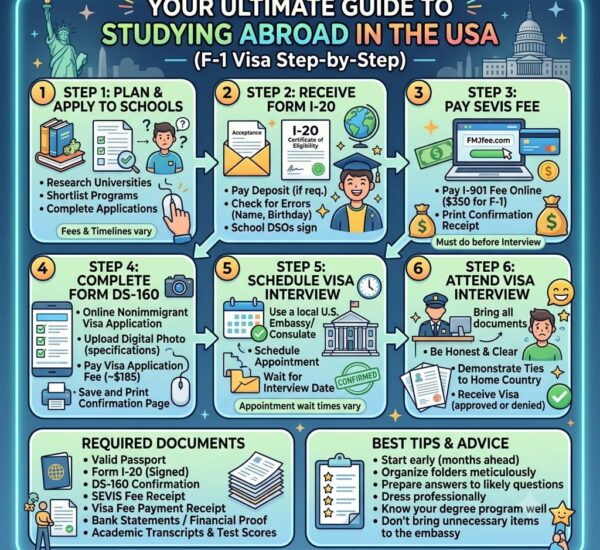
F-1 Visa Insurance Requirements
Unlike J-1, the F-1 visa itself does not carry a federal insurance mandate. However, this doesn’t mean it’s optional in practice — almost every university requires F-1 students to carry insurance meeting the school’s own waiver standards as a condition of enrollment.
What This Means for You
If you’re on a J-1 visa, your shortlist of acceptable plans is already narrowed by law. If you’re on an F-1 visa, your university’s waiver document is effectively your real rulebook — read it before comparing any plan.
Step 2: Get Your University’s Exact Waiver Requirements in Writing
Before comparing private plans, request your school’s specific waiver checklist from the international student office or bursar’s office. Common requirements include:
- Minimum coverage amount per illness/injury (often $100,000–$500,000)
- Maximum allowed deductible (often $500 or less)
- A defined network (e.g., a national PPO) with providers near campus
- Mandatory mental health benefits
- Prescription drug coverage
- Medical evacuation and repatriation minimums
Missing or misreading this checklist is the single most common reason students get their waiver rejected and end up auto-billed for the university’s own plan.
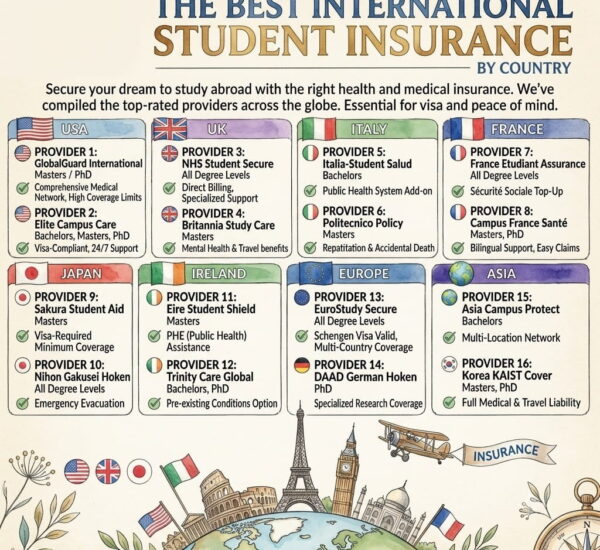
Step 3: Compare the Top International Student Insurance Plans
Here’s how the most commonly used plans actually stack up, based on publicly available 2026 plan documents.
GeoBlue Navigator (now branded Worldwide Specialty / BCBS Global Solutions)
- Underwritten by: 4 Ever Life International Limited, rated A- (“Excellent”) by A.M. Best
- Network: Blue Cross Blue Shield PPO network — one of the largest in the US
- Coverage maximum: Unlimited annual and lifetime medical maximum
- Deductible options: $0, $250, $500, $1,000, or $2,500
- F-1/J-1 compliance: Exceeds J-1 visa minimums; meets most university waiver standards at the $0, $250, and $500 deductible tiers
- Pre-existing conditions: Covered immediately with proof of prior creditable coverage
- Standout feature: No waiting period for preventive services, and coinsurance is waived entirely for care received outside the US
IMG — Patriot Exchange Program
- Built specifically for: J-1 visa compliance
- Coverage tiers: $50,000 to $5,000,000 maximum, with deductible options from $0 to $500
- Network: UnitedHealthcare PPO network
- Caution: The lowest coverage tier ($50,000 maximum) may not meet some universities’ specific waiver thresholds — always verify against your school’s exact minimum before purchasing
IMG — Student Health Advantage
- Best for: Long-term students, including PhD candidates
- Renewability: Up to 60 continuous months
- Coverage maximum: $500,000–$1,000,000
- Trade-off: Higher monthly premiums than entry-level plans, in exchange for long-term renewal flexibility
ISO Insurance (International Student Insurance)
- Underwritten by: Berkshire Hathaway Specialty Insurance Bermuda
- Position in the market: Generally the most budget-friendly, entry-level compliant option for students who need to meet minimum requirements at the lowest possible premium
WorldTrips StudentSecure
- Best for: Students studying abroad for less than a year
- F-1/J-1 compliance: Built to meet both F-1 and J-1 visa health insurance requirements
- Coverage style: Essential medical coverage and emergency services rather than the broadest possible benefit set
Allianz Care (Student/Care Plans)
- Coverage maximum: Up to $2,500,000 on core plans, with optional outpatient add-on
- Includes: Medical evacuation, oncology, inpatient and day-care treatment, rehabilitation, outpatient surgery
- Best for: Students who want a globally recognized insurer with a modular plan structure (you build up from a base plan rather than choosing a single fixed package)
- Also relevant for: Allianz Care is one of the largest approved Overseas Student Health Cover (OSHC) providers in Australia, useful if you’re comparing options across more than one study destination
Quick Comparison Table
| Plan | Best For | Coverage Maximum | F-1/J-1 Compliant | Standout Feature |
|---|---|---|---|---|
| GeoBlue Navigator (Worldwide Specialty) | Broad PPO access + unlimited coverage | Unlimited | Yes — exceeds J-1 minimums | No preventive-care waiting period |
| IMG Patriot Exchange Program | J-1 visa students specifically | $50,000–$5,000,000 | Yes (verify tier vs. school minimum) | Purpose-built for J-1 compliance |
| IMG Student Health Advantage | Long-term/PhD students | $500,000–$1,000,000 | Yes | Renewable up to 60 months |
| ISO Insurance | Budget-conscious students | Entry-level | Yes (verify against waiver) | Lowest typical premium tier |
| WorldTrips StudentSecure | Shorter programs (under 1 year) | Mid-range | Yes | Built for F-1 and J-1 alike |
| Allianz Care | Students wanting a global brand + modular coverage | Up to $2,500,000 | Yes | Strong outside-the-US/global network |
Step 4: Match Plan Features to Your Personal Situation
If You Have a Pre-Existing Condition
Check the exact waiting period and whether proof of prior continuous coverage can waive it — this varies significantly by insurer and can mean the difference between coverage starting immediately or after 6–12 months.
If You’re Bringing Dependents
Confirm whether your dependents (F-2/J-2) need to be on the same policy or a separate one, and check the per-dependent cost — this is rarely a simple multiple of the single-student premium.
If You’re Staying Long-Term (PhD, multi-year program)
Prioritize plans with long renewal periods (like IMG’s Student Health Advantage, renewable up to 60 months) over short-term plans that may require you to re-apply and re-qualify annually.
If You’re Budget-Constrained
An entry-level compliant plan (like ISO) can satisfy your legal/university requirement at the lowest premium — but check the coverage maximum and sub-limits carefully, since “cheapest” and “meets the requirement” aren’t always the same plan.
Step 5: Verify Network Access and Direct Billing
A plan is only as useful as the providers who actually accept it near your campus. Before buying:
- Confirm the plan’s network includes providers within a reasonable distance of where you live and study
- Ask whether the insurer offers direct billing with major hospitals/clinics — this means you won’t have to pay upfront and wait for reimbursement during a stressful medical situation
- If you plan to travel during breaks, check whether coverage extends outside your country of study (GeoBlue and Allianz Care, for example, both emphasize broad outside-the-US/global access)
Step 6: Calculate the True Cost — Not Just the Premium
A plan’s monthly premium is only part of the real cost. Before deciding, calculate:
True annual cost = Premium × 12 + Deductible (worst case) + Your estimated coinsurance share
A cheaper plan with a high deductible and narrow coverage maximum can cost you more out-of-pocket in a real medical event than a slightly more expensive plan with a lower deductible and broader coverage. Run this calculation for at least two or three plans before deciding, rather than comparing premiums alone.
Common Mistakes Students Make When Choosing a Plan
Mistake 1: Assuming F-1 Means Insurance Is Optional
Even though there’s no federal mandate for F-1 students, your university’s own enrollment rules almost always make it mandatory in practice.
Mistake 2: Buying the Lowest Coverage Tier Without Checking the School’s Minimum
A $50,000 maximum plan might be F-1/J-1 “compliant” in general, but still fail your specific university’s higher waiver threshold.
Mistake 3: Ignoring Sub-Limits
A plan can have a high overall maximum but still cap specific services (like surgery or a hospital stay) at a much lower amount — leaving you exposed exactly when you need coverage most.
Mistake 4: Not Checking OPT/CPT Coverage Continuity
If you plan to stay for Optional Practical Training after graduation, confirm whether your plan (or a specific OPT-extension version of it) remains valid, since many student-specific plans stop being eligible once you’re no longer enrolled in coursework.
Mistake 5: Skipping the Mental Health Benefit Check
Since this has become one of the most-used benefits among international students, confirm the number of covered sessions and any waiting period before assuming it’s included at the level you expect.
Reduce Your Overall Study Abroad Costs
Insurance is one line item in a much larger budget. Reducing your tuition burden through scholarships frees up more of your budget for stronger insurance coverage rather than the cheapest compliant option. It’s worth regularly checking an updated listing of international scholarships and funding opportunities, such as the one maintained by the Opportunity Portal, to see if you qualify for aid that lowers your overall financial burden while studying abroad.
Frequently Asked Questions (FAQs)
What type of insurance do I need for international study?
You need a plan that meets your visa’s legal minimums (mandatory for J-1; not federally mandated but usually required by your university for F-1) and your specific school’s waiver requirements — typically covering at least $100,000 per illness/injury, with a deductible of $500 or less.
What is the best health insurance for an F-1 visa student?
There’s no single best plan — GeoBlue Navigator and Allianz Care suit students wanting broad networks and high coverage maximums, ISO suits budget-conscious students needing minimum compliance, and WorldTrips StudentSecure suits shorter programs under a year.
What is the best health insurance for a J-1 visa student?
IMG’s Patriot Exchange Program was built specifically for J-1 compliance, and GeoBlue Navigator exceeds J-1 minimums by default — both are commonly used by J-1 exchange students and scholars.
How much does international student health insurance cost?
Costs typically range from roughly $50 to over $500 per month depending on the insurer, coverage maximum, and deductible chosen, with university-sponsored SHIP plans often costing more annually than comparable private plans.
Does my insurance need to cover my dependents?
If you hold a J-1 visa, your J-2 dependents must meet the same coverage minimums as you. For F-1 students with F-2 dependents, it’s not federally mandated, but it’s strongly recommended given the cost of US healthcare.
Can I keep my student insurance after I graduate on OPT?
Not always automatically. Many student-specific plans require active enrollment in coursework, so you may need a dedicated OPT-extension plan to remain covered and visa-compliant during your work authorization period.
Do these plans cover me if I travel outside the country during the semester?
It depends on the plan. GeoBlue and Allianz Care are both built around strong access outside the country of study, while some lower-cost, US-only plans may have limited or no coverage once you leave the country.
Can scholarships help offset the cost of better insurance coverage?
Yes — every dollar you receive through scholarships is a dollar you don’t need to stretch across tuition, living costs, and insurance. Resources like Opportunity Portal list current scholarship opportunities worth checking before you finalize your insurance budget.
Disclaimer: This article is for general educational and informational purposes only and does not constitute insurance, financial, or legal advice. Insurance requirements, providers, and prices change frequently and vary by university, visa category, and individual circumstances. Always verify current requirements directly with your university’s international student office and review each insurer’s official plan documents before purchasing any policy.