Here’s a fact that separates Singapore from nearly every other country in this series: its universities are English-medium by design, not as a growing exception to a mostly non-English system. That single structural point does more to answer the “without IELTS” question than any single scholarship policy could — when the entire academic system already runs in English, a prior English-medium education becomes genuinely persuasive proof, not a workaround.
The Scholarship That Skips the Question Entirely
Before getting into the MOI-letter mechanics that apply everywhere else on this list, it’s worth flagging one flagship program that sidesteps the whole issue: SINGA doesn’t ask for GRE, IELTS, TOEFL, or SAT scores at the time of application at all. It’s a joint PhD program run by A*STAR alongside NUS, NTU, SUTD, SMU, and SIT, and its own eligibility criteria simply don’t list a standardized test as a requirement — a genuinely rare structure in this entire series.
The Ten Options
1. SINGA (Singapore International Graduate Award)
Full tuition, a monthly stipend of S$2,700 rising to S$3,200 after qualifying exams, a one-time S$1,000 settling-in allowance, and up to S$1,500 in airfare, for a 4-year PhD or EngD.
🔗 a-star.edu.sg/Scholarships/for-graduate-studies/singapore-international-graduate-award-singa
Since English proficiency isn’t part of the application criteria at all, your energy is better spent on the research proposal and finding a faculty supervisor at your target institution before applying — that’s where SINGA selections are actually decided.
2. NUS Research Scholarship
Full tuition, a monthly stipend, and research funding for PhD and select Master’s candidates at the National University of Singapore.
🔗 nusgs.nus.edu.sg/scholarships
Once NUS has admitted you — with or without IELTS — the scholarship review runs on your existing admission credentials, not a separate English test, so the MOI letter question is really only relevant at the earlier admissions stage.
3. NTU Research Scholarship
Full tuition and a competitive monthly stipend for PhD candidates at Nanyang Technological University across engineering, science, business, and humanities.
🔗 ntu.edu.sg/admissions/graduate
NTU’s own admissions guidance is unusually specific about this: applicants from certain English-medium secondary systems — Indian CBSE Class 12 students, for example — are named directly as exempt from IELTS on the university’s country-specific admissions pages, not left to a vague general policy.
4. Nanyang President’s Scholarship
Full tuition, a living allowance, and enrichment funding for NTU’s most outstanding Master’s and PhD candidates.
🔗 ntu.edu.sg
Because this scholarship draws from the same admitted-student pool as standard NTU applications, whatever English documentation cleared your admission — MOI letter, PTE, or IELTS — carries straight through without a second check.
5. A*STAR Graduate Scholarship
Full tuition, a living stipend, and access to A*STAR’s research institutes for PhD students in science and engineering fields.
🔗 a-star.edu.sg/Scholarships
Structured similarly to SINGA in spirit, with selection weighted heavily toward research fit and academic record over any single standardized English score.
6. SUTD Scholarships (Singapore University of Technology and Design)
Tuition support and stipends for undergraduate, Master’s, and PhD candidates at Singapore’s design-focused technical university.
🔗 sutd.edu.sg/admissions/graduate/financial-matters
A genuinely distinctive academic model blending engineering, architecture, and design — worth checking directly for its current accepted English-proficiency documentation, since SUTD’s smaller, newer program structure sometimes updates faster than the larger universities.
7. SMU Presidential Doctoral Fellowship
Full tuition, a competitive stipend, and research support for PhD candidates at Singapore Management University, particularly in business, economics, and social science fields.
🔗 smu.edu.sg/phd
Like the NUS and NTU research scholarships above, this fellowship inherits your English-proficiency status from your existing admission rather than layering on a separate test.
8. Singapore Institute of Technology (SIT) Scholarships
Tuition support for undergraduate and postgraduate students at SIT, which specializes in applied, industry-integrated degree programs, including as a SINGA partner institution.
🔗 singaporetech.edu.sg
A practical option if your interest is in applied learning tracks rather than purely research-focused programs — SIT’s partnerships with polytechnics and industry give it a genuinely different flavor from NUS or NTU.
9. ASEAN Undergraduate Scholarship
Full tuition, accommodation, and a living allowance for undergraduate students from ASEAN member countries at NUS and NTU.
🔗 nus.edu.sg/oam/scholarships
Because most ASEAN countries’ upper-secondary systems already teach substantially in English or offer international curricula, MOI letters are a genuinely common route for this scholarship’s applicant pool specifically.
10. MOE Tuition Grant Scheme
Not a scholarship in the traditional sense, but a significant tuition subsidy from Singapore’s Ministry of Education available to international students at NUS, NTU, SMU, SUTD, and SIT, in exchange for a post-graduation work commitment in Singapore or with a Singapore-based company.
🔗 moe.gov.sg
Worth understanding as a genuinely different mechanism from every other entry on this list — it reduces your tuition bill substantially rather than covering it in full, and it comes with a bonded service obligation you should read carefully before accepting.
The Practical Test-Choice Tip Worth Knowing
If your MOI claim gets challenged, or you simply don’t qualify for an exemption, PTE Academic is worth genuine consideration over IELTS specifically because of its retake speed — results typically arrive in 24 to 48 hours, and you can resit the very next day if needed, compared to IELTS’s roughly 25-day gap between attempts. When you’re working against a tight Singapore application window, that difference alone can matter more than a marginal score preference.
Timing and What Scholarships Don’t Cover
SINGA’s application deadline typically falls around December 1 for the following year’s intake. University-level research scholarships (NUS, NTU, SMU) generally follow each program’s own admissions calendar, often in the October to March window for August intake the following year.
Whichever route applies to you, budget for what most of these don’t fully absorb: Singapore’s Student Pass financial-proof requirement, mandatory health insurance, and Singapore’s genuinely high cost of living relative to many other countries in this series. A service like Wise is worth using to move remaining funds without a heavy bank markup.
Two Questions Worth Settling
Does Singapore’s Student Pass process check my English separately?
No. Your university has already assessed your language proficiency as part of admission — the Immigration & Checkpoints Authority’s Student Pass process focuses on your acceptance letter, financial documentation, and sponsorship.
If my university rejects my MOI letter, what should I do?
Ask the admissions office in writing exactly which specific document format they require — some departments will accept a notarized statutory declaration alongside your school’s letter if the original format doesn’t meet their exact criteria, rather than requiring you to sit a fresh test outright.
Before You Apply
- Check whether your specific secondary or undergraduate system is named directly on your target university’s country-specific admissions page as MOI-exempt
- Request your MOI letter from your previous school’s registrar well in advance — some universities take two to four weeks to process these
- Contact a potential faculty supervisor before applying to SINGA or any research scholarship — this matters more to your outcome than which English test you took
- Consider PTE Academic over IELTS specifically if you’re working against a tight application deadline and might need a fast retake
- Read the MOE Tuition Grant Scheme’s post-graduation service obligation carefully before accepting it as your funding route
- Re-verify every scholarship’s current deadline and English-proficiency policy directly on the official link before applying
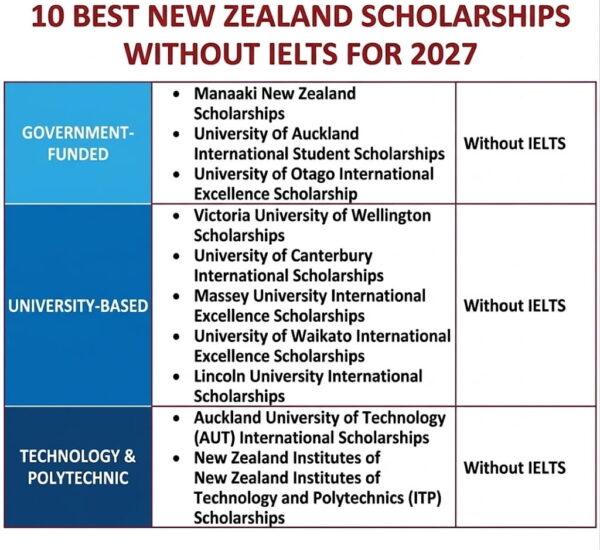
- 10 Best New Zealand Scholarships Without IELTS for 2027 (Fully Funded)
- 10 Best Singapore Scholarships Without IELTS for 2027 (Fully Funded)
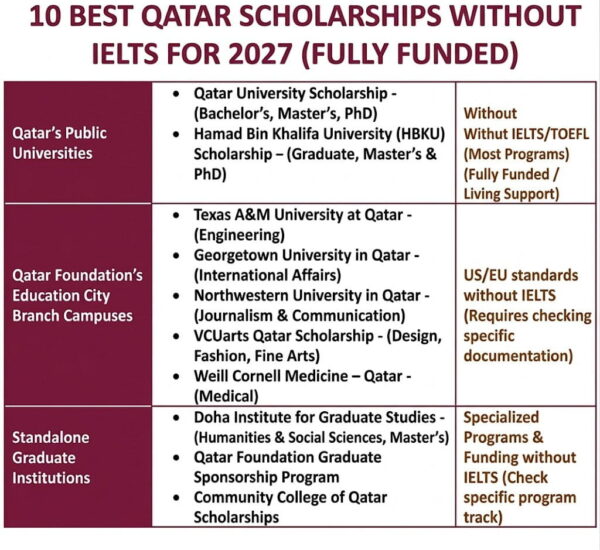
- 10 Best Qatar Scholarships Without IELTS for 2027 (Fully Funded)
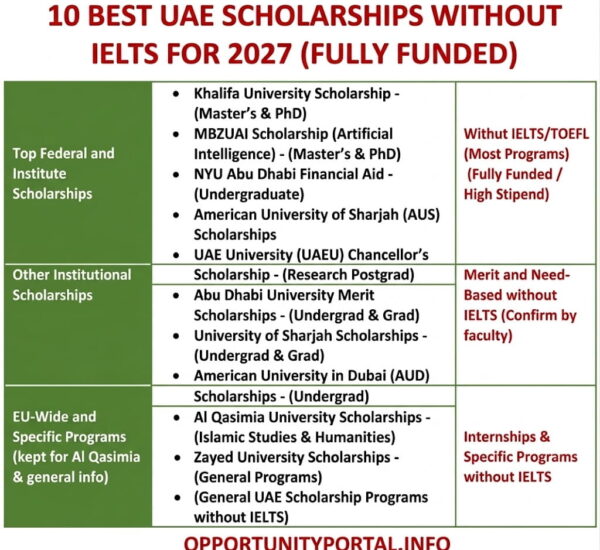
- 10 Best UAE Scholarships Without IELTS for 2027 (Fully Funded)
- 10 Best Switzerland Scholarships Without IELTS for 2027 (Fully Funded)