Every year, hundreds of thousands of international students dream of studying at an American university — Harvard, MIT, Stanford, UCLA, NYU, or any of the thousands of world-class institutions that make the United States the world’s most sought-after study destination. And every year, a significant number of those students are either denied their visa, delay their application until it is too late, or submit incomplete documentation that causes unnecessary complications.
This guide exists to make sure that does not happen to you.
The USA F-1 Student Visa is the official visa category for international students studying full-time at accredited US academic institutions. It is one of the most commonly issued non-immigrant visas in the world — but it is also one of the most carefully scrutinized, with officers evaluating not just whether you are a genuine student, but whether you have sufficient financial support, strong ties to your home country, and a clear academic purpose.
In this complete, step-by-step guide, you will learn exactly:
- How to plan and apply to US schools as a first step
- How to receive and verify your Form I-20
- How to pay the SEVIS fee correctly
- How to complete Form DS-160 without errors
- How to schedule your visa interview
- How to attend and succeed at your F-1 visa interview
- What documents you must bring — and which ones most students forget
- How to set up your bank account and demonstrate financial proof
- What student health insurance you need and why it matters
- The best tips and strategies that visa officers themselves say make the difference
This is the most complete F-1 visa guide available. Read it from start to finish. Your American education journey begins here.
Table of Contents
Understanding the F-1 Student Visa — What It Is and Who Needs It
The F-1 visa is the most common US student visa category, issued to international students pursuing full-time academic study at a US college, university, seminary, conservatory, academic high school, elementary school, or language training program. It is a non-immigrant visa — meaning it does not grant permanent residency — but it provides you the legal authorization to live and study in the United States for the full duration of your program plus a grace period.
Who needs an F-1 visa:
- Any international student enrolled full-time at a US Designated Learning Institution
- Students whose program exceeds 18 hours of English language training per week
- Students studying at the undergraduate, graduate, or postgraduate level at a US accredited institution
Who does NOT need an F-1 visa:
- US citizens and lawful permanent residents (green card holders)
- Citizens of countries with Visa Waiver Program (VWP) eligibility studying for less than 18 hours per week (though they need ESTA authorization)
- Certain diplomatic and government officials (who use different visa categories)
The F-1 visa versus other student visa types:
- F-1 visa: Full-time academic study at an accredited institution (most common)
- M-1 visa: Vocational or non-academic programs
- J-1 visa: Exchange visitor programs, including some academic exchanges
If you are a regular international student applying to a US university for a degree program, the F-1 visa is what you need.
The Complete F-1 Visa Timeline — How Long Does the Entire Process Take?
Before diving into the steps, it is critical to understand the timeline involved. One of the most common reasons international students miss their program start date is underestimating how long the F-1 visa process takes from beginning to end.
Recommended total timeline: Start 12–18 months before your intended program start date
| Stage | Recommended Timing |
|---|---|
| Research universities and programs | 18–24 months before start |
| Take TOEFL/IELTS and GRE/SAT | 12–18 months before start |
| Submit university applications | 10–12 months before start |
| Receive admission decision and I-20 | 6–9 months before start |
| Pay SEVIS fee | At least 3 business days before DS-160 |
| Complete DS-160 form | 4–6 months before start |
| Schedule visa interview | As soon as DS-160 is submitted |
| Attend visa interview | 2–4 months before start |
| Receive visa decision | 1–3 weeks after interview |
| Book travel to USA | 1–2 months before start |
| Arrive in USA (earliest allowed) | 30 days before program start |
The most common mistake: Students receive their I-20 and assume there is plenty of time, then discover that visa interview appointments in their country are booked 2–3 months in advance during peak season (May–August). Start scheduling the moment your I-20 arrives.
STEP 1: Plan and Apply to US Universities
The F-1 visa process begins not at the embassy but at the university — your admission to a US institution is the trigger for everything that follows.
Research US Universities Thoroughly
Not every university in the United States is eligible to issue F-1 visas. Only Student and Exchange Visitor Program (SEVP)-certified schools can issue Form I-20, which is the foundational document of the entire F-1 visa process. The vast majority of accredited US universities and colleges are SEVP-certified — verify certification at the official SEVP school search tool at studyinthestates.dhs.gov.
How to choose the right university:
Research program quality in your specific field rather than relying solely on overall university rankings. A school ranked #50 overall might be ranked #8 in your specific discipline. Review each school’s financial aid and scholarship availability for international students — not all US schools offer aid to non-US citizens. Consider location (urban vs suburban, coast vs interior) and cost of living — New York and San Francisco cost dramatically more than universities in smaller cities.
Build a balanced application list of 8–12 schools: 2–3 reach schools, 4–5 match schools, and 2–3 safety schools.
Complete Your Applications
Most US undergraduate applications go through the Common Application (commonapp.org) or Coalition Application. Graduate applications are submitted through each university’s individual portal.
Application documents typically required:
- Academic transcripts from all previous institutions
- English proficiency scores (TOEFL iBT or IELTS Academic)
- SAT/ACT (undergraduate) or GRE/GMAT (graduate) scores
- Statement of Purpose or Personal Essay
- Letters of Recommendation (2–3 depending on program)
- CV or Resume (graduate applications)
- Application fee ($60–$100 per university)
Application fee management tip: Many US universities offer application fee waivers for students demonstrating financial need. Research this on each university’s financial aid page before paying — applying to 10 universities can cost $600–$1,000 in fees alone if you do not use waivers where available.
Important Note on Fees and Timelines
Application fees and decision timelines vary significantly by institution and program. Early Decision (ED) deadlines are typically November 1–15, Regular Decision deadlines are January 1–February 1 for most undergraduate programs, and graduate program deadlines range from December 1 to February depending on the department. Apply to your target schools as early as possible — earlier applications consistently receive stronger scholarship consideration at most US universities.
STEP 2: Receive and Verify Your Form I-20
Once you are admitted to a US university and meet any required deposit or enrollment confirmation requirements, your Designated School Official (DSO) will issue your Form I-20 (Certificate of Eligibility for Nonimmigrant Student Status) — the single most important document in the entire F-1 visa process.
What Is Form I-20?
Form I-20 is an official US government form issued by your university’s DSO that certifies you as an eligible non-immigrant student. It contains:
- Your name, date of birth, and country of birth
- Your SEVIS ID number (beginning with N)
- Your university name and address
- Your program of study, degree level, and program start date
- Your program end date (your expected graduation date)
- The financial information your university certified for your visa application
What To Do When Your I-20 Arrives
Check every detail with extreme care before doing anything else. Errors on your I-20 — even minor ones — can cause significant problems at the visa interview or at the US border. Verify:
- ✅ Your full legal name exactly matches your passport (including middle names)
- ✅ Your date of birth is correct
- ✅ Your country of birth is correct
- ✅ Your program start date is correct
- ✅ Your program name and degree level are correct
- ✅ The financial information accurately reflects your funding source
- ✅ Your DSO’s signature is present
If any detail is incorrect: Contact your university’s international student office immediately and request a corrected I-20 before proceeding with any other step. Do not submit a visa application with an I-20 containing errors — it will cause delays or denial.
Pay Your Enrollment Deposit If Required
Some universities require payment of an enrollment deposit (typically $500–$1,500) before they issue your I-20. This deposit confirms your intention to enroll and secures your place in the program. Most universities accept international wire transfers, credit cards, or payment through platforms like Flywire or TransferMate for this deposit.
STEP 3: Pay the SEVIS Fee — I-901 Fee ($350 for F-1 Students)
The SEVIS fee (Student and Exchange Visitor Information System fee) is a mandatory US government fee that must be paid before you can attend your visa interview. For F-1 students, this fee is currently $350 USD and is paid through the official government payment portal at FMJfee.com.
How to Pay the SEVIS Fee — Step by Step
Step 1: Go to fmjfee.com (the only official government website for this payment — beware of fake websites with similar addresses)
Step 2: Click “Pay I-901 Student/Exchange Visitor Fee”
Step 3: Enter your SEVIS ID number (the N-number on your I-20), your name exactly as it appears on your I-20, your date of birth, your country of birth, and your I-20 issue date
Step 4: Select your payment method. You can pay by:
- Credit or debit card (Visa, Mastercard, American Express)
- Western Union Quick Pay
- Foreign national bank transfer (from select countries)
Step 5: Submit payment and immediately print and save your I-901 payment confirmation receipt. This receipt is required at your visa interview and at the US port of entry. Do not lose it.
Critical SEVIS Fee Rules:
- Pay at least 3 business days before your visa interview — the payment takes time to process and must appear in the SEVIS system before your interview
- Keep your payment receipt permanently — you may need it at the US border, upon transferring to a new school, or if your visa needs to be reissued
- The SEVIS fee is non-refundable — if your visa is denied, you will need to pay a new SEVIS fee for your next application in most cases
- Pay only at fmjfee.com — many scam websites charge higher fees for the same service
STEP 4: Complete Form DS-160 — Online Nonimmigrant Visa Application
Form DS-160 is the official US online nonimmigrant visa application form, completed through the Consular Electronic Application Center (CEAC) at ceac.state.gov. It collects comprehensive biographical, professional, travel, and background information that the consular officer will review before and during your visa interview.
How to Complete the DS-160 Form — Step by Step
Step 1: Access the form Go to ceac.state.gov and select your country/post from the dropdown menu. Select the US Embassy or Consulate where you intend to apply. Create your application.
Step 2: Save your application ID immediately The DS-160 generates a unique Application ID number. Save this number immediately — if your session times out or your browser closes, you need this ID to retrieve your application.
Step 3: Complete all sections accurately
The DS-160 contains approximately 40 sections covering:
Personal Information: Full legal name exactly as in your passport, date and place of birth, nationality, national identification number
Contact Information: Current address, telephone numbers, and email address. Use your most frequently checked email — consulate communications about your visa may arrive here.
Passport Information: Your passport number, issuance date, expiration date, and issuing authority — copy exactly from your passport, including any hyphens or spaces
Travel Information: Your intended date of arrival in the US, your intended length of stay, and the address where you will initially be staying in the US (your university’s address or dormitory address is acceptable)
US Contact: Name and contact information of your university’s international student office or your academic supervisor
Family Information: Marital status, parents’ names and dates of birth, and information about any immediate family members who are US citizens or permanent residents
Work/Education/Training: Your current and previous education, employment history, and any military or government service
Security and Background: A series of yes/no questions about criminal history, visa violations, immigration violations, and security-related matters. Answer all questions truthfully. Misrepresentation on the DS-160 is a serious criminal offense that can result in permanent visa ineligibility.
Step 4: Upload your digital photo Your photo must meet strict US visa photo specifications:
- Square format, minimum 600×600 pixels
- Taken within the last 6 months
- White or off-white plain background
- Full face, front view, eyes open and looking directly at camera
- Neutral expression, mouth closed
- No glasses (since 2016, glasses are no longer permitted in US visa photos)
- No head covering (except for religious reasons)
Step 5: Review everything carefully before submitting Once submitted, the DS-160 cannot be edited. Review every field carefully before clicking submit.
Step 6: Pay the visa application fee The non-immigrant visa application fee (MRV fee) is currently approximately $185 USD for F-1 student visas. Payment is made through your Embassy’s designated payment system — methods vary by country but typically include local bank transfer, online payment through the Embassy’s system, or payment at designated bank branches.
Step 7: Save and print your DS-160 confirmation page After submitting, you receive a confirmation barcode page. Print this immediately and bring it to your visa interview. The barcode must be scannable — do not fold or crease the page through the barcode area.
DS-160 Common Mistakes to Avoid:
Name spelling errors: Your name must match your passport exactly. If your passport uses a format that differs from common usage (middle names as first names, hyphenated surnames), use the exact passport format.
Travel date inconsistency: Your intended travel date should be consistent with your I-20 program start date and the earliest you are authorized to enter the USA (30 days before program start).
Employer contact information: If you listed employment, the contact information must be real and verifiable. Consular officers may verify information.
Security question misunderstanding: Many applicants are confused by security questions and either answer incorrectly or fail to explain context where needed. If you have any concerns about security questions, consult with an immigration attorney before submitting.
STEP 5: Schedule Your F-1 Visa Interview
After completing your DS-160 and paying the visa application fee, you can schedule your F-1 visa interview at your nearest US Embassy or Consulate.
How to Schedule Your F-1 Visa Interview
Step 1: Create your account on the US Embassy scheduling system Each country has its own US Embassy visa appointment scheduling system. Find the correct system for your country through the US Embassy website for your country (all accessible through usembassy.gov — select your country).
Step 2: Enter your required information You will need:
- Your passport number
- Your DS-160 confirmation barcode number
- Your visa application fee payment receipt number
- Your SEVIS ID (N-number from your I-20)
Step 3: Select your interview date and time Choose the earliest available appointment date that gives you sufficient time before your program start date. Build in buffer time in case of administrative processing delays — aim for your interview at least 8–10 weeks before your intended travel date.
Step 4: Confirm and save your appointment confirmation Save your appointment confirmation number and print your appointment confirmation page — you will need it to enter the Embassy grounds on interview day.
Interview Wait Times — A Critical Warning
In peak seasons (May through August, when most September-enrollment students are applying), visa interview appointment slots at popular US embassies fill up weeks or even months in advance. In some high-volume countries, wait times for interview appointments can extend to 90–120 days or more during peak period.
This is why starting early is not just advice — it is a survival requirement. Schedule your interview the day your DS-160 confirmation is generated. Every day you wait is a day closer to missing your program start.
Emergency appointment options: If your program start date is imminent and you cannot get a regular appointment in time, most US Embassies offer an emergency/expedited appointment request process for students with documented imminent academic deadlines. Check the emergency appointment option on your Embassy’s scheduling system.
STEP 6: Attend Your F-1 Visa Interview — Complete Preparation Guide
The visa interview is the final and most critical step of the entire F-1 visa process. Unlike other countries where visa applications are purely documentary, the US F-1 visa requires a face-to-face interview with a consular officer — and the officer’s assessment of you as a genuine student intending to return home is the deciding factor in your visa outcome.
The Documents You Must Bring to Your F-1 Visa Interview
Organize your documents in a clean folder or binder, separated by tabs. Bring every document listed below — and originals where available:
Primary Required Documents:
- ✅ Valid passport — must have at least 6 months validity beyond your intended stay in the US. If your passport expires before your program ends, renew it before your interview.
- ✅ Form I-20 — signed by both you and your university’s DSO. The student signature must be in ink, not digital.
- ✅ DS-160 confirmation page — with scannable barcode
- ✅ SEVIS fee payment receipt (I-901 confirmation) — printed from fmjfee.com
- ✅ Visa application fee payment receipt — proving you paid the MRV fee
- ✅ Visa interview appointment confirmation — showing your scheduled appointment
Academic Documents:
- ✅ University acceptance letter (from your admissions office)
- ✅ Academic transcripts from all previously attended institutions (translated into English if not originally in English)
- ✅ English proficiency test scores (TOEFL iBT or IELTS Academic)
- ✅ Standardized test scores (GRE, GMAT, SAT, or ACT as applicable)
- ✅ Degree certificates or diplomas from previously completed programs
Financial Documents (Most Critically Scrutinized):
- ✅ Bank statements from the past 3–6 months (personal account, sponsor’s account, or both)
- ✅ Scholarship award letter(s) — if you have a scholarship, this is your most powerful financial document
- ✅ Financial affidavit (if being sponsored by a family member or other sponsor)
- ✅ Sponsor’s employment verification letter and pay stubs (if applicable)
- ✅ Tax returns of sponsor for the past 1–2 years (in some cases)
- ✅ Education loan sanction letter (if using a student loan to fund your studies)
Ties to Home Country Documents:
- ✅ Evidence of family ties (family registration documents, spouse/children documents if applicable)
- ✅ Evidence of property ownership or financial assets in home country
- ✅ Proof of employment or career plans in home country (job offer letter, employer letter, business registration)
- ✅ Proof of academic or professional commitments that require return home after studies
Optional but Helpful:
- ✅ Scholarship or research correspondence with US professors
- ✅ Conference acceptances or professional organization memberships demonstrating academic engagement
- ✅ University housing confirmation or dormitory acceptance letter
The Financial Proof Requirement — How Much Bank Balance Is Required for F-1 Visa?
This is the question most asked by F-1 visa applicants — and the one with the most nuanced answer.
There is no single fixed minimum bank balance amount for the F-1 visa. Instead, consular officers evaluate whether your financial documentation demonstrates sufficient funds to cover your first year (at minimum) of tuition plus living expenses as stated on your I-20.
How to calculate the required financial proof amount:
Your I-20 contains a “Estimated Average Costs” section showing your university’s certified estimate of:
- Tuition and fees
- Living expenses
- Books and supplies
- Transportation
- Personal expenses
- Health insurance (in most cases)
Your financial documentation must show enough available funds to cover this total. For most US universities, this ranges from $25,000 to $85,000 for the first academic year depending on the institution, program, and location.
Bank statement requirements:
- Statements must be official (on bank letterhead with bank stamp and signature)
- Must be dated within the last 28–30 days of your visa application or interview date
- Must show account holder name, account number, and transaction history
- Funds must have been in the account for a reasonable period — a sudden large deposit the week before your interview raises red flags. Ideally, funds should show consistent presence for 3–6 months.
If you have a scholarship: A scholarship award letter covering full or partial costs is the single most powerful financial document you can bring to an F-1 visa interview. A Fulbright letter, a university fellowship letter, or any other official scholarship documentation significantly strengthens your financial case and reduces the amount of personal/family bank balance the officer will expect to see.
Banking Setup — Why Your Bank Account Matters Before, During, and After the Visa Process
Your bank account is relevant to the F-1 visa process in two distinct ways: as documentation for your visa application, and as the financial infrastructure you need the moment you land in the USA.
For visa documentation purposes:
International bank statements — particularly from countries where banking records may be inconsistent or where accounts are held in multiple currencies — can be complex to present. Here are the best practices:
Present a clean, consolidated financial picture. If your funds are spread across multiple accounts, consider consolidating the most relevant balance into a primary account at least 3 months before your visa application. A single account with a clear, substantial balance is more compelling than six accounts each with small amounts.
Translate and notarize non-English statements. If your bank statements are not in English, have them officially translated and notarized before your interview.
Match your financial documents to your I-20. If your I-20 shows a specific sponsor name (such as a parent), the financial documents must be in that person’s name with supporting documentation showing their relationship to you.
For your financial life in the USA after arrival:
Open a US bank account as early as possible after arriving in the USA. The best options for newly arrived F-1 students:
Wise (Best Pre-Arrival Option) Open before you leave home. Provides a real US bank account number and routing number usable from day one in the USA. No SSN required. No US address required. Excellent exchange rates for converting money from home. 👉 Official Website: wise.com
Chase Bank — Best Traditional US Bank for International Students Chase accepts F-1 students with passport and I-20 for account opening without an SSN at many branches. Widely available near major US university campuses. 👉 Official Website: chase.com
Bank of America — Student Checking Account Student checking with no monthly fee for qualifying students. Available at most major US university towns. 👉 Official Website: bankofamerica.com
Citibank — Best for International Connectivity Citibank’s global network makes it easiest for students who will regularly receive transfers from family in countries where Citi has a presence. 👉 Official Website: citibank.com
Critical banking action items for F-1 students:
- Provide your new US bank account details to your scholarship or financial aid office immediately — stipend delays are often caused simply by missing account information
- Set up Zelle through your US bank immediately — used universally in the USA for instant bank-to-bank transfers for rent, bills, and shared expenses
- Apply for a secured student credit card 3–6 months after arrival to begin building your US credit history
Student Health Insurance for F-1 Visa Holders — Mandatory and Critical
Health insurance for F-1 students in the USA is not optional — it is both a practical necessity and in many cases a visa or enrollment requirement.
The US healthcare system is the most expensive in the world. A single emergency room visit costs $3,000–$30,000 without insurance. Surgery can cost $20,000–$100,000+. A week-long hospitalization can exceed $50,000. Without insurance, one medical emergency can generate a debt that takes years to repay.
Most US universities mandate health insurance enrollment for all enrolled students — including international students. The university health insurance premium is typically included in your cost of attendance (the figure on your I-20) and can be covered by financial aid or scholarships if your award covers the full cost of attendance.
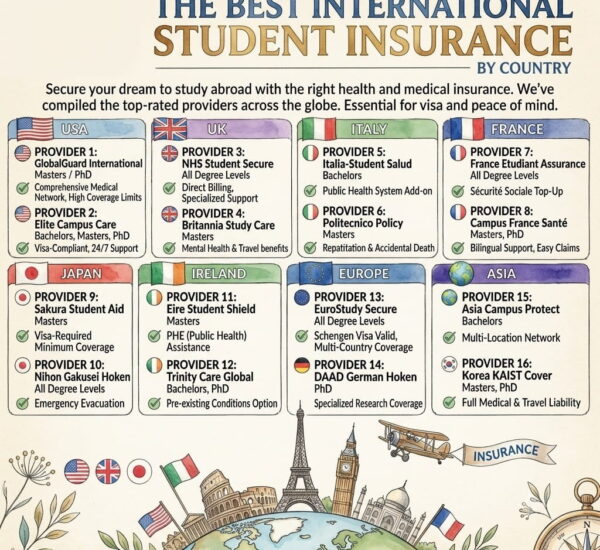
Best student health insurance options for F-1 visa holders:
ISO Student Health Insurance — Most Widely Used for F-1 Students ISO (International Student Organization) is one of the most widely recognized and accepted international student health insurance providers in the USA. Plans are specifically designed to meet US university health insurance waiver requirements. 👉 Official Website: isoa.org
IMG Global International Student Insurance Comprehensive coverage with high annual limits suitable for the US healthcare environment. Accepted as a waiver plan at many US universities. 👉 Official Website: imglobal.com
Cigna Global Student Health Insurance Strong network, telemedicine access, mental health coverage, and prescription drug benefits. Particularly good for students at universities with Cigna-networked campus health centers. 👉 Official Website: cigna.com
AXA Student Health Insurance Comprehensive student plan with flexible deductible options and strong emergency evacuation benefits. 👉 Official Website: axaassistance.us.com
Key insurance terms every F-1 student must understand:
- Deductible: The amount you pay out of pocket before insurance starts covering costs. Choose $250–$500 annual deductible for the best balance between premium cost and coverage access.
- Copayment: Your fixed share of each covered medical service (typically $15–$40 per GP visit).
- Premium: Your monthly insurance fee — typically $100–$250 per month for comprehensive student coverage.
- Out-of-pocket maximum: The most you will ever pay in a single year — your insurance covers 100% of costs beyond this amount.
- In-network providers: Doctors and hospitals that have contracted rates with your insurance. Always use in-network providers to minimize your costs.
- Pre-authorization: Some procedures require advance approval from your insurance provider before they are covered. Know your plan’s pre-authorization requirements.
Mental health coverage: US mental health parity laws require all insurance plans to cover mental health services at the same level as physical health services. Given the academic pressure and cultural adjustment challenges many international students face, mental health counseling and therapy coverage is critically important. Use this benefit without hesitation if you need it — your campus counseling center accepts all enrolled students regardless of insurance status.
What Happens at the F-1 Visa Interview — A Complete Walkthrough
Arriving at the Embassy:
Arrive at least 15–20 minutes before your scheduled appointment time. US Embassies have strict security — you will go through airport-style security screening before entering. Leave all electronics (including smartphones) outside or in a secure locker at the Embassy — most Embassies do not permit personal electronic devices inside the interview area.
Dress professionally and conservatively. While there is no absolute dress code, consular officers are forming an overall impression of you as a credible, serious student. Business casual or formal dress signals professionalism. Avoid overly casual clothing, visible logos, or anything that draws unnecessary attention.
The security and document verification process:
Your documents will be checked at several stages before reaching the consular officer. Staff will verify your appointment confirmation, check your passport, scan your DS-160 barcode, and review your SEVIS fee receipt. They may take your fingerprints (biometric collection) before you reach the officer’s window.
The interview itself:
F-1 visa interviews are typically brief — between 2 and 10 minutes. The consular officer is not trying to catch you out or find reasons to deny you. They are evaluating two specific questions:
- Are you a genuine student with a clear academic purpose and the financial means to complete your program?
- Do you have sufficient ties to your home country to ensure you will return after completing your studies?
Everything you say and every document you present should be oriented toward convincingly answering both of these questions.
The Most Common F-1 Visa Interview Questions — And How to Answer Each
“Why do you want to study in the United States?”
This is the most fundamental question and the most important to answer specifically. Do not say “because the USA has good universities” — that is too generic. Be specific: name your program, your target university, specific research resources or faculty at that university that are relevant to your goals, and why those resources are only available at a US institution rather than in your home country.
Strong answer example: “I have been accepted to [University Name]’s [Program Name] program. Professor [Name]’s research on [specific topic] directly aligns with my thesis work on [your specific topic], and their lab is one of only three in the world with access to [specific equipment or dataset]. I cannot pursue this specific research direction at home because…”
“Why did you choose this specific university?”
Again, be specific. Reference something real and specific about the university — a specific faculty member, a specific research center, a specific program component — that demonstrates genuine research rather than a generic choice. Officers can immediately distinguish students who have genuinely researched their university from those who simply applied to any school that accepted them.
“Who is paying for your education?”
Be clear, direct, and consistent with your financial documentation. If you are personally funded: “I have personal savings of $[amount] and my family is supporting me — I have brought bank statements showing $[amount] available.” If you have a scholarship: “I have been awarded the [Scholarship Name], which covers [what it covers]. I have brought my scholarship award letter.” If using a combination: explain each source clearly.
“What will you do after you finish your degree?”
This is the ties-to-home-country question — the officer wants to know you have a reason to return home. Be specific about professional plans in your home country. Reference a job offer if you have one, a family business you plan to return to, a career path that specifically requires or benefits from returning home, or professional opportunities in your field that are best pursued in your home country.
“Do you have family in the United States?”
Answer truthfully. If you have family in the US, the officer may probe this more carefully to ensure you are not using a student visa as a pretext for immigration. If you have US family members, emphasize your ties to your home country and your specific academic goals even more strongly.
“What is your program about? What will you study?”
Know your program. Know your field. Know why you chose it and what you plan to do with it. Consular officers occasionally ask detailed academic questions — not to trick you, but to confirm you genuinely understand what you are applying to study. If you cannot explain your own program, it raises doubt about whether you are a genuine student.
“Have you visited the US before? Do you have any family members who have overstayed a US visa?”
Answer truthfully. If you or any family member has a visa violation history, disclose it honestly and be prepared to explain the circumstances. Attempting to conceal visa violations is significantly worse than the violation itself — consular databases are extensive and misrepresentation is a permanent bar to future visa issuance.
How to Demonstrate Ties to Your Home Country — The Most Critical Factor
Demonstrating ties to your home country — evidence that you have compelling reasons to return home after completing your studies — is the single most important factor in F-1 visa decisions for students from countries with historically high non-immigrant visa overstay rates.
The concept of “immigrant intent” is central to all US non-immigrant visa categories: the officer must be convinced that you do not intend to immigrate permanently to the United States using your student visa as the entry point.
Strongest types of home country ties:
Family ties: Immediate family members (spouse, children, parents) remaining in your home country are powerful evidence that you have personal reasons to return. Bring documentation — marriage certificate, children’s birth certificates, or family registration documents.
Property and financial assets: Ownership of property, a business, or significant financial assets in your home country demonstrates economic roots that require your return. Bring property deed documents or business registration certificates.
Employment offer or job commitment: A letter from a home country employer confirming that you have a position to return to after your studies is among the most compelling single documents you can bring.
Professional licensure or registration: Being registered with a professional body in your home country (medical license, engineering board, bar association) and having a license that requires home country-based practice creates a professional incentive to return.
Academic commitment: If you are a mid-career student who has taken a leave of absence from a job to study abroad, a letter from your employer confirming your leave and your position upon return is very valuable.
What weakens your ties to home country:
- Applying for immigrant visas while your student visa application is pending
- Having immediate family members who have overstayed US visas
- Having previously overstayed any US visa yourself
- Having no clear career or professional plans that require returning home
After the Interview — What Happens Next?
If Your Visa Is Approved
After a successful interview, your passport is typically retained by the Embassy for visa printing. The F-1 visa stamp is usually printed within 3–5 working days and your passport is returned to you by courier or available for collection depending on your Embassy’s process.
Examine your visa stamp carefully when you receive your passport:
- Confirm your name is spelled correctly
- Confirm the visa classification (should be F-1)
- Note the visa start date and expiry date
- Note the number of entries allowed (F-1 visas are typically issued as multiple-entry)
The expiry date on your F-1 visa stamp is NOT your authorized period of stay. Your authorized period of stay is listed as “D/S” (Duration of Status) on your I-94 record — meaning you are authorized to remain in the USA for the full duration of your program as listed on your I-20, plus a 60-day grace period after completion.
If Your Visa Is Denied
F-1 visa denials are more common than many students realize — and understanding why they happen is the first step toward a successful reapplication.
Most common reasons for F-1 visa denial:
Section 214(b) denial — Failure to overcome immigrant intent presumption: The most common denial reason. The officer was not convinced you have sufficient ties to your home country to ensure your return. Address this in reapplication by bringing stronger documentation of home country ties.
Insufficient financial documentation: Your financial proof did not cover the full cost of attendance or appeared inconsistent or suspicious. Bring cleaner, more consolidated financial documentation in your reapplication.
Program not aligned with academic background: The officer questioned why you are pursuing this particular program given your previous education — prepare a more compelling explanation of your academic trajectory.
Incomplete or inconsistent documentation: Your documents contained errors, inconsistencies with each other, or were incomplete. Prepare a more thorough document package for reapplication.
Can you reapply after denial? Yes. There is no mandatory waiting period after an F-1 denial, though most advisors recommend waiting at least 3–6 months and addressing the specific denial reason before reapplying. When reapplying, you must complete a new DS-160, pay the MRV fee again, and schedule a new interview.
If Your Application Is in Administrative Processing (221(g))
Sometimes, rather than approving or denying your visa at the interview, the officer places your application in administrative processing (indicated by a yellow or white form 221(g)). This means additional background checks or documentation review is required before a decision can be made.
Administrative processing can take anywhere from a few days to several months. There is nothing you can do to expedite this process beyond providing any additional documents the Embassy specifically requests. Contact your university’s DSO immediately if administrative processing delays your program start — most universities have procedures for deferring enrollment for students with pending visa administrative processing.
BEST TIPS AND ADVICE — What Visa Officers Say Makes the Difference
These are the most impactful practical tips for every F-1 visa applicant:
Tip 1: Start Early — Earlier Than You Think You Need To
If you think you need 4 months, start 6 months early. Visa interview appointment slots fill up faster than most students anticipate, administrative processing happens unpredictably, and document problems always take longer to fix than expected. Start everything earlier than feels necessary.
Tip 2: Organize Your Documents Meticulously
Present your documents in a clean, organized folder with dividers separating academic documents, financial documents, and personal documents. A well-organized document presentation signals professionalism and preparation — qualities the officer is assessing from the moment they see you.
Use a checklist (like the one in this guide) and check off every document the night before your interview. Place documents in the order you anticipate needing them during the interview — most important documents at the front.
Tip 3: Prepare Answers to Likely Questions
Practice your answers to the 8–10 most common F-1 visa interview questions listed above. Practice out loud — not just in your head. Practice with a friend, a family member, or in front of a mirror. The goal is not to memorize scripted answers but to speak naturally, confidently, and specifically without hesitation.
Record yourself answering questions and review the recording — listen for filler words, hesitations, and vague answers that need more specificity.
Tip 4: Be Honest and Clear at All Times
Consular officers are professionally trained to detect inconsistencies, evasiveness, and deception. Any perceived dishonesty — even about minor matters — significantly increases the probability of denial. Be direct, clear, and truthful in every answer.
If you do not know the answer to a question, say “I do not know” rather than guessing. If you misunderstand a question, politely ask for clarification. Officers appreciate candidates who are calm, clear, and honest over those who appear rehearsed or nervous.
Tip 5: Dress Professionally
While there is no absolute dress code, your appearance contributes to the overall impression the officer forms of you as a serious, credible student. Business casual or formal attire is appropriate. Avoid casual clothing, branded sportswear, or anything that appears careless about the seriousness of the occasion.
Tip 6: Know Your Degree Program Well
If an officer asks you about your program, you should be able to explain what you will study, why you chose this field, and what you plan to do with your degree — in clear, specific terms that demonstrate genuine academic engagement. Not knowing basic details about your own program is one of the most significant red flags an officer can encounter.
Tip 7: Do Not Bring Unnecessary Items to the Embassy
Most US Embassies prohibit electronic devices, large bags, food and beverages, and other items that require checking or create security complications. Bring only your document folder and your passport. Leave your phone, laptop, and bag in the car or with a companion waiting outside. Check your specific Embassy’s prohibited items list on their website before your appointment day.
Tip 8: Arrive on Time — Or Earlier
Arriving late to your visa interview appointment will typically result in forfeiture of the appointment and require rescheduling — which could set you back weeks. Arrive at the Embassy area at least 30 minutes before your appointment time to account for security lines, document verification queues, and the unexpected delays that always seem to happen on important days.
Tip 9: Keep All Documents Organized After Your Visa Is Issued
Once you receive your F-1 visa and travel to the USA, keep all your documents organized and accessible permanently:
- Passport with F-1 visa stamp
- Form I-20 (keep every I-20 you have ever been issued)
- I-94 record (downloadable at cbp.dhs.gov/i94)
- SEVIS fee receipt
- US bank account information
- University enrollment confirmation
Your I-20 must be kept physically up-to-date with your current program information. If your program end date changes, your major changes, or you transfer to a new school, your DSO must issue a new I-20 and your visa status must be maintained accordingly.
Tip 10: Maintain Your F-1 Status Throughout Your Studies
Receiving your F-1 visa is not the end of your immigration compliance responsibilities — it is the beginning. To maintain valid F-1 status throughout your studies:
- Enroll full-time every semester (minimum 12 credit hours for undergraduates, 9 credit hours for most graduate programs)
- Never work off-campus without proper authorization (OPT, CPT, or other USCIS authorization)
- Report address changes to your DSO within 10 days
- Do not travel outside the USA without a valid (not expired) visa stamp and a travel signature from your DSO on your I-20
Violating your F-1 status — even inadvertently — can result in termination of your SEVIS record, which effectively invalidates your visa and your authorization to be in the USA.
Frequently Asked Questions About the F-1 Visa
Q: How long does the F-1 visa process take from start to finish? The complete process — from university application to visa receipt — typically takes 6–12 months. The visa application itself (after receiving your I-20) takes 4–8 weeks minimum and potentially longer if administrative processing occurs.
Q: Can I work in the USA on an F-1 visa? Yes, with restrictions. F-1 students can work up to 20 hours per week on campus during the semester, and full-time during school breaks. Off-campus employment requires specific authorization — Curricular Practical Training (CPT) or Optional Practical Training (OPT). Unauthorized off-campus work is a serious F-1 status violation.
Q: What is OPT and can I stay in the USA after graduation? Optional Practical Training (OPT) is a 12-month work authorization period available to F-1 graduates — extended to 36 months for STEM graduates. During OPT, you can work full-time for any US employer in a job related to your field of study. OPT must be applied for through your DSO and USCIS before your program end date.
Q: What happens if my F-1 visa expires while I am still studying? The expiry date on your F-1 visa stamp does not affect your authorization to remain in the USA. You can continue studying after your visa stamp expires as long as your I-20 is current and your SEVIS record is active. You will need a valid (not expired) visa stamp only when re-entering the USA after international travel.
Q: Can I change my major or program after arriving in the USA? Yes, but you must notify your DSO who will update your I-20 to reflect the program change. If you are changing to a significantly different program, confirm that your SEVIS record and I-20 are updated before your next registration.
Q: What is the difference between my visa expiry date and my authorized period of stay? Your visa expiry date is the last date you can use the visa to enter the USA. Your authorized period of stay is listed as “D/S” on your I-94 and covers the full duration of your program. These are two different things — many students confuse them.
Final Thoughts — Your F-1 Visa Journey Starts Today
The US F-1 Student Visa is the gateway to one of the greatest educational opportunities in the world. The process is thorough, the documentation is substantial, and the interview requires genuine preparation — but none of it is beyond the reach of any student who is genuinely committed to studying in the United States and approaches the process with seriousness and adequate time.
You now have everything you need: the complete six-step process, the full document checklist, the financial proof guidance, the banking setup strategy, the health insurance options, the interview question preparation, the tips that visa officers themselves say make the difference, and the post-approval compliance requirements.
Start today. Apply to your dream schools. Receive your I-20. Pay your SEVIS fee. Complete your DS-160. Schedule your interview. Walk in prepared, dressed professionally, documents organized, answers practiced.
Your American academic adventure is waiting. The visa office is the last door between you and it.
Be honest. Be clear. Be prepared. Get your visa. Change your life.