Here’s something that trips people up about Denmark: there isn’t really “a” Danish Government Scholarship you apply to. There’s one government-funded pool of money, split across eight universities, each of which runs its own version of the rules — different amounts, different processes, and in one case, an actual extra document the others don’t require. Treat this list less as ten separate scholarships and more as one national program with eight very different personalities.
The Language Requirement, Explained Once
Before going university by university, it’s worth settling the English question centrally, because it’s the same across all eight. Denmark asks for proficiency “comparable to the Danish B level,” and accepts any of the following as proof: a language requirement form completed through your admission process, a secondary school leaving certificate showing at least 210 hours of English instruction, an IELTS score of 6.5+, or an equivalent TOEFL score. Notice what’s missing from that list — a simple letter from your prior university stating your degree was in English isn’t, on its own, one of the named routes here. The 210-hours-of-secondary-school-English document is the closest thing Denmark has to an MOI-style alternative, and it’s worth digging out your old school transcripts to check if you meet it before assuming you need a fresh test.
Why Applying Is Simpler Than It Sounds
At most of these universities, you don’t fill out a separate scholarship form at all — your regular master’s application is automatically reviewed for scholarship eligibility. There are two notable exceptions, and they matter enough to flag now rather than let you discover them after a rejection: DTU requires a separate personal statement specifically requesting the tuition waiver, and Roskilde asks for a dedicated motivational letter and CV for scholarship consideration. Miss either of those, and your regular admission can still go through while your scholarship chance quietly doesn’t.
Table of Contents
The Eight Universities (Plus Two More Routes)
1. University of Copenhagen (UCPH)
Full or partial tuition waivers plus a living-cost grant, for non-EU/EEA/Swiss master’s applicants.
🔗 ku.dk/studies/masters/application-and-admission/scholarships
One detail worth knowing before you budget: UCPH charges tuition upfront by the standard deadline regardless of scholarship status, and only reimburses you after the scholarship decision — which sometimes lands after that payment deadline. Plan your cash flow accordingly rather than assuming the waiver arrives before the bill does.
2. Aarhus University
Tuition support, and in Arts and Aarhus BSS faculties, a monthly living stipend on top of it.
🔗 au.dk/en
No separate scholarship form, no embassy nomination — you’re automatically assessed the moment you submit your regular master’s application, making this one of the more straightforward entries on this list procedurally.
3. Technical University of Denmark (DTU)
Full tuition waivers for competitive engineering and technology applicants.
🔗 dtu.dk/english/education/msc/scholarships
DTU is the exception worth remembering: you must attach a separate personal statement explicitly requesting the tuition waiver alongside your admission application — skip that step and there’s no scholarship consideration at all, no matter how strong your academic file is.
4. University of Southern Denmark (SDU)
Full tuition waiver plus a DKK 3,000 monthly stipend, though only for specific programs on the Vejle and Sønderborg campuses.
🔗 sdu.dk
Selection here runs on GPA plus an online interview, which is a step beyond the purely document-based review most other Danish universities use — worth practicing for if SDU’s specific eligible programs match your field.
5. Copenhagen Business School (CBS)
Merit-based tuition waivers for master’s applicants in business, management, and economics.
🔗 cbs.dk
CBS automatically considers all non-EU/EEA applicants who meet its admission requirements — genuinely competitive given the school’s reputation, but no extra scholarship-specific paperwork on top of your regular application.
6. Aalborg University (AAU)
Tuition waivers across AAU’s engineering, IT, architecture, and social sciences programs, built around its distinctive problem-based learning model.
🔗 aau.dk
Like UCPH, AAU charges tuition upfront by the standard deadline and reimburses after the scholarship decision — a structural quirk shared by only these two of the eight, so don’t assume every university works the same way here.
7. Roskilde University (RUC)
A monthly living scholarship paid alongside a tuition waiver, capped at 22 months — structured differently from the straight reimbursement model most other Danish universities use.
🔗 ruc.dk
Remember RUC’s extra requirement: a motivational letter and CV specifically for scholarship consideration, submitted alongside (not instead of) your standard admission materials.
8. IT University of Copenhagen (ITU)
Tuition waivers for ITU’s computer science, digital design, and data science master’s programs.
🔗 itu.dk
A smaller, more specialized applicant pool than the flagship universities above — worth considering if you’re in a genuinely tech-focused field and want statistically better odds than Copenhagen’s larger institutions.
9. Erasmus Mundus Joint Master Degrees (EMJMD)
€1,400/month stipend, tuition, and travel allowance, for joint master’s degrees delivered across 2+ European countries, several including Danish partner universities.
🔗 eacea.ec.europa.eu/scholarships/erasmus-mundus-catalogue_en
Several EMJMD consortia exempt applicants from English-speaking countries or English-medium degree holders from a formal test entirely — check the specific consortium’s page, since this exemption isn’t universal across the catalogue.
10. DTU International PhD Scholarships
Full tuition, a competitive monthly salary (structured as employment, similar to Norway’s model), work-related travel, and research funding for doctoral candidates.
🔗 dtu.dk/english
Worth distinguishing from the master’s-level DTU entry above: PhD funding here works through hiring you as a paid researcher rather than a scholarship application, and positions open on a rolling basis throughout the year rather than a single annual deadline — check DTU’s vacancy listings directly rather than looking for a scholarship form.
Getting Your Documents in Order
- Pull out your secondary school transcripts and count your English instruction hours — if you clear 210, you may not need IELTS or TOEFL at all
- If you don’t clear that threshold, budget for either IELTS 6.5 or the equivalent TOEFL score well ahead of your target university’s admission deadline
- If you’re applying to DTU, draft your personal statement requesting the tuition waiver as a separate document from your regular application essay
- If you’re applying to Roskilde, prepare a dedicated motivational letter and CV specifically for scholarship consideration
- Confirm whether your target university charges tuition upfront (UCPH, Aalborg) before assuming the waiver arrives before any bill does
Timing and the Costs Nobody’s Waiver Covers
Most Danish master’s applications for these scholarships close around January 15–March 15 depending on the university, tied to the same deadline as regular admission — there’s no separate, later scholarship-only window. Whichever university you target, budget separately for what these tuition waivers generally don’t touch: Denmark’s residence permit requires proof of sufficient funds for living costs (a figure the Danish Immigration Service updates periodically), plus mandatory health coverage. A service like Wise is worth using to move that money without a heavy bank markup.
Two Questions Worth Settling Upfront
Does the Danish residence permit process re-check my English separately?
No. By the time you apply for the permit, your university has already assessed your language proficiency as part of admission. Immigration Denmark’s focus is your acceptance letter, financial proof, and insurance — not a second language check.
If I don’t have 210 hours of secondary-school English, is there a cheaper alternative to IELTS?
TOEFL is accepted equally across all eight universities as a direct alternative. Beyond that, Denmark’s system doesn’t currently offer a Duolingo or Cambridge-based waiver route the way some other European countries do — so outside the secondary-school-hours exemption, plan for one of the two named standardized tests.
Before You Apply: The Short Version
- Check your secondary school English hours against the 210-hour threshold before booking any test
- Note DTU’s separate personal statement requirement and Roskilde’s separate motivational letter — both are easy to miss
- Confirm whether your target university reimburses tuition after the fact (UCPH, Aalborg) or waives it upfront
- Apply well before the January–March window closes, since there’s no separate later scholarship deadline
- Budget for Denmark’s residence permit funds requirement and health insurance separately from any tuition waiver
- Re-verify current award amounts and deadlines directly on each university’s page, since these figures shift yearly
- 10 Best Denmark Scholarships Without IELTS for 2027 (Fully Funded)
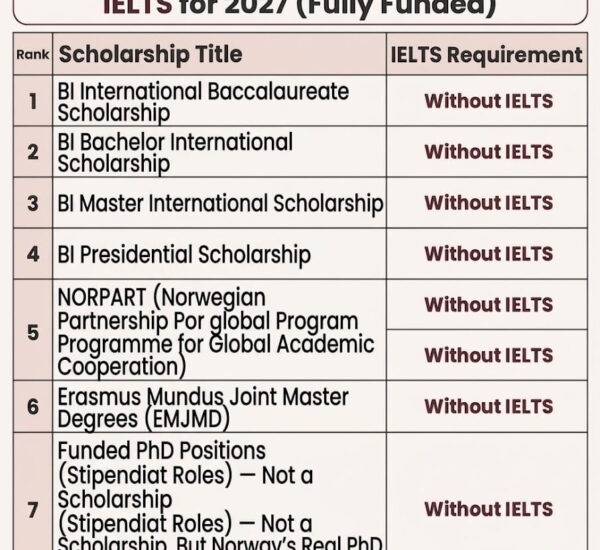
- 7 Best Norway Scholarships Without IELTS for 2027 (Fully Funded)
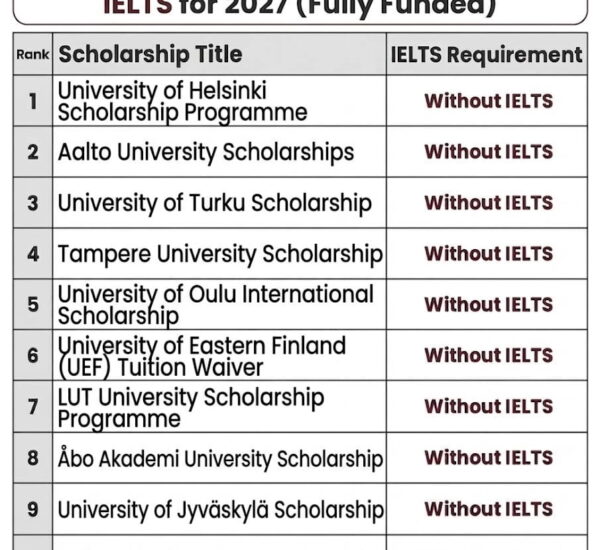
- 10 Best Finland Scholarships Without IELTS for 2027 (Fully Funded)
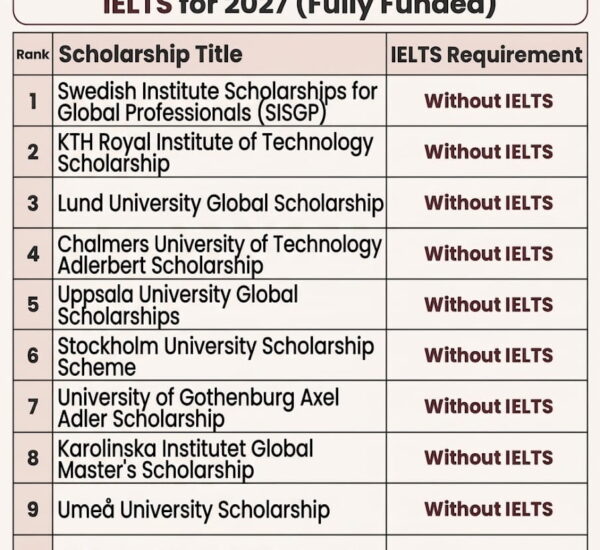
- 10 Best Sweden Scholarships Without IELTS for 2027 (Fully Funded)
- 10 Best Netherlands Scholarships Without IELTS for 2027 (Fully Funded)