Canada is one of the world’s most welcoming and most rewarding study destinations — and in 2027-2028, it is backing that welcome with scholarship funding that ranges from the Lester B. Pearson Scholarship’s complete 4-year undergraduate package to the Banting Postdoctoral Fellowship’s extraordinary CAD $70,000/year for postdoctoral researchers.
Home to University of Toronto (top 25 globally), McGill University (top 35 globally), University of British Columbia (top 40 globally), University of Alberta, and dozens of other internationally recognized research institutions — Canada combines world-class academic quality with one of the world’s most accessible immigration systems, a multicultural society that genuinely welcomes international talent, and a post-graduation pathway that leads thousands of international students to Canadian permanent residency every year.
This guide covers Canada’s top 10 scholarships for 2027-2028 — every coverage detail, eligibility requirement, and official application link.
Table of Contents
Why Study in Canada in 2027?
World-class universities at competitive costs. Canada’s top universities are globally ranked with international student tuition fees ranging from CAD $20,000–$55,000/year — significantly lower than comparable US programs, particularly for graduate students funded through research scholarships.
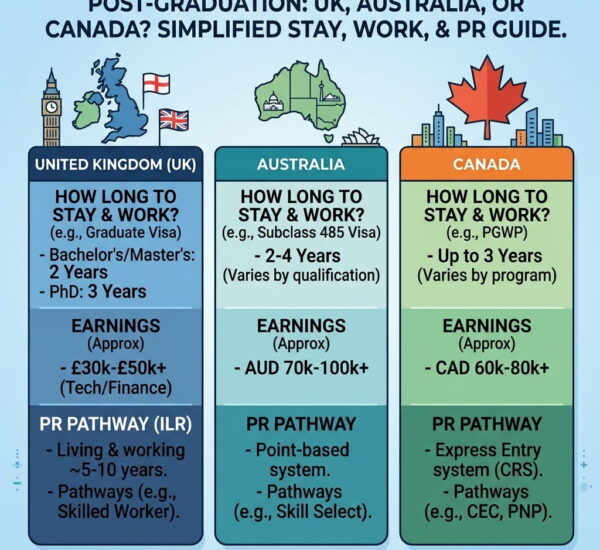
Post-Graduation Work Permit (PGWP). Canada offers a work permit valid for up to 3 years (equal to the program length) for international graduates — one of the most generous post-study work authorizations in the world. This directly supports Canadian Permanent Residence applications through programs like Canadian Experience Class (CEC).
Express Entry immigration pathway. Canada’s points-based immigration system actively prioritizes educated, English/French-speaking workers. A Canadian degree plus Canadian work experience provides an extraordinarily strong immigration profile.
Multicultural, safe, and welcoming. Canada consistently ranks among the world’s most livable countries with strong international communities across Toronto, Vancouver, Montreal, Calgary, and Ottawa.
Research excellence. Canada’s tri-council research funding bodies (NSERC, SSHRC, CIHR) inject billions annually into university research — creating richly funded research environments particularly in STEM, health sciences, and social sciences.
The Top 10 Canada Scholarships 2027-2028
🏆 1. Lester B. Pearson International Scholarship (University of Toronto)
Degree Level: Bachelor’s Coverage: 100% tuition coverage + Accommodation + Books Eligibility: Exceptional international undergraduate leaders
The Lester B. Pearson International Scholarship at the University of Toronto is Canada’s most prestigious and financially comprehensive undergraduate scholarship for international students — named after Canada’s Nobel Peace Prize-winning Prime Minister and awarded to exceptional students who demonstrate outstanding academic achievement combined with exceptional leadership and creativity.
What it covers:
- 100% tuition fees for all 4 years of undergraduate study at UofT
- Accommodation costs — full university residence fees covered
- Books and incidental fees — complete coverage of study-related expenses
- Total 4-year value: approximately CAD $200,000+
Who can apply: High school students (in final year of secondary school) from any country outside Canada with exceptional academic records and demonstrated leadership, creativity, and significant impact in their schools and communities.
Important: You must be nominated by your secondary school — you cannot apply directly as an individual. Contact your school’s principal or guidance counselor about Pearson nomination eligibility. Only schools that have actively nominated students can be selected.
Number of awards: Approximately 37 Pearson Scholars selected annually from thousands of nominees worldwide — making this among Canada’s most competitive undergraduate scholarships.
Deadline: School nominations typically due November — check UofT’s Pearson scholarship page for current cycle dates
👉 Official Website: future.utoronto.ca/pearson
🏆 2. Pierre Elliott Trudeau Foundation Scholarships
Degree Level: PhD Coverage: Up to CAD $40,000/year stipend + CAD $20,000/year research/travel allowance Eligibility: Doctoral candidates in humanities/social sciences with social leadership focus
The Pierre Elliott Trudeau Foundation Scholarship — named after Canada’s transformative Prime Minister — is one of Canada’s most prestigious doctoral awards, combining exceptional financial support with a world-class mentorship and leadership development program.
What it covers:
- Annual stipend of up to CAD $40,000 (~$29,700 USD)
- Annual research and travel allowance of CAD $20,000 — for fieldwork, conferences, and international research collaboration
- Access to the Trudeau Foundation’s extraordinary network of scholars, mentors, and public leaders
- Total 3-year value: approximately CAD $180,000
Who can apply: PhD candidates at Canadian universities in humanities, social sciences, law, and related disciplines whose research engages questions of deep social concern — human rights, responsible citizenship, Canada and the world, or people and their natural environment.
Selection: Not just academic excellence but demonstrated commitment to creating real-world social impact through research. Trudeau Foundation selects scholars who will engage public life, not just academic careers.
Deadline: Typically October–December annually
👉 Official Website: trudeaufoundation.ca/programs/phd-scholarship
🏆 3. Banting Postdoctoral Fellowships
Degree Level: Postdoctoral Research Coverage: CAD $70,000/year for 2 years Eligibility: Top national and international postdoctoral researchers
The Banting Postdoctoral Fellowship — named after Sir Frederick Banting, co-discoverer of insulin — is Canada’s most prestigious postdoctoral award, administered by the federal government through Canada’s tri-council agencies (NSERC, SSHRC, CIHR).
What it covers:
- Annual salary/stipend of CAD $70,000 (~$52,000 USD) for 2 years
- Total value: CAD $140,000 — one of the world’s highest postdoctoral stipends
- Full research independence to pursue the Banting’s holder’s own research agenda
Who can apply: Exceptional postdoctoral researchers (within 3 years of PhD completion) at any Canadian university in health research (CIHR), natural sciences and engineering (NSERC), or social sciences and humanities (SSHRC). Both Canadian and international applicants are eligible.
Competition: Approximately 70 Banting Fellowships awarded annually from several hundred applications — extraordinarily competitive but transformative for career trajectory.
Deadline: Typically September annually
👉 Official Website: banting.fellowships-bourses.gc.ca
🏆 4. Karen McKellin International Leader of Tomorrow Award (UBC)
Degree Level: Bachelor’s Coverage: Full tuition fee coverage + Living stipend proportional to financial need Eligibility: UBC merit award for high-achieving international undergraduates
The Karen McKellin International Leader of Tomorrow Award at the University of British Columbia is one of Canada’s most comprehensive undergraduate scholarships — combining merit recognition for exceptional academic and leadership achievement with need-based financial support that ensures financial barriers do not prevent outstanding students from attending UBC.
What it covers:
- Full tuition fee coverage for the undergraduate program
- Living stipend calibrated proportionally to demonstrated financial need — higher financial need = larger living support
- Renewable annually with maintained academic performance
Who can apply: Outstanding non-Canadian international students admitted to UBC’s undergraduate programs with exceptional academic records and demonstrated leadership. Financial need must be demonstrated through official documentation.
UBC’s global standing: Consistently ranked among the world’s top 40 universities, UBC’s Vancouver campus — with Pacific Ocean views, world-class research infrastructure, and direct access to Canada’s most international city — provides an extraordinary undergraduate environment.
Deadline: Aligned with UBC undergraduate admissions — typically November–January for September intake
👉 Official Website: students.ubc.ca/enrolment/finances/scholarships-awards-bursaries/international-leader-tomorrow-award
🏆 5. McCall MacBain Scholarships (McGill University)
Degree Level: Master’s, Professional Coverage: 100% tuition and fees + CAD $2,000/month living stipend Eligibility: Comprehensive leadership-focused graduate scholarship at McGill
The McCall MacBain Scholarship at McGill University — funded by a transformational CAD $200 million gift from John and Marcy McCall MacBain — is Canada’s most generous and most comprehensive graduate scholarship, combining complete financial support with an extraordinary leadership development program.
What it covers:
- 100% tuition and fees — complete coverage at McGill
- Monthly living stipend of CAD $2,000 (~$1,490 USD) — sufficient for comfortable living in Montreal
- Access to the McCall MacBain leadership development program including mentorship, residency experiences, and a global network of scholars
- Health and dental insurance contribution
Who can apply: Outstanding graduates applying to any of McGill’s eligible Master’s and professional programs across all disciplines. Selection based on academic excellence, leadership qualities, and commitment to positive community impact.
McGill’s global standing: Ranked #29 globally by QS, McGill is one of Canada’s most internationally diverse universities with over 30% international students and a world-class reputation in medicine, law, sciences, and management.
Deadline: Typically October–November annually
👉 Official Website: mccallmacbainscholars.org
🏆 6. Ontario Trillium Scholarship (OTS)
Degree Level: Master’s, Professional (PhD) Coverage: CAD $40,000/year for up to 4 years Eligibility: Top international PhD students at Ontario universities
The Ontario Trillium Scholarship (OTS) is a provincial government scholarship specifically designed to attract the world’s best international PhD students to Ontario universities — covering the full cost of doctoral study at institutions including University of Toronto, University of Waterloo, Western University, Queen’s University, and others.
What it covers:
- CAD $40,000 per year — covering tuition plus a living contribution
- Available for up to 4 years — total value up to CAD $160,000
- Administered by individual Ontario universities from provincial government funding
Who can apply: Outstanding non-Canadian international students applying to PhD programs at participating Ontario universities. Selection is conducted by each university individually — contact your target Ontario university’s graduate office for their specific OTS application process.
Deadline: Varies by university — typically November–February
👉 Official Website: ontario.ca/page/ontario-trillium-scholarship
7. University of Calgary International Entrance Scholarship (PhD)
Degree Level: PhD Coverage: CAD $15,000/year + Renewable up to CAD $60,000 over 4 years Eligibility: Merit-based entrance scholarship for international PhD students
The University of Calgary International Entrance Scholarship at the doctoral level provides annual financial support for outstanding international students beginning PhD programs at the University of Calgary — one of Canada’s leading research universities with particular strength in energy sciences, engineering, medicine, and social sciences.
What it covers:
- CAD $15,000 per year for each year of doctoral study
- Renewable for up to 4 years — total value CAD $60,000
- Typically combined with research assistantship or teaching assistantship income
University of Calgary’s strengths: Energy and environmental sciences (reflecting Calgary’s role as Canada’s energy capital), engineering, medicine, business (Haskayne School of Business), and social sciences.
Deadline: Typically aligned with PhD admissions — October–February for September intake
👉 Official Website: ucalgary.ca/registrar/finances/scholarships-awards/entrance-scholarships/international
8. University of Calgary International Entrance Scholarship (Bachelor’s)
Degree Level: Bachelor’s Coverage: CAD $15,000/year + School scholarships Eligibility: Merit-based entrance for international undergraduates
At the undergraduate level, the University of Calgary offers International Entrance Scholarships of CAD $15,000/year for outstanding international students — one of Canada’s most accessible and substantial merit-based undergraduate awards.
What it covers:
- CAD $15,000 per year in tuition contribution
- Additional faculty-specific and program-specific scholarships may supplement this award
- Renewable based on maintained academic performance
Who can apply: Outstanding non-Canadian international students admitted to University of Calgary undergraduate programs with strong secondary school academic records.
Deadline: Typically January–March for September intake
👉 Official Website: ucalgary.ca/registrar/finances/scholarships-awards/entrance-scholarships/international
🏆 9. Canada Graduate Scholarships — Master’s (CGS-M)
Degree Level: Master’s Coverage: CAD $17,500 for 1 year Eligibility: Federal grant through SSHRC, NSERC, or CIHR for research-based Master’s
The Canada Graduate Scholarships — Master’s (CGS-M) program — funded by the federal government through Canada’s three research councils — is the most widely awarded Master’s scholarship in Canada, providing research funding to outstanding graduate students across virtually every academic discipline.
What it covers:
- One-time award of CAD $17,500 for 1 year of Master’s study
- Non-renewable (one-time award)
- No service obligation or residency requirement beyond program enrollment
Three funding streams:
- NSERC CGS-M: Natural sciences and engineering
- SSHRC CGS-M: Social sciences and humanities
- CIHR CGS-M: Health research
Who can apply: International students enrolled in research-based Master’s programs at Canadian universities are eligible — this is one of Canada’s most accessible federal scholarships for international graduate students.
Application: Through your Canadian university’s graduate office — universities administer CGS-M allocations and nominate their strongest candidates.
Deadline: Typically December–February — check with your university’s graduate scholarship office
👉 Official Website: nserc-crsng.gc.ca/students-etudiants/pg-cs/cgsm-bescm_eng.asp
10. Quebec Merit Scholarships for Foreign Students (FRQNT/FRQSC)
Degree Level: Master’s, PhD, Postdoctoral Coverage: CAD $25,000–$35,000/year living allowance + Health coverage Eligibility: International postgraduates and researchers at Quebec universities
The Quebec Merit Scholarships for Foreign Students — administered by the Fonds de recherche du Québec (FRQ) through its three branches (FRQNT for nature and technology, FRQSC for society and culture, FRQS for health) — provides substantial financial support for outstanding international researchers at Quebec universities including McGill, Université de Montréal, UQAM, Laval, and others.
What it covers:
- Annual living allowance of CAD $25,000–$35,000 depending on degree level and research council
- Health coverage — medical insurance contribution included
- Available for Master’s (1–2 years), PhD (3 years), and Postdoctoral (2 years) levels
Who can apply: International students from countries outside Canada applying to or enrolled in graduate programs at Quebec universities. Must conduct research aligned with each FRQ branch’s priority areas.
Montreal’s advantage: Montreal is Canada’s second-largest city, one of North America’s most livable cities, and one of the world’s great bilingual (English-French) cosmopolitan cities — with living costs significantly lower than Toronto or Vancouver and a vibrant cultural, culinary, and academic scene.
Deadline: Typically October–January — check each FRQ branch website for current call details
👉 FRQNT: frq.gouv.qc.ca/en/bourses/bourses-de-merite-pour-etudiants-etrangers 👉 FRQSC: frq.gouv.qc.ca/en
Quick Reference — All 10 Canada Scholarships
| # | Scholarship | Level | Key Coverage | Deadline |
|---|---|---|---|---|
| 1 | Lester Pearson (UofT) | Bachelor’s | Full tuition + accommodation + books | November (nominations) |
| 2 | Trudeau Foundation | PhD | CAD $40k/yr stipend + $20k travel | Oct–Dec |
| 3 | Banting Postdoctoral | Postdoc | CAD $70,000/year × 2 years | September |
| 4 | Karen McKellin (UBC) | Bachelor’s | Full tuition + need-based stipend | Nov–Jan |
| 5 | McCall MacBain (McGill) | Masters/Professional | 100% tuition + CAD $2,000/mo | Oct–Nov |
| 6 | Ontario Trillium (OTS) | Masters/PhD | CAD $40,000/yr × 4 years | Nov–Feb |
| 7 | UofC International (PhD) | PhD | CAD $15,000/yr × 4 years | Oct–Feb |
| 8 | UofC International (UG) | Bachelor’s | CAD $15,000/yr | Jan–Mar |
| 9 | CGS-M | Master’s | CAD $17,500 (1 year) | Dec–Feb |
| 10 | Quebec Merit FRQ | Masters/PhD/Postdoc | CAD $25-35k/yr + health | Oct–Jan |
Health Insurance in Canada — What International Students Need
Canada’s healthcare system varies by province — and international students’ access to provincial health coverage depends on where they study and their residency status.
Province-by-province health coverage:
Ontario (Toronto, Ottawa, Waterloo): International students are generally NOT eligible for OHIP (Ontario Health Insurance Plan). Must purchase private health insurance.
British Columbia (Vancouver, Victoria): International students eligible for BC MSP after 3-month waiting period. During waiting period: purchase private insurance.
Quebec (Montreal): Varies by home country — students from countries with Quebec-France social security agreements may access RAMQ. Others need private insurance.
Alberta (Calgary, Edmonton): Most international students eligible for AHCIP immediately upon arrival with valid study permit.
Best private health insurance for Canadian international students:
Guard.me International Insurance — Most Popular Most widely used international student health insurance in Canada. Plans available for academic year or full year. 👉 guard.me
Blue Cross Canada — Comprehensive Coverage Strong pan-Canadian coverage with good network access. 👉 bluecross.ca
Studentcare — University-Integrated Plans Administers health plans for students at 60+ Canadian universities — your plan may already be included in student fees. 👉 studentcare.ca
Quebec Merit Scholarship recipients: Health coverage is explicitly included in the FRQ scholarship package — verify exact coverage details with your host institution.
Banking in Canada — Complete Setup Guide
Scotiabank StartRight — Best Pre-Arrival Program Scotiabank’s dedicated newcomer banking program allows international students to begin account opening online from their home country before departure. Most recommended by Canadian universities for international student banking. 👉 scotiabank.com/startright
RBC — Best for Airport Convenience RBC allows pre-arrival online account initiation and has branches at major Canadian airports — collect your debit card upon landing. 👉 rbcroyalbank.com/newcomers
TD Bank — Best for Ontario Students TD’s strongest presence is in Ontario — near University of Toronto, Waterloo, and Western University campuses. 👉 td.com/student
CIBC Smart Banking — Best for McGill Students Strong presence near McGill University in Montreal and across Quebec. 👉 cibc.com/student
Wise — Best for International Transfers Use Wise for transferring money from your home country to your Canadian account — saving 70–85% in fees compared to traditional bank wire transfers. 👉 wise.com
SIN (Social Insurance Number): Apply for your SIN at a Service Canada location within your first week — required for employment (including Teaching Assistantships), banking products, and tax filing. Bring your passport and study permit. Issued same day.
Canadian Study Permit — Financial Requirements
All non-Canadian students need a Canadian Study Permit for programs longer than 6 months.
Financial proof required:
- Tuition fees for the first year of study
- Living expenses: CAD $20,635/year (updated 2024 — verify current requirement at IRCC website)
- Return transportation to home country
- Scholarship award letters count as financial proof
Application: Online through IRCC (Immigration, Refugees and Citizenship Canada) at ircc.canada.ca
Processing time: Typically 4–12 weeks depending on country of citizenship
Provincial Attestation Letter (PAL): As of 2024, most international student study permit applications require a PAL from the province where your institution is located — your university’s international office provides guidance on obtaining this.
5 Tips to Maximize Your Canada Scholarship Success
Lester Pearson requires school nomination — start in September. Since you need a school nomination, talk to your school’s principal or guidance counselor in September of your final secondary school year. Many schools miss the nomination window simply because students ask too late.
McCall MacBain and Trudeau are Canada’s most prestigious graduate scholarships. For graduate students, these two represent the gold standard. Both require compelling leadership narratives alongside academic excellence — start preparing your application materials 6–8 months before the deadline.
Ontario Trillium and CGS-M provide excellent combined funding. Many Ontario PhD students receive both OTS and CGS-M funding simultaneously — check stackability with your target Ontario university’s graduate office.
Quebec’s lower living costs make FRQ scholarships particularly valuable. The CAD $25,000–$35,000 FRQ annual allowance goes significantly further in Montreal than equivalent amounts in Toronto or Vancouver. Factor cost of living into your total scholarship value calculation.
Banting is for postdocs — apply in your final PhD year. Banting applications must be submitted while you are still a PhD student (within the eligibility window). Plan your Banting application timeline as part of your PhD completion strategy.
Final Thoughts — Canada’s Scholarship Ecosystem Is World Class
Canada in 2027 offers international students a combination that is genuinely extraordinary: Lester Pearson’s complete 4-year undergraduate package at Canada’s #1 university. McCall MacBain’s CAD $2,000/month leadership scholarship at McGill. Banting’s CAD $70,000/year — one of the world’s highest postdoctoral stipends. Ontario Trillium’s CAD $160,000 over 4 PhD years. Quebec Merit Scholarship’s living allowance plus health coverage in one of North America’s most livable cities.
Add to this Canada’s Post-Graduation Work Permit, Express Entry immigration pathway, and one of the world’s most welcoming multicultural societies — and Canada becomes not just a scholarship destination but a genuine life destination.
Lester Pearson nominations: November. McCall MacBain: October–November. Banting: September. Ontario Trillium: November–February. Quebec Merit: October–January.
Your Canadian education awaits. Apply today.
👉 Lester Pearson (UofT): future.utoronto.ca/pearson 👉 McCall MacBain (McGill): mccallmacbainscholars.org 👉 Banting Fellowship: banting.fellowships-bourses.gc.ca 👉 Ontario Trillium: ontario.ca/trillium-scholarship 👉 Study in Canada Portal: educanada.ca